· Venture Capital Tracker Research · venture-capital
KymaThera Raises $80M Series B to Take K-1728 Into Phase 1
KymaThera closed an $80 million Series B led by Alta Partners to advance mutant-selective PI3Kα inhibitor K-1728 into Phase 1 testing.
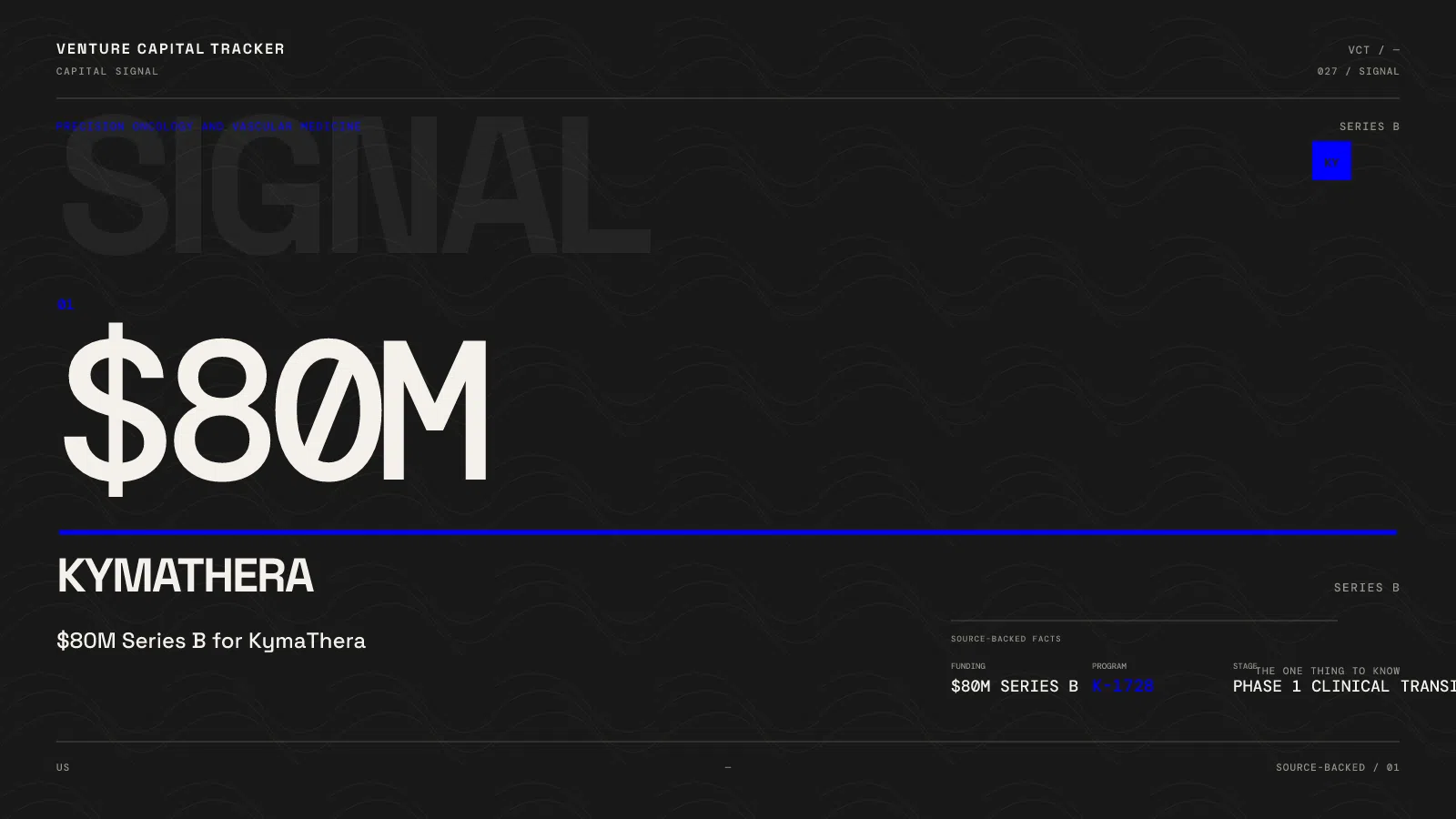
KymaThera has closed an $80 million Series B to move its lead drug, K-1728, from preclinical work into human testing. Alta Partners led the financing, with participation from returning investors Venrock and Foresite Capital, new investor J. Wood Capital and others.
The round brings the San Diego biotechnology company's disclosed capital above $100 million. KymaThera expects to begin Phase 1 patient dosing in the fourth quarter of 2026 and says the financing should carry K-1728 through initial clinical proof-of-concept.
The financing at a glance
- Amount: $80 million
- Stage: Series B
- Status: Closed; announced October 6, 2026
- Lead investor: Alta Partners
- Other named investors: Venrock, Foresite Capital and J. Wood Capital
- Total capital raised: More than $100 million
- Lead program: K-1728
- Next milestone: Phase 1 patient dosing expected in Q4 2026
- Valuation: Not disclosed
What K-1728 is designed to change
PI3Kα is a well-established drug target in oncology. The problem is not whether the pathway matters; it is how selectively a drug can inhibit disease-driving mutations without also suppressing the normal, or wild-type, protein.
That distinction matters because wild-type PI3Kα inhibition is associated with metabolic toxicity, especially hyperglycemia. Existing drugs have validated the target, but tolerability and incomplete coverage of clinically relevant mutations can limit dosing and efficacy.
KymaThera describes K-1728 as an oral, pan-mutant selective PI3Kα inhibitor. It is designed to inhibit both kinase-domain and helical-domain mutations while sparing wild-type PI3Kα. In company-reported preclinical studies, the drug produced tumor regressions at low once-daily doses and showed a separation between exposures associated with tumor activity and those associated with hyperglycemia.
Those are encouraging preclinical claims, not evidence of safety or efficacy in patients. The Series B therefore finances the point where KymaThera's central thesis becomes testable.
Two initial clinical markets
KymaThera plans to develop K-1728 in two settings.
The first is HR-positive, HER2-negative breast cancer, where the company intends to test the drug both alone and in combination regimens. This is a large, competitive market with established standards of care and several PI3K-pathway programs.
The second is PI3Kα-driven vascular malformations. These rare disorders can be painful and debilitating, while systemic treatment options remain limited. The same molecular target creates a potential bridge between oncology and genetically defined non-cancer disease, although the appropriate dose, benefit-risk profile and development path may differ substantially.
A dual-indication strategy can broaden the program's value. It also increases execution complexity. Investors are funding one molecule that must establish a credible therapeutic window before either market can be fully underwritten.
What the $80 million actually buys
KymaThera is not yet financing a registration trial or commercial launch. The practical goal is to generate a first human dataset capable of answering four questions:
- Can K-1728 reach biologically active exposure in patients?
- Does its claimed wild-type sparing translate into a meaningfully better safety profile?
- Is there early antitumor or vascular response across both kinase- and helical-domain mutations?
- Can the drug be combined with other breast-cancer therapies without erasing its tolerability advantage?
A clean answer would give KymaThera options: expand the Phase 1 study, pursue indication-specific cohorts, add combination arms or seek a partnership. A weak selectivity signal would make the crowded PI3Kα field much less forgiving.
Competitive context
K-1728 enters a market where pathway validation cuts both ways. Approved products such as Novartis's Piqray and Roche's Itovebi demonstrate that PI3Kα can be drugged, but they also establish benchmarks for efficacy, patient selection and safety. Mutant-selective programs including Eli Lilly's STX-478 raise the bar further.
KymaThera's proposed advantage is breadth plus selectivity: cover more clinically relevant mutations while limiting wild-type inhibition. The company owns K-1728 outright, which preserves strategic flexibility if the clinical data are positive.
The risk is that several competitors are pursuing similar improvements. A broad preclinical profile will not be enough. Differentiation must show up in human pharmacokinetics, glucose management, dose intensity and response.
Investor read-through
Alta Partners' lead position adds a specialist life-sciences investor as KymaThera crosses into the clinic. Venrock and Foresite, which co-led the 2024 Series A, returned for the Series B. That continuity suggests the existing syndicate was willing to re-underwrite the preclinical package, while J. Wood Capital adds a new participant.
The round is large for a company with a single disclosed lead asset, but it fits the capital needs of an oncology program moving through IND-enabling work, dose escalation and early expansion. It also gives KymaThera time to produce data before relying on a partnership or another financing.
What to watch next
The immediate catalyst is first-patient dosing. After that, the important disclosures will be dose-escalation progress, treatment-emergent hyperglycemia, pharmacokinetic exposure, mutation-specific activity and the design of any combination cohorts.
The investment case is straightforward: KymaThera has raised enough capital to test whether a rationally designed PI3Kα inhibitor can improve on a clinically validated but imperfect drug class. The clinical data—not the size of the Series B—will decide whether K-1728 is differentiated.
Related VCT coverage
KymaThera's clinic-entry financing follows other concentrated biotech bets tracked by VCT, including RougeTx's $58 million Series A for hereditary hemorrhagic telangiectasia.
Last updated:
Editorial note: AI tools assisted with research, structure, or drafting. Venture Capital Tracker retains human editorial responsibility for factual accuracy, relevance, and source quality before publication.