· Venture Capital · 3 sources · Verified
Tolan Raises $30M for AI Companions: Retention, Trust and Cost
Tolan’s $30M financing backs a persistent AI companion. We examine the investors, undisclosed terms and the retention, trust and compute-cost trade-off.

By Venture Capital Tracker
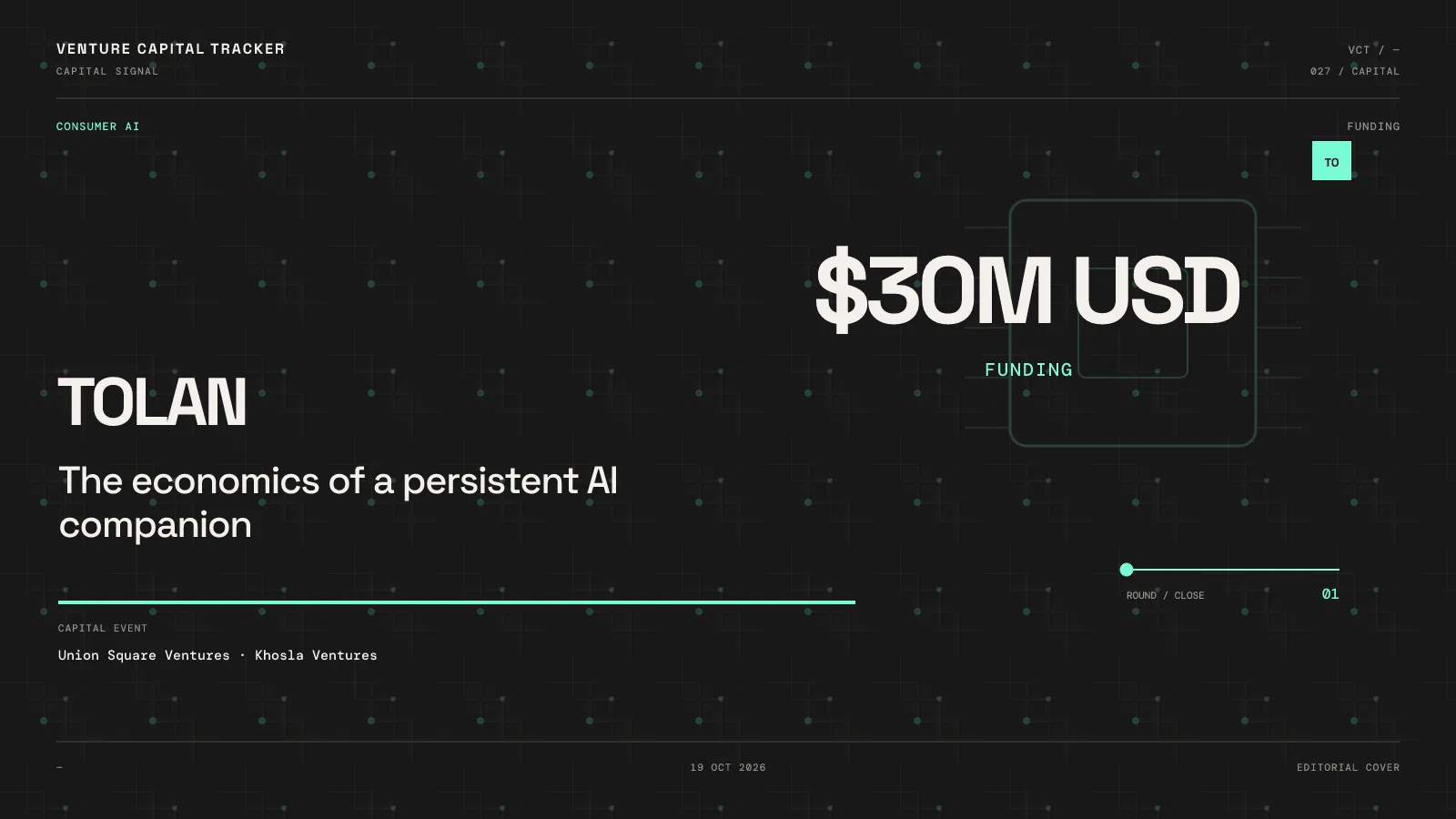
Tolan has raised $30M in new financing, with Union Square Ventures leading alongside existing investor Khosla Ventures. USV announced the investment on October 19, 2026. Homebrew also participated, according to reporting by Upstarts Media.
The round backs an AI companion that combines continuing conversation with help organizing everyday life. The investment question is whether an ongoing relationship can support durable paid use without making inference costs or user-safety demands unmanageable.
What the financing announcement establishes
| Item | Verified detail |
|---|---|
| New financing | $30M |
| Lead investor | Union Square Ventures |
| Other named investors | Khosla Ventures; Homebrew |
| Announcement date | October 19, 2026 |
| Round stage and valuation | Not disclosed in the reviewed primary announcement |
The lead investor's announcement confirms the new amount and USV's lead role. Upstarts Media's report names Homebrew and says the company declined to disclose its new valuation. We do not substitute a database estimate for an agreed financing valuation.
This is announced startup financing, not a debt facility, grant, acquisition or secondary-sale announcement. Individual allocations, ownership percentages, security terms and the exact legal closing date remain undisclosed. A Series B label should not be inferred merely because earlier financing exists.
A companion becomes an entry point for assistance
Tolan presents a persistent character that can remember context and engage in continuing conversations. Its official website describes building additional systems around underlying AI models rather than treating a chat interface alone as the product.
The site reports more than 250,000 active users and over 70 million conversations during the past year. Those are company-reported engagement figures, not independently audited paying-customer counts. The two periods also differ: dividing annual conversations by a current active-user figure would not establish a valid retention or usage cohort.
USV describes users bringing household planning and other practical tasks into their conversations. Our view is that this creates an acquisition route for assistance that is different from buying a workplace tool: the conversation may precede the task.
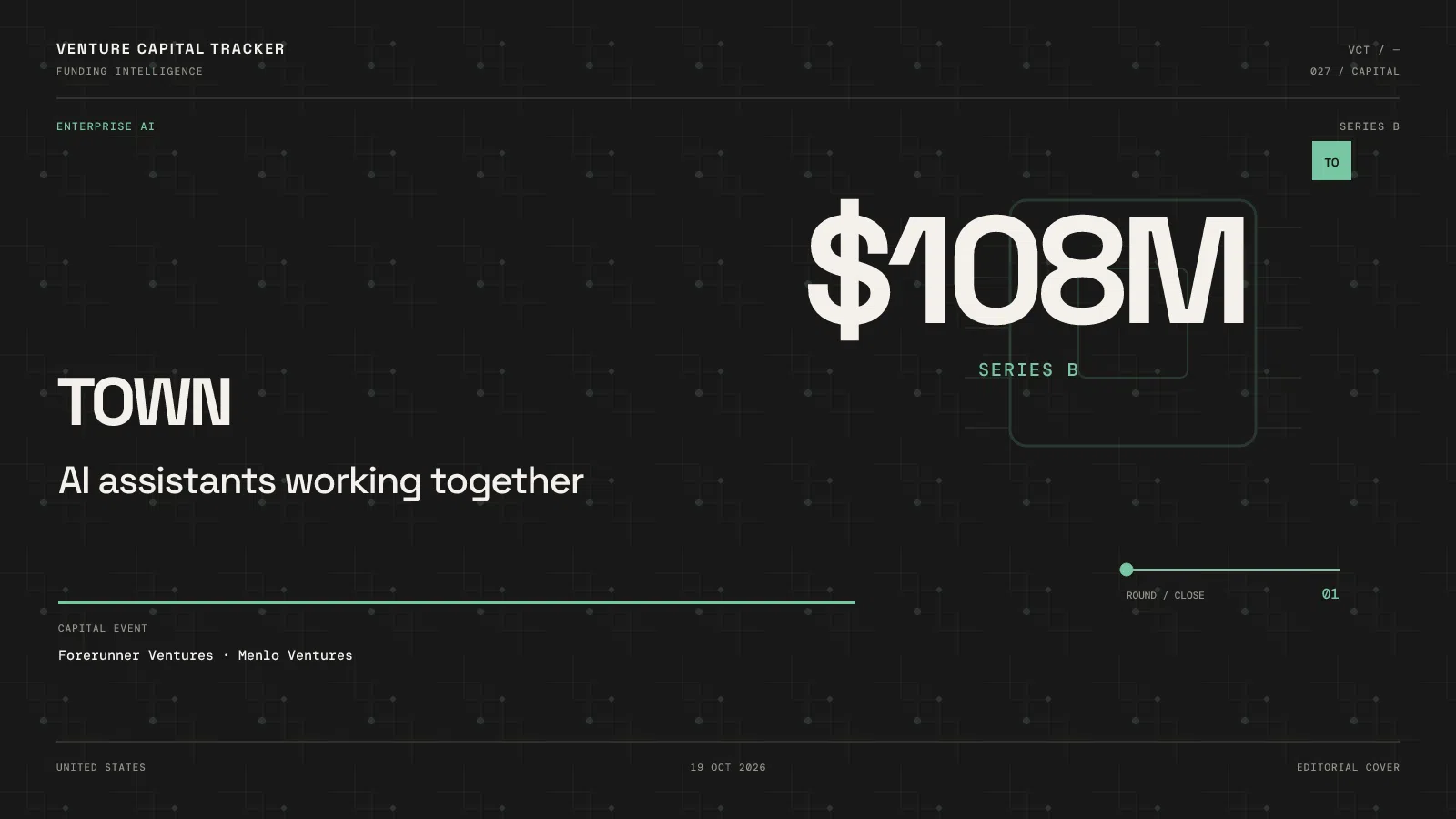
For contrast, Town's recent financing supports personalized assistants coordinating work across teams. Tolan's consumer proposition depends on a different buyer, budget and reason to return.
Retention has to survive the cost of conversation
A product used frequently can still have difficult economics. Longer voice sessions, persistent memory, model calls and support create costs that rise with engagement. A subscription needs to cover those costs across both light and heavy users.
Useful diligence would separate paid conversion, renewal and contribution margin by cohort and usage level. Aggregate conversation volume does not reveal whether the highest-engagement customers are also the most economical to serve.
Changes to limits or pricing can affect the product's perceived continuity. The business therefore needs to learn which usage creates lasting value, which can be served more efficiently and which requires clearer boundaries. These are analytical tests, not disclosed unit-economics results.
Trust is an operating requirement, not a funding metric
A companion may receive highly personal information. Memory controls, understandable privacy choices and reliable handling of inappropriate requests matter to both retention and delivery cost.
For investors, more time spent talking is not automatically a better outcome. Diligence should examine whether the product helps people complete useful tasks and maintain agency, as well as how problems are detected and addressed. The funding announcement establishes neither clinical efficacy nor a verified safety advantage.
The $30M provides additional resources for that work. The strongest evidence for the investment case would be durable paid retention, demonstrably useful assistance and improving economics together—not an estimated valuation or conversation count alone.
Source note: The financing amount and lead role are investor-disclosed; Homebrew's participation is reported by Upstarts Media. Engagement figures are attributed to Tolan. The retention, cost and trust discussion is VCT analysis.
Follow Venture Capital Tracker in Google
Add VCT as a preferred source to make our venture-capital coverage easier to find in Google Search.
Editorial note: AI tools assisted with research, structure, or drafting. Venture Capital Tracker retains human editorial responsibility for factual accuracy, relevance, and source quality before publication.