· Venture Capital · 5 sources · Verified
Tenstorrent Closes $1.5B Series E to Scale Open AI Compute
Tenstorrent’s $1.5B Series E values it at $6.2B post-money. The next test is manufacturing scale, usable software and repeat deployment of Galaxy servers.

By Venture Capital Tracker
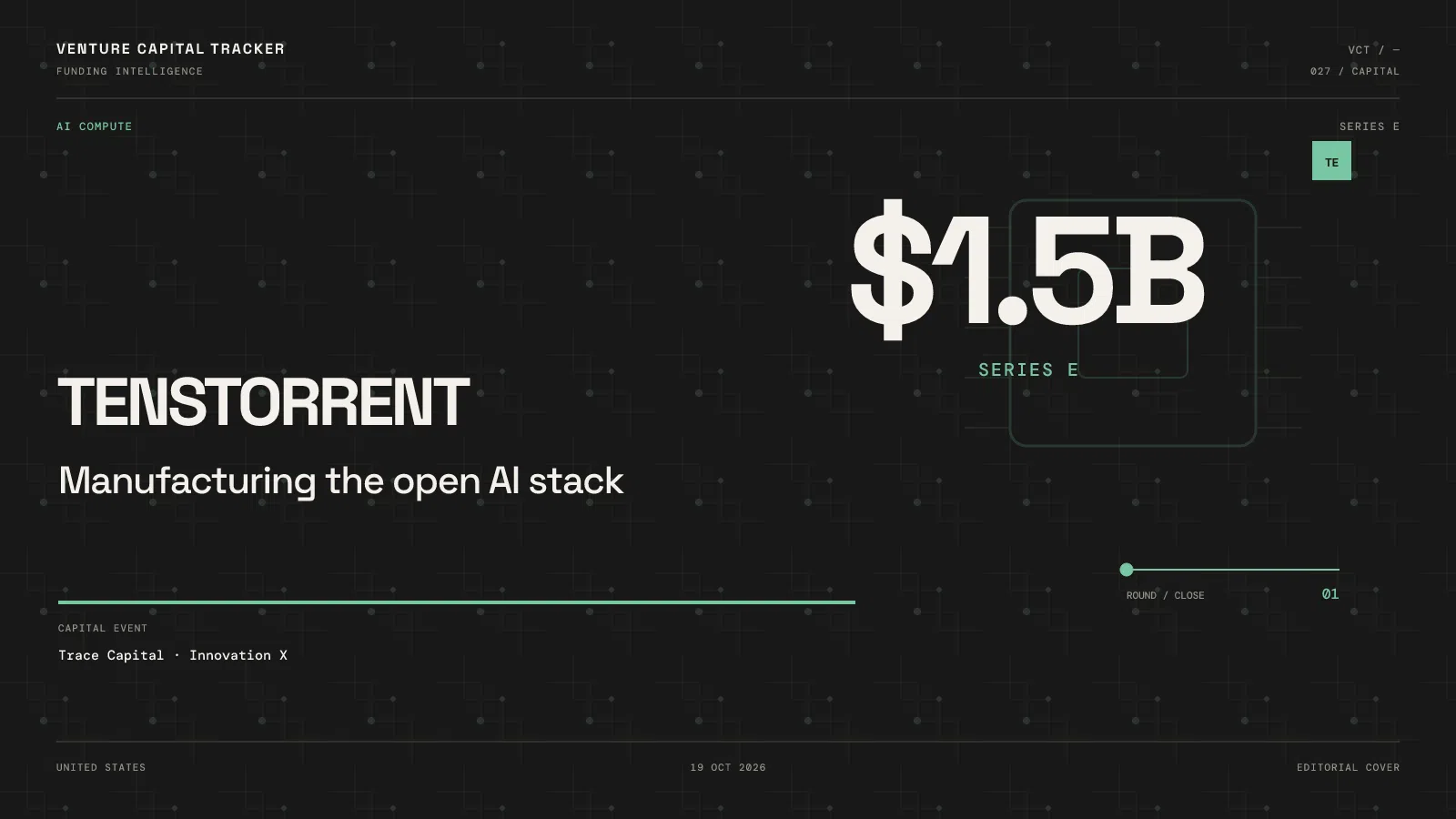
Tenstorrent has closed a $1.5B Series E at a $6.2B post-money valuation, the AI-computing company announced on October 19, 2026. Trace Capital and Innovation X co-led the equity round.
The company announcement identifies volume manufacturing and global commercial expansion as priorities. This is confirmed company financing, not a takeover, a debt facility or an employee share sale.
The Series E at a glance
| Item | Company-disclosed detail |
|---|---|
| New equity financing | $1.5B |
| Stage | Series E |
| Post-money valuation | $6.2B |
| Co-leads | Trace Capital; Innovation X |
| Announcement | October 19, 2026 |
| Priorities | Galaxy server deployment, manufacturing and AI/CPU intellectual property |
Other disclosed participants include Agostinelli Group, ARK Invest, Brett Barna, Cadence Ventures, Eclipse, Fidelity Management & Research Company, Maverick Silicon, Morgan Stanley, Protagonist, Sandisk, T. Rowe Price, Tether Investments, Troluce Capital, Virtu Financial and XTX Markets. Individual allocations and share-class terms were not disclosed.
One architecture, several routes to market
Tenstorrent describes a business spanning accelerator hardware, complete systems and licensable chip intellectual property. Its open-source software stack is part of that proposition, alongside Galaxy servers and designs used by customers developing their own silicon.
Our analytical view is that these routes can reinforce each other, but they have different economics. A server sale brings manufacturing, delivery and support obligations. Licensing can reduce some physical supply-chain exposure, yet revenue timing depends on contract structure and the customer’s development cycle.
The financing therefore supports more than a chip-design milestone. The commercial test is whether products can move from demonstrations and initial deployments into repeatable customer use.
Why manufacturing and software must scale together
Hardware capacity is useful only when customers can put it to work. Procurement teams need evidence about deployment effort, workload support, reliability and the cost of operating a complete system—not simply the theoretical capability of an individual processor.
For an alternative AI-compute platform, software maturity can influence the cost of switching. Model compatibility, compiler behavior, tooling and troubleshooting all affect how much engineering a customer must commit before production use. These are diligence questions, not deficiencies established by the financing announcement.
Likewise, openness is an architectural and distribution choice, not proof of lower total cost. A meaningful comparison needs the same workload, model quality, precision, latency target, batch size, power measurement and system configuration.
This article does not adopt an investor quotation or company performance claim as an independently verified benchmark.
What to watch after the raise
The strongest follow-up signals would be manufacturing execution, accepted customer deliveries, repeat orders and the proportion of deployments that require substantial bespoke engineering. Product gross margins, support costs and cash tied up in inventory would help distinguish commercial scale from unit growth alone.
The licensing business deserves separate disclosure: contracted work, recognized revenue and potential future royalties are not interchangeable. Nor is a post-money valuation a measure of current revenue or public-market liquidity.
The Series E gives Tenstorrent substantial resources to pursue its open-compute strategy. The investment thesis will become clearer as the company demonstrates that its hardware, software and service model can scale together.
Source note: Financing, valuation and participant names are company-disclosed. Commercialization and operating-economics discussion is VCT analysis. No independent performance benchmark or investor allocation is inferred from the round.
Follow Venture Capital Tracker in Google
Add VCT as a preferred source to make our venture-capital coverage easier to find in Google Search.
Editorial note: AI tools assisted with research, structure, or drafting. Venture Capital Tracker retains human editorial responsibility for factual accuracy, relevance, and source quality before publication.