· 11 sources · Updated · Verified
DataLabs gains Yachiyo and Great Wave backing for 3D modeling
The Japanese startup pairs engineering-industry capital with a model-generation workflow that still requires review. Here is what its tools do—and what buyers need to verify.

Editorial team
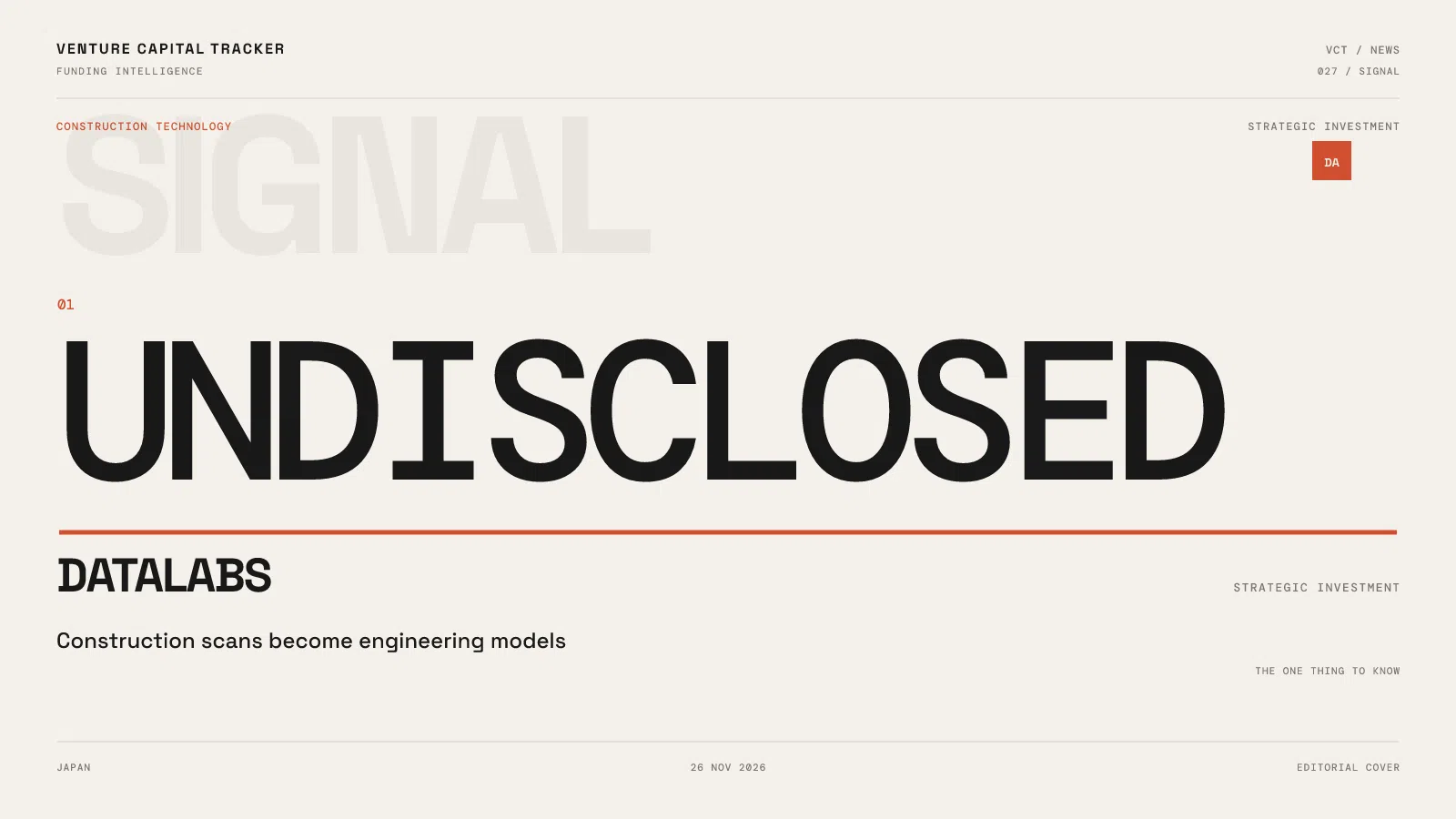
Japan’s DataLabs has gained backing from Yachiyo Engineering and Great Wave Ventures Fund II L.P. to advance software that turns construction drawings and scans into engineering models. The November 26 investment and business alliance build on years of collaboration with the construction consultancy; financial terms were not disclosed.
Deal details & investors
Funding event
DataLabs
Backed by Yachiyo Engineering , Great Wave Ventures Fund II L.P.
A construction scan can record a site’s geometry without producing a model an engineer can readily use. DataLabs wants to reduce the work between those two stages. Its documented workflow starts with an automatically generated model and continues through review, correction and delivery to the next team.
An investor with a route into engineering projects
Yachiyo Engineering is a Tokyo-based construction consultancy whose work includes infrastructure planning, design and maintenance. It says it has collaborated with DataLabs since 2021 through product trials, technical improvements and project development. The investment formalizes an existing working relationship.
Yachiyo says it has supported feasibility studies in Indonesia, Thailand and Malaysia, including introductions to government and research organizations. DataLabs also accompanied it when Yachiyo signed an October memorandum with Digital Penang. Those activities establish a route to potential customers; they do not establish completed overseas sales.
The venture investment comes from Great Wave Ventures Fund II L.P., a specific investment vehicle. The manager, Great Wave Ventures, formerly Agya Ventures, describes an early-stage focus on industrial productivity, including construction, logistics and manufacturing. Its legal notice identifies Fund II separately from the earlier Agya Ventures Fund.
In DataLabs’ November 26 announcement, Great Wave founder Nobuhito Iguchi identifies slow, labor-intensive model creation as the investment opportunity. He also says Yachiyo and existing DataLabs shareholder Tokyu Construction are investors in the venture firm’s fund. Their individual commitments and the size of this DataLabs investment were not disclosed.
Three tools, different jobs
DataLabs was established in July 2020, according to its company profile. It builds cloud software around point clouds and drawings.
A point cloud records spatial measurements; a structured model identifies objects and their relationships. buildingSMART’s explanation of IFC describes an open, vendor-neutral format for exchanging information about buildings and civil infrastructure. An IFC file can carry information about components and materials, rather than only their appearance.
That distinction matters when a model must move between designers, contractors and owners. File exchange is useful only if the receiving team gets the objects and information it needs.
Its products address distinct parts of construction work:
| Tool | Documented task | What the evidence establishes |
|---|---|---|
| Modely | Reinforcing-steel inspection using point-cloud data captured with equipment such as a LiDAR-equipped iPad | The company describes conversion into a 3D model and generation of measurement reports. |
| Hatsuly | Inspection and measurement for infrastructure repair work | An existing inspection product, distinct from Framy’s broader model-generation effort. |
| Framy | Creating initial engineering models from drawings or point clouds | A model-generation workflow with review and correction, currently promoted through a paid trial. |
DataLabs reports cumulative adoption of Modely and Hatsuly at 500 companies. The figure covers those two inspection products. It does not disclose paying Framy customers, revenue or retention.
What a Framy project would involve
An illustrative workflow drawn from Framy’s current product documentation starts with a contractor uploading a point cloud or a two-dimensional DXF drawing. The software produces an initial IFC model. The project team then reviews the result, compares versions and chooses how to finish it, including its own corrections or DataLabs’ manual correction service.
This is a documented product journey, not a VCT test. The Japanese page explicitly offers a paid trial but does not publish a fixed tariff. Its example processing times vary with the input; they are not a universal delivery promise.
A prospective customer therefore needs to establish the total cost of capture, model generation and correction—not just the time required to produce the first file. A useful trial would check dimensions against the source survey, missing or misclassified objects, and whether the intended engineering software imports the required information. These are procurement questions arising from the documented workflow, not measured failure rates.
There is an established alternative. Autodesk’s Revit documentation explains how a linked point cloud serves as a reference for authoring a building model. Framy proposes automating the initial conversion instead. The relevant comparison is the time and cost to reach an accepted, usable model, including review—not a scan-to-file speed comparison alone.
The funding announcement also describes expansion into cost estimation and construction cost management. Buyers need to establish which capabilities are included in the offered trial and which remain development plans. For the investors, the test is whether initial model generation can lead to repeatable, accepted engineering work.
Follow Venture Capital Tracker on Google
Add VCT as a preferred source to see more of our venture-capital reporting in Google Search.
Last updated:
Editorial note: AI tools assisted with research, structure, or drafting. Venture Capital Tracker retains human editorial responsibility for factual accuracy, relevance, and source quality before publication.