· 10 sources · Updated · Verified
T-Therapeutics Raises $133M Series B: Funding, TCR Drugs and Clinical Risks
Cambridge biotech T-Therapeutics closed a $133M Series B led by Advent and British Business Bank. Here is its $224M funding timeline, TCR-CD3 science, preclinical pipeline and competitive risks.

Editorial team
Funding event
T-Therapeutics
Led by Advent Life Sciences , British Business Bank
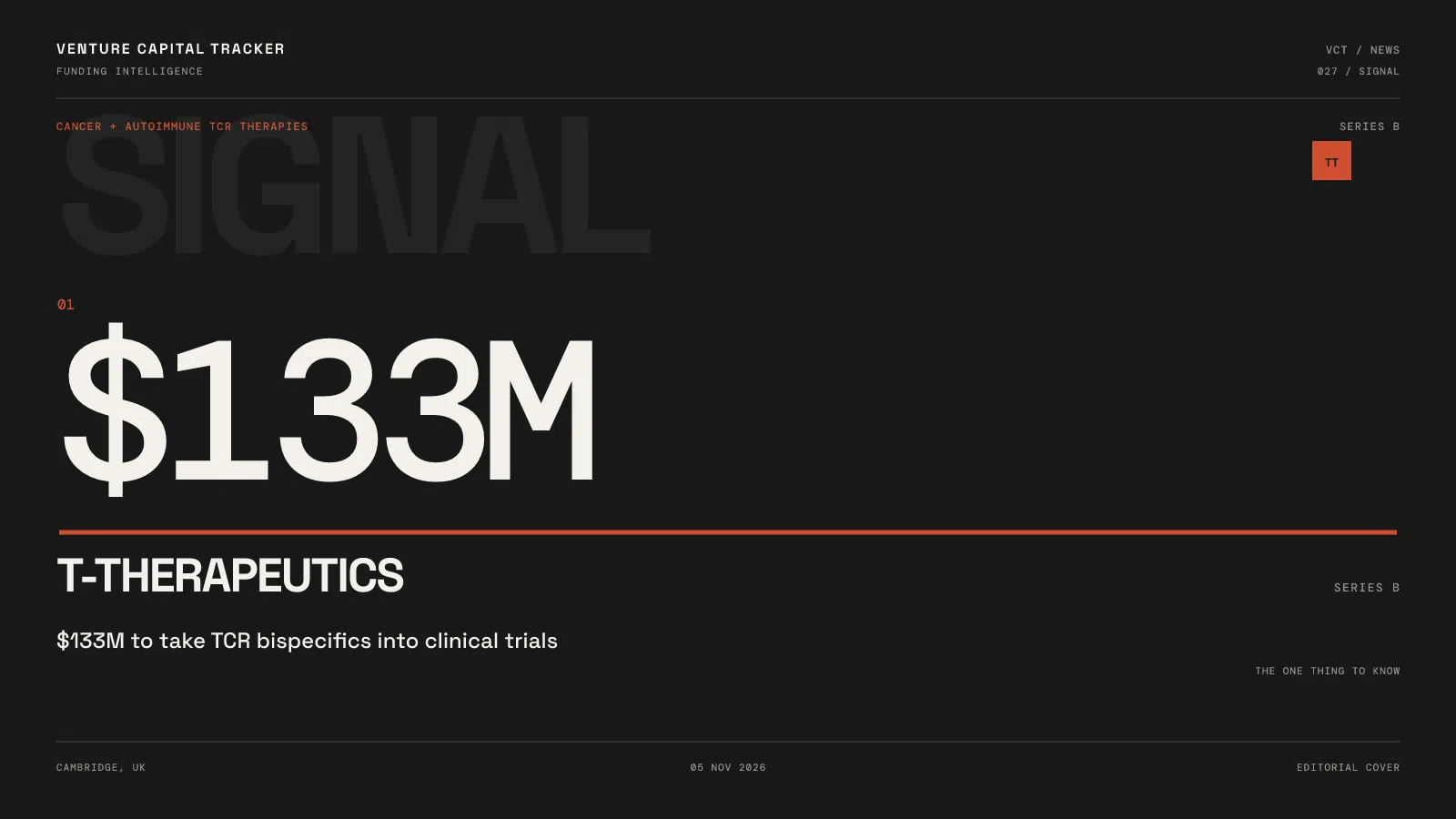
T-Therapeutics, a University of Cambridge spinout, announced the closing of an oversubscribed $133 million Series B on November 5, 2026, co-led by Advent Life Sciences and the British Business Bank. The investment is intended to take two experimental medicines—one in cancer and one in autoimmune disease—into human studies and toward clinical proof of concept. New investors include the venture arm of Johnson & Johnson, Samsara BioCapital, M-Ventures and Eli Lilly. The company did not announce a valuation, and neither medicine is approved.
The financing matters because T-Therapeutics is trying to solve a hard limitation of conventional antibody medicines: many disease-driving proteins are inside cells, beyond the reach of antibodies that bind only exposed surface proteins. Its proposed answer is a soluble molecule that recognizes a protein fragment displayed on the cell surface and recruits an immune T cell to attack that cell. This remains a development thesis, not clinical proof of effectiveness.
The $133M round: investors, use of funds and what is undisclosed
| Item | Verified position |
|---|---|
| Announcement | November 5, 2026; company says the Series B closed |
| New capital | $133 million Series B, described as oversubscribed |
| Co-leads | Advent Life Sciences and British Business Bank |
| Other new backers | Johnson & Johnson Innovation–JJDC, Samsara BioCapital, M-Ventures and Eli Lilly |
| Existing shareholders participating | Sofinnova Partners, F-Prime, Digitalis Ventures, Cambridge Innovation Capital, Sanofi Ventures, Tencent and BGF |
| Intended milestones | Take lead oncology and immunology TCR-CD3 bispecific programmes into clinical studies and generate proof-of-concept data |
| Not disclosed | Pre-money/post-money valuation; share price; individual investor allocations other than the Bank's reported direct stake; patient trial readout dates |
The lead investor's original thesis is unusually specific: T-cell engagers have produced results in blood cancers, while solid tumours have been harder because suitable cell-surface targets are scarce. T-Therapeutics hopes to enlarge the target set through intracellular antigen recognition. That is a rationale for taking development risk, not evidence that this company's molecules will be safe or effective.
The British Business Bank separately disclosed a direct investment of approximately $20.2 million in dollar-equivalent terms, calculated from the originally reported sterling commitment at the ECB's November 5, 2026 reference rates. Its release also identifies a pre-existing indirect exposure through Cambridge Innovation Capital Fund II. These are two forms of exposure to the same business, not proof of two new funding rounds. The Bank's release also mentions commitments to Advent-managed funds; those LP commitments are not part of T-Therapeutics' $133 million Series B.
Funding history: why the $91M Series A must not be counted twice
| Announcement | Incremental disclosed funding | Interpretation |
|---|---|---|
| November 15, 2023 | $59M | Initial Series A financing, originally announced in another denomination; the company later confirmed the USD equivalent |
| November 13, 2025 | $32M | Series A extension: brings cumulative Series A to $91M |
| November 5, 2026 | $133M | New Series B |
| Total disclosed across these announcements | $224M | $59M + $32M + $133M; a sum of announced financing, not a current valuation or cash balance |
This arithmetic is important. Funding records must treat the November 2025 $91 million figure as the cumulative Series A, rather than a second $91 million raise. Adding it again to the initial financing would overstate capital. The company explicitly identified the extension as $32 million added to the original $59 million.
VCT's T-Therapeutics profile tracks those transactions separately. As of November 6, 2026, no company source reviewed here provides a defensible valuation or audited revenue estimate.
What does T-Therapeutics actually make?
The product is an experimental drug platform, not a patient-facing service and not a medicine a hospital can order today. The company calls its discovery system OpTiMus, and its engineered bispecific architecture T-Bridge. The difference is easier to follow as a candidate-development journey.
1. Identify a disease-associated intracellular protein. Cells break proteins into small fragments and display selected fragments bound to major histocompatibility complex (MHC) molecules. A conventional antibody generally cannot see the original protein inside the cell; an appropriately designed T-cell receptor (TCR) can recognize a peptide–MHC combination on the surface. The exact peptide, MHC presentation pattern and expression across healthy tissue determine whether a target is clinically plausible.
2. Discover a fully human TCR that recognizes that peptide–MHC combination. OpTiMus uses an engineered mouse platform to generate candidate receptors. According to T-Therapeutics' platform documentation, it further filters binders with yeast display, machine-learning approaches and structural prediction. These are research methods, not demonstrations that off-target binding is eliminated.
3. Turn a receptor into an immune-cell recruiter. In the T-Bridge format, the target-binding TCR is combined with a CD3-binding component and an Fc region. The intended effect is to physically connect an appropriate immune T cell to a disease cell and trigger killing. Fc engineering is designed to extend drug exposure for practical dosing; the company says it has tuned CD3 binding to reduce cytokine release.
4. Validate the molecule before human use. Researchers must test binding specificity against healthy tissues, functional potency, unwanted inflammation, manufacturability and animal toxicology. A TCR that recognizes an intracellular antigen can also bind unexpected peptide–MHC complexes; this is a critical safety challenge, not merely a manufacturing detail.
5. Obtain trial authorization and measure actual clinical outcomes. Human studies must establish dose, tolerability, biomarkers and signals of efficacy before larger trials can show clinical benefit. Those are future milestones financed by this round. Any hypothetical patient treatment pathway at this stage would be speculative.
This is also the probable buyer and monetization pathway: successful drug candidates could eventually be commercialized through specialist healthcare systems or licensed/co-developed with pharmaceutical partners. The company does not disclose a drug price, commercial sales, licensed partnership economics or a per-patient market forecast for these programs. A likely business model is not an existing customer contract.
The two lead programmes are at different stages
Independent interviews with management, reported by Fierce Biotech on November 5, identify TTX-008, an oncology programme across tumour types, as preclinical and in IND-enabling development. They identify TTX-018, an immunology programme aimed at disease-driving inflammatory cells, as discovery stage. The CEO told Fierce the immunology programme was less than a year behind the oncology effort, but that is management's anticipated development timeline rather than a regulatory timetable.
In cancer, the company wants its molecule to find a peptide–MHC target on a tumour cell and recruit a T cell to kill it. In autoimmune disease, it is exploring selective elimination of pathogenic immune-cell populations—a form of precision immune reset. The immunology thesis has its own risk: removing the wrong immune population or triggering excessive activation could create harm even if a target is present.
Neither platform-generated target identification nor the description pan-tumour or pan-autoimmune proves broad real-world eligibility. Different patients can express different HLA molecules, and expression of a target in healthy tissues remains a potential limitation.
How it differs from Immunocore, Immatics and TCR cell therapy
It would be misleading to call all TCR bispecifics a brand-new drug category. Immunocore's Kimmtrak (tebentafusp) received FDA approval in January 2022 for a narrowly defined uveal-melanoma population with the required HLA type. The FDA also describes significant initial infusion monitoring needs. That clinical precedent proves the modality can work for a specific cancer; it does not validate T-Therapeutics' undisclosed targets or next-generation safety claims.
Immatics provides a second useful benchmark. Its TCR-bispecific candidate IMA402 was already being evaluated in a Phase 1b study as of its October 2026 investor update. Immatics targets a PRAME peptide–MHC complex. Its trial progress is not directly comparable to T-Therapeutics' preclinical portfolio without matching populations, targets and endpoints.
Engineered TCR cell therapies represent a different trade-off: immune cells are collected and modified for treatment, introducing personalized manufacturing and care-delivery steps. T-Therapeutics is developing an off-the-shelf soluble bispecific design, which might simplify supply and dosing if proven clinically, but does not remove immune toxicity or target-specificity risk. Conventional CD3 bispecific antibodies for surface antigens also compete for oncology budgets, but they generally cannot recognize the same intracellular peptide–MHC targets.
| Approach | Therapeutic format | Evidence and trade-off |
|---|---|---|
| T-Therapeutics | Preclinical soluble TCR-CD3-Fc bispecifics | Novel target-selection/engineering thesis; no disclosed human efficacy yet |
| Immunocore | Approved soluble TCR bispecific for a specific indication | FDA-cleared clinical precedent; HLA and indication restrictions |
| Immatics IMA402 | Investigational PRAME-targeted TCR bispecific | In human trials, unlike T-Therapeutics' lead oncology programme |
| Engineered TCR cell therapies | Modified patient/donor immune cells | Distinct manufacturing and clinical logistics, with potential target overlap |
What investors are underwriting—and what would disprove the thesis
Three source-backed observations distinguish this raise from an ordinary biotech financing headline.
First, the development milestone has shifted. The 2023 and 2025 announcements funded discovery and candidate progression; the November 2026 round specifically funds a transition toward first-in-human proof of concept. The risk has shifted from whether a binder can be engineered to whether patients can tolerate and benefit from a medicine.
Second, the syndicate combines specialist life-science investors, a public development bank and strategic pharmaceutical investors. That supports access to experience and potential partnerships, but an investment by Lilly or J&J's venture arm is not evidence that either has agreed to license a drug or manufacture a medicine.
Third, the public-sector funding exposure is nuanced: the British Business Bank holds both a new direct position and an existing indirect one through an investment fund. Its separate Advent LP commitments should not be added to this company's funding history.
The key questions remain open. Which exact peptide–MHC targets and HLA groups will be used? Do preclinical cross-reactivity screens predict human safety? Can the Fc/CD3 engineering deliver sufficient tumour killing without clinically unacceptable cytokine release? What are first-in-human doses and independent response results? Can the immunology program selectively deplete harmful cells without compromising useful immunity? How much further capital will clinical trials require? Public sources do not answer these questions yet, and describing the programs as potential blockbusters does not answer them.
For another example of how funding is moving into investigational biology rather than commercially available software, see VCT's Alethio Therapeutics profile, covering a separate $90 million Series A announced the same day. Alethio addresses myeloproliferative neoplasms through a different antibody target: the two financings are not comparable clinical efficacy data.
Bottom line: T-Therapeutics' $133 million Series B is substantial financing for a scientifically distinctive TCR-targeting strategy. The most important next evidence is not a follow-on valuation claim; it is convincing human safety and proof-of-concept data from well-defined programmes.
Last updated:
Editorial note: AI tools assisted with research, structure, or drafting. Venture Capital Tracker retains human editorial responsibility for factual accuracy, relevance, and source quality before publication.