· 5 sources · Updated · Verified
Siena AI Raises $17M: Agent of Record, Pricing, Investors and Real Support ROI
Siena AI's $17M Series A, York IE lead, Agent of Record strategy and $750 + $0.90/ticket pricing explained with buyer ROI checks.

Editorial team
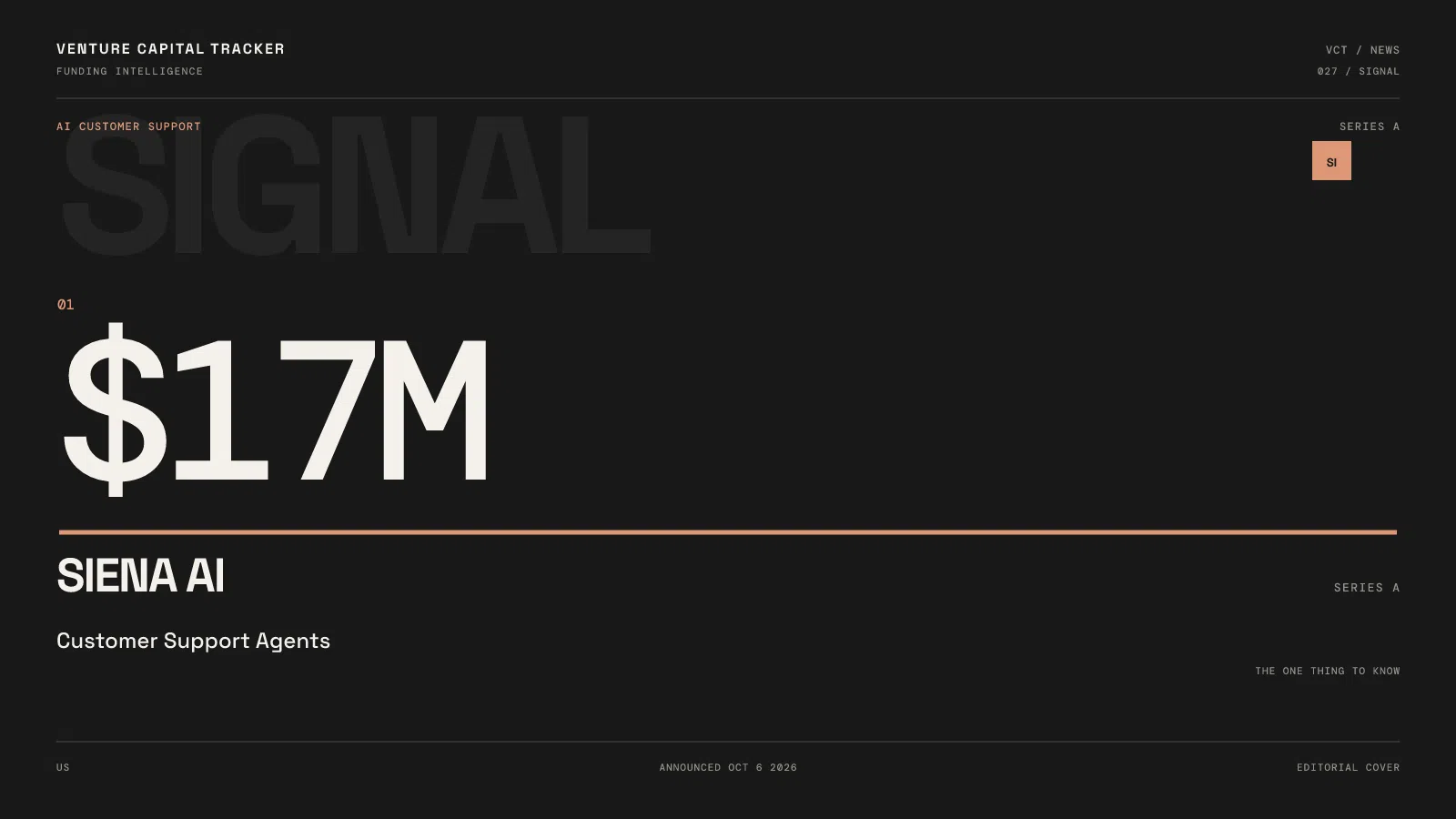
Siena AI announced a $17 million Series A on October 6, 2026, led by York IE. Its ambition goes beyond automating customer-support tickets: Siena calls its broader platform the Agent of Record, a shared intelligence layer for support, shopping and other customer interactions. For founders and operators, the interesting question is whether a connected agent really improves customer outcomes enough to justify its platform fee and usage charges.
Deal details & investors
Funding event
Siena AI
Led by York IE
The short version
- For founders: budget customer support for peak-volume months as well as the median.
- For buyers and users: define successful resolution with recontact and customer satisfaction checks.
- For investors: track durable renewal and expansion after implementation, not gross interaction counts.
Siena AI funding: investors, stage and valuation
| Fact | Evidence |
|---|---|
| New capital | $17M Series A |
| Announcement date | October 6, 2026 |
| Lead investor | York IE |
| Other participants | Joyance Ventures; existing investors Aglaé Ventures, Sierra Ventures and Super Angel Fund |
| Valuation | Not disclosed in the company announcement |
| Use of funds | Extend its Agent of Record platform for consumer brands |
The $17M is the new Series A amount, not a valuation or an automatically confirmed lifetime fundraising total. Do not attach an invented post-money valuation or an unverified equity stake to the deal.
What is Siena's Agent of Record?
Siena started with an AI customer-service agent. The newer pitch is a consistent customer-intelligence layer used across support, sales and brand interaction workflows. That means an agent answering a delivery question, a shopping assistant suggesting a product and a human CX teammate should be able to use compatible account and conversation context.
Siena says it works with hundreds of consumer brands, naming SPANX, FIGS, HexClad and Comfrt, and claims to have automated hundreds of millions of interactions. Those are company-reported reach figures, not independently audited results for the average customer.
An important distinction: an 'agent of record' is Siena's product positioning, not a standard compliance status or a guarantee that Siena is the system of record for orders, payments or customer identities. Buyers still need to identify which underlying platform owns each record and exactly where the agent may act.
Siena AI pricing: examples using the published billing model
As checked on Siena's own pricing page in November 2026, it shows a $750 monthly platform fee, an Automation Pack at $0.90 per automated ticket, and a separate Support & Implementation component for which a universal public price is not supplied. The vendor asks prospects to request a tailored quote.
| Automated tickets/month | $750 platform + $0.90 per ticket | Important exclusions |
|---|---|---|
| 500 | $1,200 | Implementation, negotiated terms, taxes |
| 1,000 | $1,650 | Implementation, negotiated terms, taxes |
| 5,000 | $5,250 | Implementation, negotiated terms, taxes |
| 10,000 | $9,750 | Implementation, negotiated terms, taxes |
This is illustrative arithmetic based on the published rate, not a quote or guarantee of final invoicing. Volume tiers, contract minimums, packaging or added support may change the bill. Get written definitions for what counts as an 'automated ticket': every ticket handled, an interaction, or only an independently successful resolution?
How to calculate Siena's effective cost per resolved issue
An ecommerce buyer should test a real ticket sample, not compare two vendors' headline automation percentages:
- Define a successful resolution in advance, including a correct outcome and no repeat contact about the same issue within seven days.
- Track how many conversations Siena bills as automated tickets and how many independently satisfy that success definition.
- Combine platform fees, per-ticket usage, implementation, other contracted costs and human follow-up labor.
- Divide the resulting full cost by genuinely resolved issues, and compare with a matched baseline and customer-satisfaction scores.
For illustration, the published $750 platform fee plus 1,000 automated tickets at $0.90 produces a $1,650 monthly platform-and-usage charge. If hypothetically only 700 cases meet the buyer's audited resolution definition, that is approximately $2.36 per verified resolution, before implementation or labor. This is a mathematical scenario, not a report of Siena's actual performance.
Which metrics really matter for an AI support agent?
Reddit discussions about Intercom Fin and other agents repeatedly raise questions about per-resolution billing, unresolved tickets mistakenly counted as completed, cost spikes during peak ecommerce seasons, poor knowledge-base quality and unreliable human handoffs. Some contributors are vendors or competitors, so the discussions are buyer-research clues, not verified comparative performance studies.
To evaluate Siena or any competitor, run a pilot with your own customer support mix and track:
- Autonomous resolution rate, with a definition audited against conversation outcomes.
- Seven-day repeat contact rate for the same issue, to detect false positives.
- CSAT on AI-only cases, separately from conversations transferred to humans.
- Escalation quality, including whether previous context survives the handoff.
- Correct action rate for refunds, orders, shipping and changes of address.
- Effective cost per genuinely resolved issue after platform, usage and human-review costs.
- Revenue influence, measured separately from support resolution to avoid attributing every touched order to AI.
A high 'deflection rate' can be misleading if shoppers abandon the conversation or reopen the case later. Likewise, a claim of revenue 'influenced' by an agent is not an estimate of causal incremental sales without a credible comparison group.
Siena versus Intercom Fin, Gorgias and alternatives
| Option | Typical evaluation context | What to verify |
|---|---|---|
| Siena AI | Commerce-focused AI agents and shared customer intelligence | Platform fee, per-ticket definition, knowledge access, support-to-shopping handoff |
| Intercom Fin | Automated support integrated with Intercom workflows | Billing definition, recontact rate, existing Intercom seat costs |
| Gorgias | Commerce helpdesk and support automation | Helpdesk needs, automation charges, order integrations |
| Gladly, Zowie and related providers | Alternative CX platforms or AI agent layers | Migration complexity, agent capabilities, data retention and human handoffs |
This is an evaluation framework, not a ranking based on controlled product testing. The pricing units and feature scope of these vendors are not identical. To compare fairly, normalize the same incoming ticket mix and a clear successful-outcome standard.
What would justify Siena's $17M investment thesis?
For a consumer brand, the appeal is not simply cheaper support. It is an agent that can respond accurately across order questions, product discovery and follow-up interactions while respecting existing customer data. A shared intelligence layer can be valuable if integration and operational complexity are lower than assembling several independent bots.
But there are execution risks: brand-specific policy exceptions, incorrect order actions, privacy safeguards, hallucinated product claims, inconsistent experience across channels and poor attribution of sales. The strongest signal to investors would be durable net retention from brands that verify both service quality and economics, not just a growing total of automated conversations.
What to watch next
Look for clearly disclosed customer-cohort results, an auditable definition of automated resolutions, additional workflow integrations, transparent contract terms and evidence that cross-channel intelligence improves repeat purchase or service cost without degrading experience.
Frequently asked questions
How much did Siena AI raise? Siena announced a $17M Series A on October 6, 2026.
Who led Siena's Series A? York IE led; Joyance Ventures and existing investors Aglaé Ventures, Sierra Ventures and Super Angel Fund participated.
What is Siena AI's valuation? The company did not disclose a valuation in the cited Series A announcement.
How much does Siena AI cost? Its publicly listed pricing included a $750/month platform fee and $0.90 per automated ticket, plus additional terms to confirm with sales.
Does Siena AI replace a helpdesk? Its product is positioned as an AI agent and customer-intelligence layer. Whether it complements or replaces elements of an existing stack depends on the integrations and contract.
Research method and limitations
This VCT analysis compares the dated company/investor disclosures with publicly available product information and market reporting. Any calculations identified as illustrative use explicit assumptions and are not audited company results or independent product tests. Pricing, roadmaps and private-company valuations may change. The announcement date of the financing is distinct from the date this article was written or updated.
Follow Venture Capital Tracker on Google
Add VCT as a preferred source to see more of our venture-capital reporting in Google Search.
Last updated:
Editorial note: AI tools assisted with research, structure, or drafting. Venture Capital Tracker retains human editorial responsibility for factual accuracy, relevance, and source quality before publication.