· 6 sources · Updated · Verified
Rox Raises $100M at $1.3B: Investors, AI Sales Agents, Pricing and Risks
Rox raised $100M at $1.3B. Understand investors, pricing, Databricks, AI sales competitors and what revenue-agent ROI claims actually establish.

Editorial team
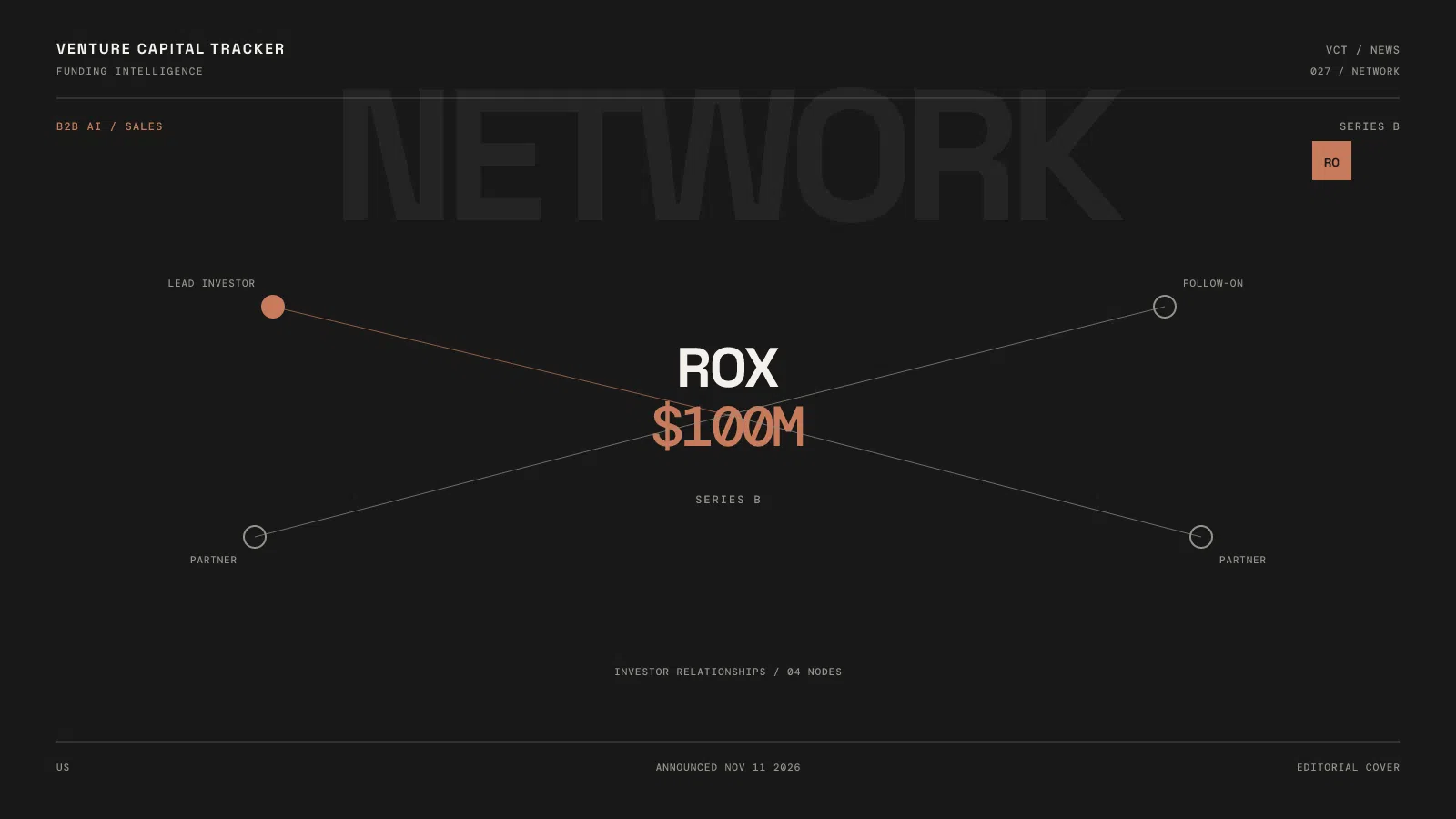
Rox announced $100 million in Series B funding on November 11, 2026, at a $1.3 billion valuation. General Catalyst and March Capital co-led the round, with Sequoia Capital, Factory, Databricks Ventures and Prosperity7 Ventures among the other named investors. Unlike a routine funding headline, the investable question is whether Rox's AI revenue agents make customer data materially more useful—and whether buyers can prove the effect on closed business.
Deal details & investors
Funding event
Rox
Led by General Catalyst , March Capital
Reported valuation $1.3B
The short version
- For founders: ask whether AI increases qualified sales, not just outreach volume.
- For buyers and users: trial CRM writeback accuracy and compare closed-won outcomes with a control group.
- For investors: separate the company's 10x ARR growth and 702% NRR claims from independently audited results.
Rox funding and valuation at a glance
| Fact | Evidence |
|---|---|
| New round | $100M Series B |
| Announced | November 11, 2026 |
| Valuation | $1.3B; pre/post-money basis not specified publicly |
| Co-leads | General Catalyst; March Capital |
| Other participating firms | Sequoia Capital; Factory; Databricks Ventures; Prosperity7 Ventures |
| Prior disclosed funding | $50M combined seed and Series A announced November 2024 |
Do not count Databricks Ventures' November 13 partnership-and-investment announcement as another round. Rox explicitly places that strategic participation within the November 11 Series B. Likewise, the previously announced $50M covered two earlier financing stages, not one $50M seed round.
TechCrunch reported an earlier $1.2B valuation in March 2026. That media-sourced earlier mark and the company's $1.3B announced November mark should stay dated and separately attributed. The new release does not specify enough financing terms to calculate exact ownership or investor dilution.
The most important distinction: pipeline is not revenue
Rox's release gives two different customer examples. A global IT-services customer is said to have created $330 million of qualified pipeline in eight weeks; a separate medical-technology customer is said to have closed $24 million of revenue over five months. These figures come from different customers, use different periods and measure different outcomes. Dividing $24M by $330M would produce a meaningless conversion rate.
| Metric | What it actually measures | What is still needed |
|---|---|---|
| Qualified pipeline | Potential deal value accepted for further selling | Opportunity definition, duplicate removal, eventual win rate |
| Closed revenue | Booked business attributed to the sales process | Contract records, timing, a control cohort |
| 702% enterprise NRR | Reported expansion/retention in a selected existing-customer cohort | Baseline ARR, sample size, time window |
| 25x claimed ROI | Vendor-reported return for some customers | Cost inclusions, attribution and independent validation |
Editorial conclusion: the competitive advantage to test is not how much pipeline an agent describes, but how much incremental won revenue it creates without corrupting CRM data. The funding supplies resources for that experiment; it does not prove the outcome.
What does Rox AI funding mean?
Rox AI funding refers to the company's disclosed private investment rounds, not revenue its agents generate for customers. The new $100M Series B supports product development and expansion, but it does not reveal cash burn, cash proceeds to individual shareholders, exact investor ownership or public-market share prices. For investors, the follow-up is whether enterprise deployments improve independently verified pipeline conversion and Rox's sustainable retention economics.
What does Rox AI do?
Rox describes its software as a revenue agent for enterprise sales: it can investigate prospects, monitor accounts, qualify leads, prepare outbound activity, surface expansion opportunities and help update CRM records. Rather than replace every existing data system, it is designed to work with the tools and customer context a business already uses.
Two product paths should not be confused. Pipeline generation aims to find and qualify new business; account growth and retention uses signals such as product activity, billing and support history to identify churn risk or upsell possibilities. A sales leader should test each separately. More generated opportunities, email messages and meeting briefs are activity metrics; incremental booked revenue is an outcome metric.
Why the Databricks connection matters
On November 13, Rox described a strategic investment by Databricks Ventures and Built-On Databricks partner recognition. The companies say that their joint architecture can use governed lakehouse data, including product usage and customer history, to inform the agent without losing control of enterprise access rules.
That is potentially more powerful than a tool that depends on public prospect lists alone. It also creates specific diligence questions: Which CRM objects can the agent write? Are approval gates configurable? Is the model permitted to copy any data outside the lakehouse? What happens on a failed writeback? Can administrators audit the saved record rather than accepting a success message from the agent?
The reported customer examples and revenue gains are vendor-selected evidence, not independent randomized tests. Ask for a reference customer with your industry's data and procurement constraints.
Rox pricing: check what an Agent Action actually buys
As checked in November 2026, Rox's official pricing page listed an Individual tier at $100 per month with 10,000 Agent Actions, Teams at $255 per month with 15,000 Agent Actions, and negotiated Enterprise pricing. It also advertises a free starting experience. Enterprise options include additional integration and identity-management controls.
An Agent Action is a metering unit, not necessarily a completed, qualified lead. Agent tasks vary in complexity and actions consumed. Do not divide the monthly fee by the allowance to claim a verified cost per won customer. During procurement, request a representative workload quote including account research, outreach, follow-ups, CRM sync, extra action consumption and time spent on human review.
Rox versus Salesforce, Gong, Clari, 11x and Artisan
| Competitor category | Representative products | Decision question |
|---|---|---|
| CRM plus native AI | Salesforce | Does the product preserve a reliable source of truth and permissions? |
| Conversation and revenue intelligence | Gong; Clari | Does it primarily forecast/analyze or actually perform account actions? |
| AI sales-development agents | 11x; Artisan | How are outbound quality, approvals, deliverability and accepted meetings verified? |
| Enrichment and GTM workflow tools | Clay and adjacent services | Who owns identity matching, data freshness and process orchestration? |
| Enterprise revenue agents | Rox | Can it turn governed CRM and warehouse context into attributable outcomes? |
These are category comparisons, not independently scored feature tests. Pricing, integrations and available modules change; test each finalist on the same accounts, permission model and pilot criteria.
How to interpret Rox's unusually large performance figures
The company says annual recurring revenue increased more than tenfold during its first year in market. Its November 13 release also cites 702% net revenue retention for a strategic/enterprise cohort and selected customer examples with substantial claimed pipeline and ROI. These figures are company-reported, and cohort size, baseline and accounting methodology are not fully public. A small starting revenue base can generate an impressive percentage without establishing overall profitability.
A meaningful buyer-controlled trial should measure:
- Verified CRM state: compare each claimed writeback with the actual saved account, contact or opportunity.
- Data quality: stale records, duplicate contacts and unsupported prospect claims.
- Pipeline acceptance: opportunities explicitly accepted by sales, not only machine-created records.
- Incremental results: a comparable control cohort and closed-won revenue, accounting for deal timing.
- Commercial cost: subscription, actions, deployment, data services and seller time.
- Risk controls: outbound limits, human approvals, data retention, audit logs and vendor security review.
Public Reddit discussions about CRM and sales automation highlight stale source records and the risk of an agent reporting that a task was saved when no database change occurred. This is general user research, not evidence of a defect in Rox. It points to the right testing method: verify outcomes against the system of record.
Investor takeaways and next milestones
The $100M financing gives Rox resources for applied AI research and enterprise expansion, but a $1.3B private valuation is not a share price or evidence of positive earnings. Watch for disclosed ARR scale, retained deployment cohorts, customer-verified opportunity attribution, cross-industry adoption and whether warehouse-native integration reduces operational friction.
Questions readers ask
How much did Rox raise? The new November 2026 Series B is $100M. An earlier $50M announcement combined seed and Series A funding.
Who led the round? General Catalyst and March Capital.
What is Rox's valuation? The company announced $1.3B in November 2026; it did not identify the valuation as pre- or post-money in the cited release.
Does Rox replace Salesforce? Its revenue-agent approach may overlap with some Salesforce workflows, but Rox also integrates with existing CRM systems.
How much does Rox cost? Rox listed Individual at $100/month and Teams at $255/month, with custom Enterprise pricing when checked November 2026.
Research method and limitations
This VCT analysis compares the dated company/investor disclosures with publicly available product information and market reporting. Any calculations identified as illustrative use explicit assumptions and are not audited company results or independent product tests. Pricing, roadmaps and private-company valuations may change. The announcement date of the financing is distinct from the date this article was written or updated.
Follow Venture Capital Tracker on Google
Add VCT as a preferred source to see more of our venture-capital reporting in Google Search.
Last updated:
Editorial note: AI tools assisted with research, structure, or drafting. Venture Capital Tracker retains human editorial responsibility for factual accuracy, relevance, and source quality before publication.