Readily Raises $11M Series A for Healthcare Compliance AI
Define Ventures leads Readily's $11M Series A as the healthcare compliance platform connects regulatory changes with owners, actions and audit evidence.
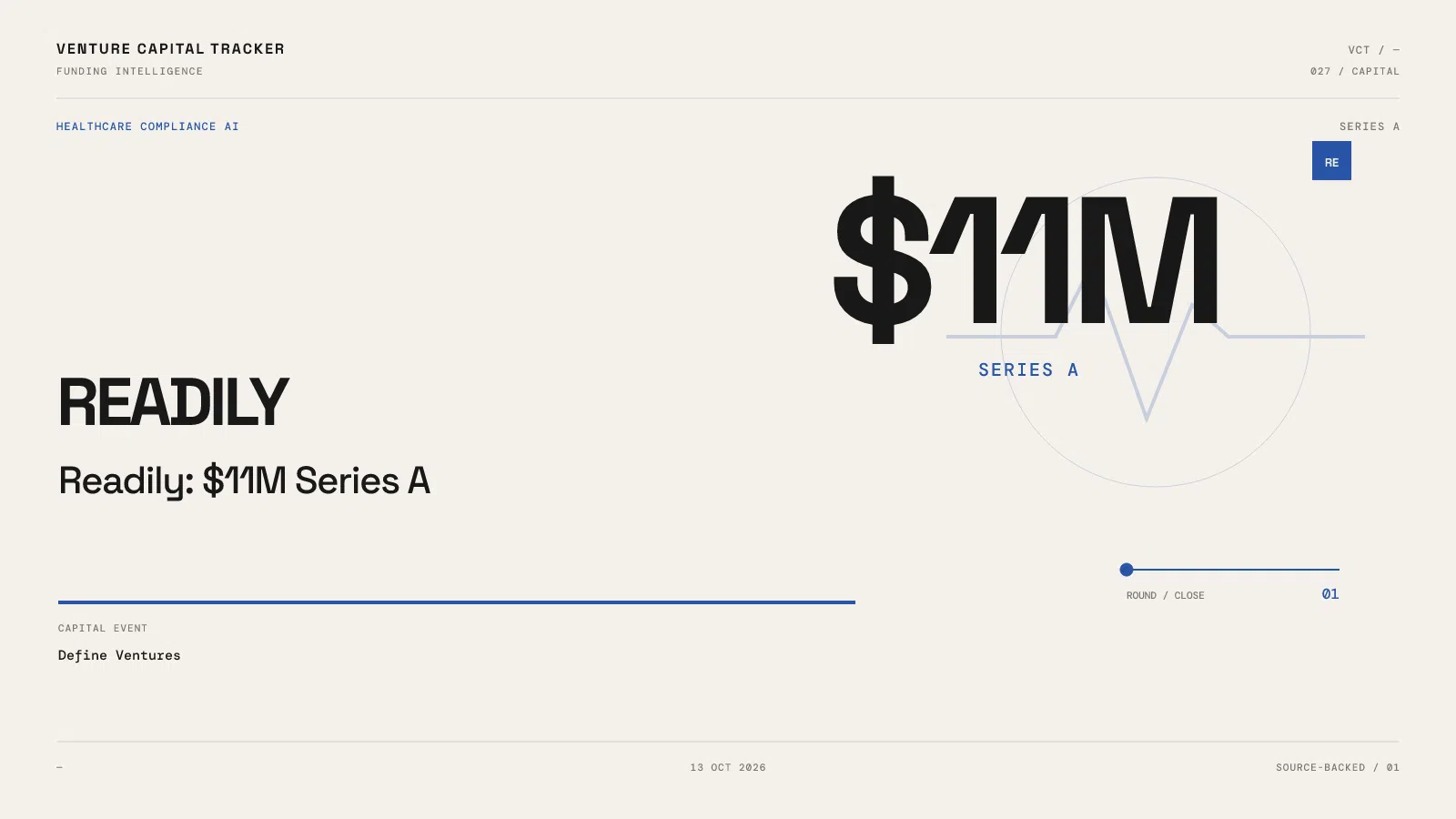
Readily Raises $11M Series A for Healthcare Compliance AI
Readily announced an $11 million Series A on October 13, 2026, led by Define Ventures, with participation from Y Combinator and the California Health Care Foundation Innovation Fund.
The San Francisco company connects regulatory requirements with policies, responsible staff, follow-up actions and audit evidence. It plans to expand that compliance foundation into broader enterprise oversight for healthcare organizations.
The valuation was not disclosed. This is a company-announced financing, not a new grant award or an acquisition.
What is being financed?
| Item | Disclosed position |
|---|---|
| New financing | US$11M Series A |
| Lead | Define Ventures |
| Other named investors | Y Combinator; CHCF Innovation Fund |
| Announcement date | October 13, 2026 |
| Product focus | Healthcare compliance intelligence and operational oversight |
| Valuation | Undisclosed |
Readily's announcement describes workflows that retain qualified staff's responsibility for decisions. That is an important boundary: analyzing a rule is not the same as accepting legal or operational responsibility for complying with it.
The opportunity lies after the document summary
A regulatory update may require policy changes, operating instructions, staff assignments and evidence that work was completed. A summary helps someone understand the change; it does not establish that the organization acted.
VCT's analysis is that the more durable opportunity sits in these connections. Software that preserves the relationship between an obligation, its owner and its supporting evidence can become part of recurring oversight.
This also explains the attraction of starting with a specific healthcare workflow. Terminology, local requirements and existing review processes create implementation complexity that generic document tools may not address well.
The same specialization creates a scaling constraint. Expansion into new organizations and jurisdictions may require substantial domain work, not just more model capacity.
Investor evidence supports a focused customer base
The California Health Care Foundation's Readily profile says the company serves 15 health plans, primarily Medi-Cal managed care organizations, including roughly 70% of California's local health plans. Those are investor-reported figures, not independently audited market-share data.
CHCF also records a $1 million program-related investment dated June 2026. That earlier entry should not be added to the new round or presented as CHCF's newly disclosed Series A check. The October announcement does not itemize individual investor contributions.
The distinction is relevant because CHCF is a philanthropy with an investment program. Its participation in a financing round is not automatically a non-dilutive grant.
The evidence standard for compliance AI
A plausible answer is insufficient when an audit requires traceable evidence. Buyers need to know which source and version support a conclusion, what changed, who reviewed it and whether the recommended action was completed.
Readily's product direction puts these questions within its intended scope. The commercial test is whether it can make the chain of evidence dependable enough for customers to use repeatedly.
Revenue, retention and implementation economics remain undisclosed in the financing announcement. Customer examples can demonstrate practical utility, but cannot establish average savings across the entire customer base.
The most useful milestones would be shorter verified review cycles, reliable source citations, broader paid adoption within existing customers and evidence that implementation costs fall as workflows become reusable.
A distinct healthcare-AI investment thesis
Recent healthcare AI funding has covered clinical documentation, patient communications and provider operations. Brellium's clinical-note compliance platform is adjacent, but it does not address the identical payer-regulatory workflow.
Readily's thesis is narrower than replacing healthcare administration wholesale. It begins with identifying what changed and establishing who is accountable for the response.
The Series A finances a move toward a system of operational evidence. Its value will depend less on how fluently AI explains a regulation than on whether healthcare organizations can prove that the right work actually happened.
Editorial note: AI tools assisted with research, structure, or drafting. Venture Capital Tracker retains human editorial responsibility for factual accuracy, relevance, and source quality before publication.