· Venture Capital Tracker · venture-capital
Pear VC Closes $333M Fund V to Invest Faster at Pre-Seed
Pear VC closed a deliberately smaller $333M fifth fund and plans to deploy it faster across roughly 175 pre-seed and seed companies.
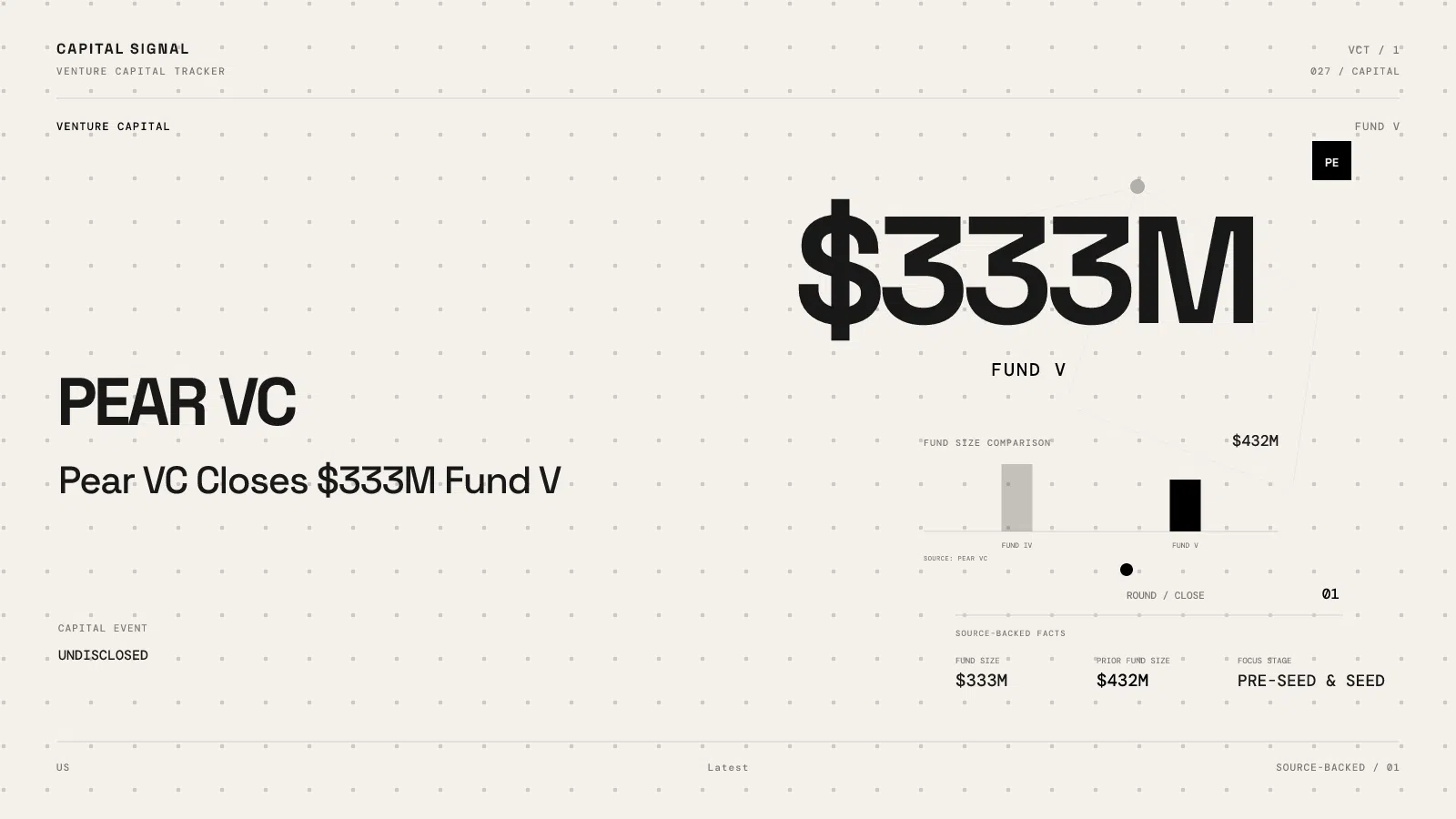
Pear VC has closed its fifth fund at $333 million, giving the Menlo Park firm a deliberately smaller pool of capital at a time when many competitors are moving in the opposite direction.
Fund V is approximately 23% smaller than Pear's $432 million fourth fund from 2023. The reduction is strategic, not a shortfall: Pear plans to deploy the new vehicle over roughly two and a half years, compared with the three-and-a-half to four years historically taken to invest its funds.
| Deal field | Detail |
|---|---|
| Vehicle | Pear Fund V |
| Close | $333 million |
| Previous fund | $432 million in 2023 |
| Firmwide AUM | More than $1.1 billion |
| Focus | Pre-seed and seed |
| Initial checks | Approximately $250,000 to $6 million |
| Deployment plan | About 2.5 years |
| Follow-on reserve | Approximately one-third of the fund |
A smaller fund designed to make more first checks
Pear expects to back about 125 pre-seed companies and 50 seed-stage companies. If one-third of the vehicle is reserved for follow-ons, roughly $222 million remains for initial investments—an average of about $1.27 million across the planned 175 new positions. The actual distribution will be uneven because seed checks can reach $6 million.
That math makes the strategy clearer. Pear is not trying to win late-stage allocation contests with larger pools. It is using its PearX accelerator, university networks and founder relationships to acquire ownership before companies become obvious.
The new deployment period also matters. A $333 million fund invested over 2.5 years implies a materially faster annual pace than the $432 million predecessor invested over 3.5–4 years. Smaller does not mean slower.
Why Pear is resisting the megafund model
The venture market has become increasingly concentrated around a limited number of multibillion-dollar managers. That structure rewards firms that can write very large growth checks, but it can also inflate round sizes and make seed portfolios harder to support with focused partner time.
Pear's answer is specialization. It wants to remain a formation-stage investor across AI, enterprise software, healthcare, consumer, fintech, biotech and deep tech. Early investments in DoorDash, Gusto, Vanta and Guardant Health underpin the pitch; more recent Pear-backed companies include Listen Labs, Forus, Gravis Robotics and Vals AI.
This is also a test of whether brand and sourcing can substitute for balance-sheet scale. The decisive metric will not be how quickly Pear spends the capital, but whether its faster cadence preserves entry discipline and meaningful ownership.
Portfolio construction: the constraint is follow-on capital
Keeping only one-third of Fund V for follow-ons leaves approximately $111 million to support winners. With 175 planned initial investments, Pear will have to be selective about which companies receive additional capital.
That creates two trade-offs:
- More shots at formation stage. A broader initial portfolio increases the chance of finding outliers before competitive Series A rounds.
- Less internal capital per winner. Breakout companies may need external growth investors sooner, potentially diluting Pear unless the firm uses opportunity vehicles or accepts lower pro-rata participation.
Pear has chosen sourcing breadth over maximizing its ability to fund every later round. That is coherent with a seed specialist, but it places more weight on selection and reserve management.
Limited partners and leadership
The firm did not publish a full LP list. The Wall Street Journal identified Mizuho, Duke University and StepStone Group among the limited partners. Pear also promoted Arash Afrakhteh, Ajay Kamat and Shravan Reddy to general partner.
Those promotions suggest Fund V is an organizational expansion as well as a capital event. Pear needs enough senior investors to maintain founder access and board support while increasing the number of early-stage investments.
What to watch
The most useful indicators will be PearX application quality, the proportion of accelerator companies that receive follow-on financing, entry ownership at seed, and how frequently Pear can maintain pro rata in the strongest performers.
Fund V's contrarian signal is not simply that it is smaller. It is that Pear believes a focused seed franchise can compound more effectively by increasing the velocity of informed first checks while refusing to drift into the capital requirements of later-stage venture.
Accuracy note: the $333 million final close and more-than-$1.1 billion AUM are company-disclosed. Portfolio targets, check sizes, deployment timing, reserve allocation and named LPs were reported by the Wall Street Journal. Pear did not disclose fees, carry, target returns or a complete LP list.
Follow Venture Capital Tracker in Google
Add VCT as a preferred source to make our venture-capital coverage easier to find in Google Search.
Editorial note: AI tools assisted with research, structure, or drafting. Venture Capital Tracker retains human editorial responsibility for factual accuracy, relevance, and source quality before publication.