Altay Therapeutics Closes $37M Series A for an Oral FSHD Drug
Sound Bioventures and HealthCap co-lead Altay's $37M Series A, backing investigational DUX4 inhibitor DX5057 ahead of planned human testing in 2027.
Altay Therapeutics Closes $37M Series A for an Oral FSHD Drug
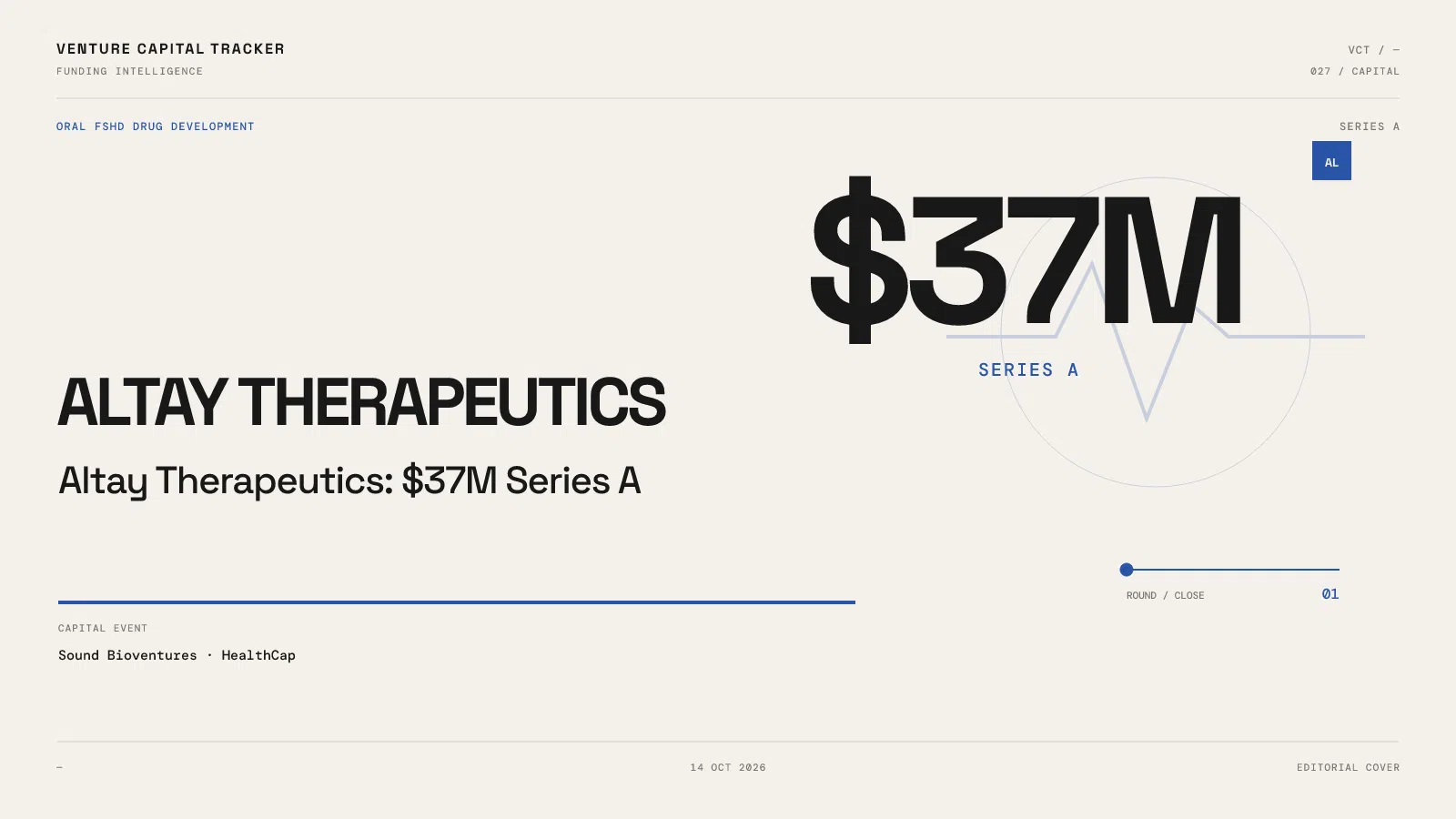
Altay Therapeutics closed a $37 million Series A, announced on October 14, 2026, to advance its investigational oral treatment for facioscapulohumeral muscular dystrophy, or FSHD.
Sound Bioventures and HealthCap co-led the round. Fountain Healthcare Partners, Biogen New Ventures, Pappas Capital and Global BioAccess Fund participated. Altay did not disclose a valuation.
The financing moves a preclinical drug-development thesis toward its first human test. Oral delivery is the potential advantage; demonstrating safe target engagement and meaningful benefit is the harder task.
What the financing supports
| Item | Disclosed position |
|---|---|
| Financing | Completed US$37M Series A |
| Announcement | October 14, 2026 |
| Lead program | DX5057, an investigational oral DUX4 inhibitor |
| Planned milestone | Phase 1 safety study expected in Q1 2027 |
| Further intended use | Phase 2 proof-of-concept development |
| Valuation | Undisclosed |
The announcement carried by co-lead HealthCap describes a completed financing, not a target or contingent commitment. The trial timetable remains a company expectation.
Why the delivery approach matters
Altay targets DUX4, a transcription factor implicated in FSHD. Its lead compound is designed to inhibit DUX4 activity through an orally administered small molecule.
Altay's platform description centers on finding allosteric binding sites on transcription factors and designing inhibitors against them. That is a discovery strategy, not proof that a specific medicine will succeed in patients.
If an oral drug can achieve adequate exposure across affected muscles, it could offer practical advantages for repeated treatment. But convenience is conditional on a therapeutic window: the dose must produce sufficient biological activity without unacceptable toxicity.
Neither the financing nor encouraging nonclinical results resolves that trade-off. Preclinical findings should not be treated as human efficacy data or as evidence of superiority to another modality.
A venture-philanthropy bridge, not a new grant package
SOLVE FSHD says it has provided nearly $7 million in seed investment since 2022, alongside strategic support. Its October 14 statement frames the Series A as a milestone in attracting institutional capital.
That earlier seed support is separate from the new $37 million round. It is not an additional grant announced with the Series A, nor enough information to reconstruct Altay's complete historical capitalization.
The broader investment lesson is that disease-focused capital can finance early work that specialist venture investors later underwrite at a more mature milestone. It does not remove the scientific or liquidity risks of drug development.
The milestones that matter next
First comes execution: regulatory readiness, trial initiation and enrollment. Then investors need human safety and exposure data, followed by evidence that the compound changes the intended biology.
For a progressive muscle disease, a biomarker response and a functional patient benefit are not interchangeable. Trial design, duration and the relationship between target engagement and clinically meaningful outcomes will matter more than a headline comparison with another platform.
Altay's wider pipeline offers optionality, but it should not obscure concentration in the lead program. Early platform breadth does not substitute for a validated clinical asset.
The FSHD financing context
VCT recently covered Soufflé Therapeutics' $135 million Series B, which includes an FSHD program within a broader RNA-delivery strategy. The shared disease focus does not make the technologies equivalent.
Altay offers exposure to a different approach: an oral small molecule rather than the same RNA-delivery platform. Its $37 million round is best understood as capital for a defined clinical transition—not confirmation that the transition has already succeeded.
Editorial note: AI tools assisted with research, structure, or drafting. Venture Capital Tracker retains human editorial responsibility for factual accuracy, relevance, and source quality before publication.