· Venture Capital · 5 sources · Verified
Nouscom Closes $135M Series D for Cancer-Interception Trial
Nouscom’s $135M Series D backs a registration-enabling trial of investigational NOUS-209. The funding is confirmed; clinical success remains to be demonstrated.

By Venture Capital Tracker
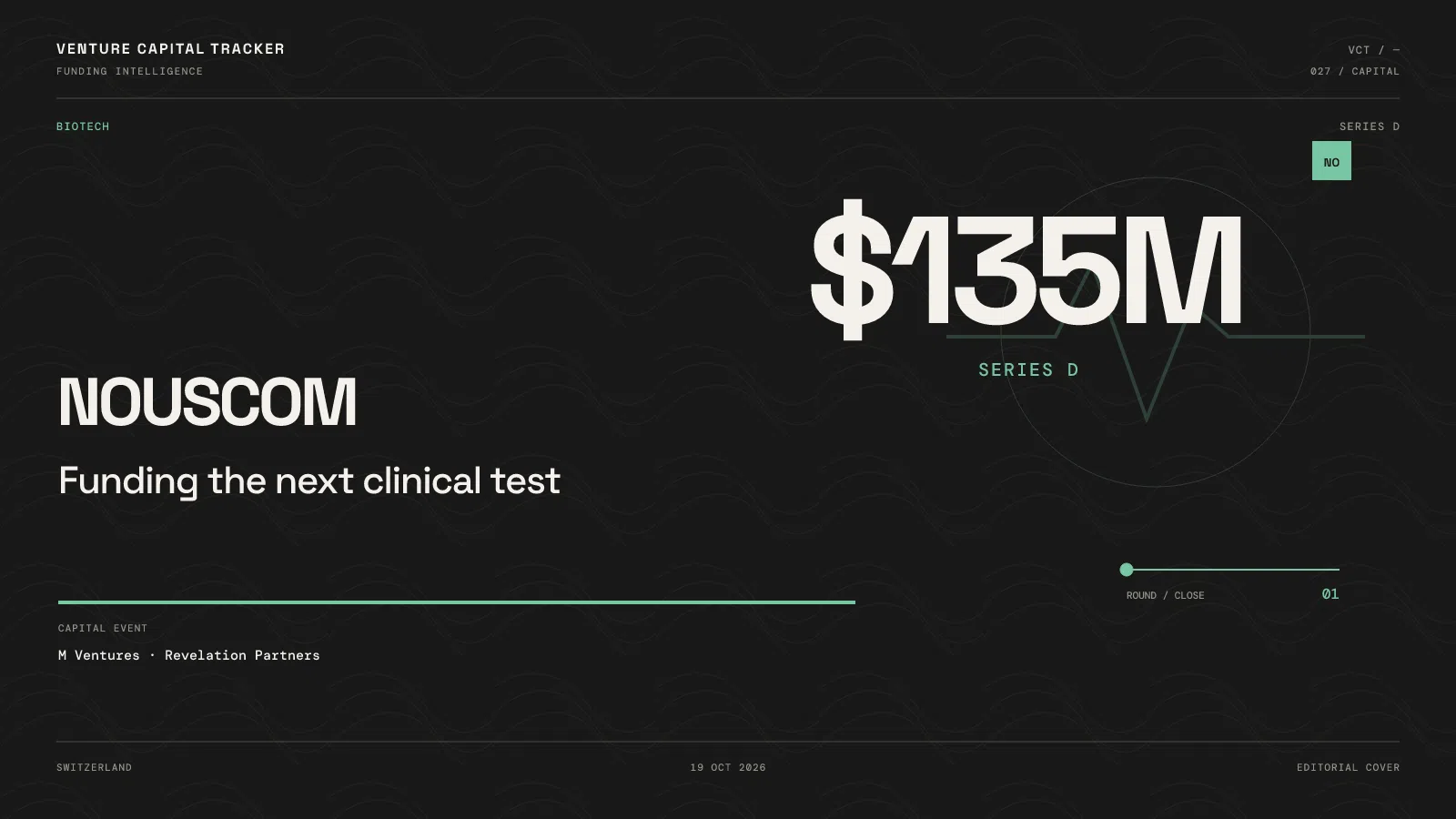
Nouscom announced the close of a $135M Series D, originally EUR120M, on October 19, 2026. M Ventures and Revelation Partners co-led the oversubscribed financing.
The company release provides the dollar equivalent directly. It describes one financing, not separate euro and dollar rounds. Proceeds will support a global, registration-enabling trial of NOUS-209, an investigational immunotherapy being developed for cancer interception in people with Lynch syndrome.
What the Series D establishes
| Item | Company-disclosed detail |
|---|---|
| Financing | Series D, closed |
| Reader-facing amount | $135M |
| Original amount | EUR120M |
| Co-leads | M Ventures; Revelation Partners |
| Lead program | Investigational NOUS-209 |
| Valuation | Not disclosed |
New participants are Angelini Industries through Angelini Investments, the European Investment Bank through Aurea, and Neva SGR. Returning investors include 5AM Ventures, Andera Partners, Angelini Ventures, Bpifrance through InnoBio2, CDP Venture Capital through its Large Ventures Fund, EQT Life Sciences, Indaco Venture Partners, Panakes Partners, Versant Ventures and XGEN Ventures.
The release identifies the EIB’s participation within this round; it does not establish a separate credit facility to add to the total. Earlier public research funding is likewise not additional Series D capital.
Financing a clinical test, not a proven prevention product
Nouscom’s pipeline includes off-the-shelf and personalized immunotherapy approaches. The funded program remains investigational. A registration-enabling development plan describes the intended evidence pathway; it does not guarantee a positive trial, an approval or commercial availability.
Our analytical view is that the round’s significance lies in funding a more demanding test of the product hypothesis. Investor participation validates financing capacity and willingness to take risk—not clinical efficacy.
Early observations can inform trial planning, but immune responses, a limited follow-up dataset and a demonstrated reduction in clinically meaningful events are different kinds of evidence. This article does not treat the company’s outcome claims as an independently established prevention benefit.
The investment questions move toward execution
For a clinical-stage company, capital must support recruitment, site operations, manufacturing, monitoring and the time required to observe outcomes. The relevant financing question is which development milestones the round can support, and what additional capital could be needed if timelines change.
Those are analytical questions rather than a disclosed runway calculation. Nouscom did not provide a spending schedule, individual investor commitments or a valuation in the reviewed announcement.
The off-the-shelf approach creates a further execution question: whether manufacturing consistency and supply can support a larger study. It does not remove the need to demonstrate safety, clinical benefit and a workable administration model.
Evidence to watch next
A useful follow-up would explain the study design, comparator, endpoints, enrollment progress, follow-up period and handling of missing data. These details matter more than describing a study simply as pivotal.
Commercial analysis is necessarily conditional. Even a positive study would leave questions about the eligible population, delivery pathway, reimbursement and adoption. None of those outcomes should be capitalized into a guaranteed market opportunity from a funding announcement alone.
The Series D is a meaningful confirmed close. Its value to the investment case will depend on the quality of the evidence generated and the company’s ability to execute the planned study.
Currency note: The October 19 company announcement reports EUR120M as $135M. We use that disclosed equivalent, not an independently calculated exchange rate, while preserving EUR120M in the canonical funding record.
Source note: Financing and development plans are company-disclosed. Clinical success, approval, valuation and investor allocations are not assumed. Trial-execution and investment discussion is VCT analysis.
Follow Venture Capital Tracker in Google
Add VCT as a preferred source to make our venture-capital coverage easier to find in Google Search.
Editorial note: AI tools assisted with research, structure, or drafting. Venture Capital Tracker retains human editorial responsibility for factual accuracy, relevance, and source quality before publication.