· 11 sources · Verified
Mudita’s $120M Fund II targets AI software with paying customers
The Detroit manager combines outside investments with a venture studio. Its founder criteria, portfolio and conflicting check-size guidance show how the two routes differ.

By Venture Capital Tracker
Mudita Venture Partners targets existing AI software businesses with paying customers. Its second fund combines investments in existing companies with capital for businesses created by its own venture studio. For founders, those are different propositions.
Deal details & investors
Fund close
Mudita Venture Fund II
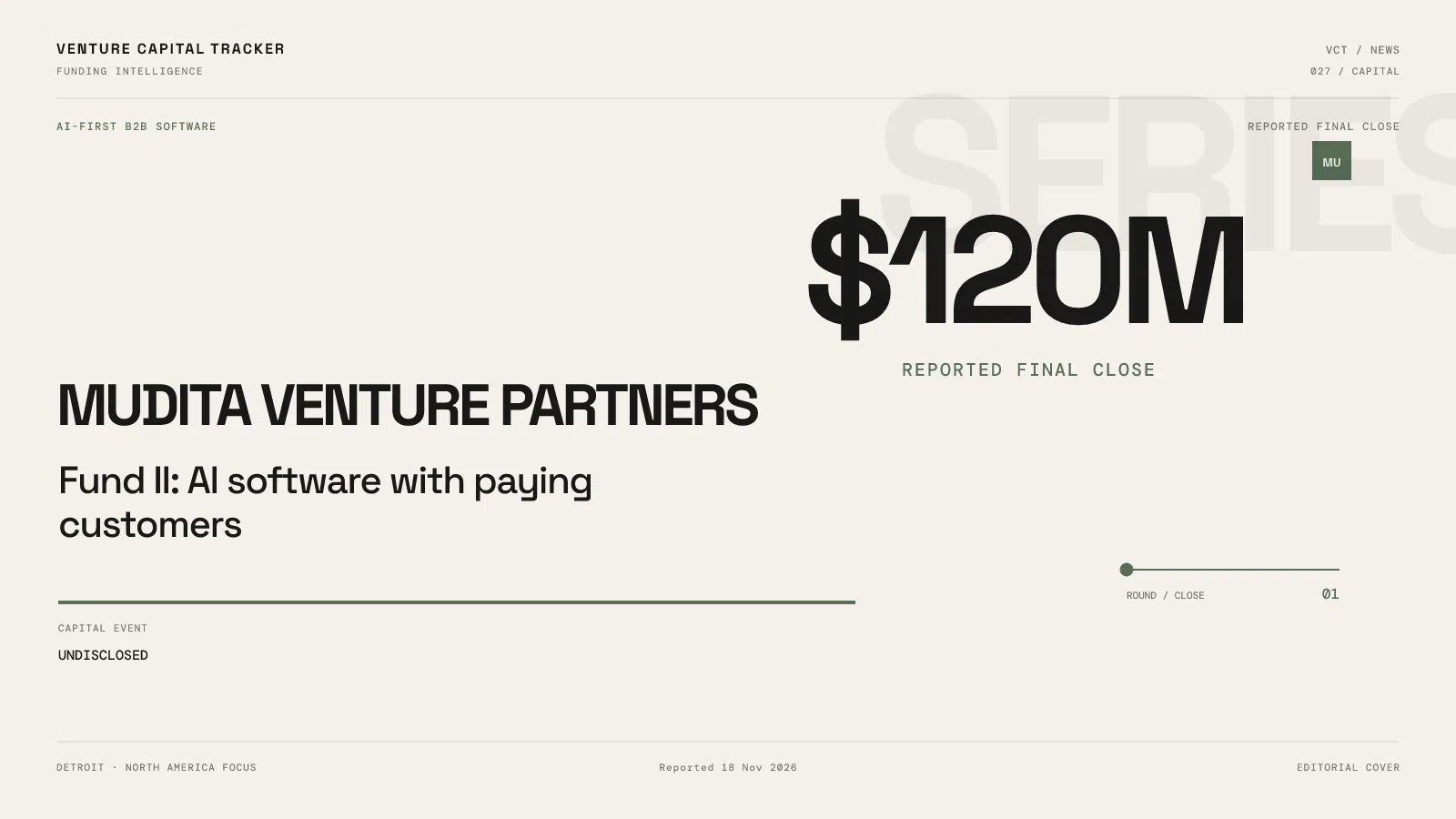
The Detroit manager's final close was reported on November 18 by DBusiness's R.J. King, quoting its managing partners. The report says 80% of capital goes to outside software investments and 20% to companies created by Mudita Studios. It also reports 16 Fund II investments already made and roughly 20 more planned over three years. Those are the firm's reported figures and intentions, not a guarantee of future deployment.
From first close to final close
Mudita Venture Fund II described an $85M first close against a $125M target in its June 25, 2025 issuer announcement. The November report puts the final total at $120M. These are successive milestones in the same vehicle; the earlier commitments are included in the final total.
The first announcement expected the remainder within 90 days. The final-close report appeared about 17 months later and $5M below the initial target—simple comparisons across the two announcements. That does not establish when the legal closing occurred or why the timetable changed.
Which founders fit?
Mudita's published founder criteria describe businesses generally generating $1M–$5M in annual recurring revenue: an annualised measure of recurring sales. Its geographic focus is North America, with occasional opportunities beyond the US where it sees a strong operational or strategic fit. Being based in Detroit does not make this a Detroit-only fund.
A plausible applicant would therefore arrive with customers, evidence of recurring demand and a specific problem that more capital could solve. An idea-stage founder should distinguish the firm's external investment mandate from its separate studio route.
The manager's operating-support description emphasises product development, go-to-market work, customer introductions and organisational expansion. These are services the firm says it provides. Founders still need to establish which partner will work with them, how much time is committed and what support is included in their investment terms.
The check-size guidance needs a conversation
Mudita's public materials give different initial investment ranges, checked on November 23:
| Source | Initial investment guidance |
|---|---|
| Who We Back FAQ | $250,000–$2M |
| About-page FAQ | $500,000–$1M, with exceptions |
| November 18 DBusiness fund report | $1M–$2.5M; up to $5M total per company |
The sources do not reconcile those ranges or establish which applies to a particular Fund II deal. A founder should confirm the initial check and any later-round allocation before planning a raise.
The Who We Back page describes a 30–90-day diligence process; the About page says 30–60 days. These are planning estimates, and the firm says it can invest alongside other investors without leading.
An illustrative applicant journey follows the firm's published process: send materials, have an initial conversation, explore traction and team with a partner, then proceed to partnership review and reference checks if both sides remain interested. This is a description of the stated process, not a report of a founder's experience or an assured route to investment.
What “AI-first B2B” looks like in practice
Cableteque, which Mudita identifies as a Fund II investment, sells software for manufacturers of wire harnesses—the bundles of wires and connectors used in equipment. It is a useful example of software built around an established industrial task.
Consider a manufacturer's estimator responding to a customer's request for a quote. In Cableteque's documented workflow, the team uploads or forwards drawings and other files. The software builds a bill of materials and wire list, flags items for review, pulls supplier pricing and fills in the manufacturer's labour template. Engineers adjust work that needs judgment, and the estimator sets margins before sending a quote. The company says the customer's existing enterprise resource planning system remains the system of record.
That is a documented, illustrative journey, not a VCT product test. It makes the investment thesis concrete: the software has to understand the customer's documents, parts and commercial workflow. A buyer needs to evaluate those connections alongside the model's output.
There is a buying decision behind the AI label. Cableteque's pricing page bases packages on assembly volume and complexity, with implementation included and add-ons priced separately. It asks prospective customers to obtain a quote rather than publishing a universal dollar subscription. A manufacturer comparing it with an existing spreadsheet-and-ERP process needs to measure quoting time, corrections, integration effort and the complete subscription cost, rather than assume every quoted hour becomes a saving.
Mudita's own Cableteque investment rationale stresses founder Arik Vrobel's industry experience and a complicated workflow. That is an investor's argument for the company, not independent proof of returns or product superiority.
Joining a portfolio is different from building with a studio
Mudita Studios describes a sequence of idea generation, demand and feasibility testing, building and launching a company. It also works for other venture firms and corporate clients. That differs from investing in an existing business with its own product, customers and founding team.
For an established founder, the practical comparison is whether an investor can help the company reach its next commercial milestone. For someone considering a studio-built business, the unanswered questions start earlier: who owns the intellectual property, what equity and compensation the operating founder receives, who controls decisions, and what happens if the project stops.
The reported 20% studio allocation is a share of fund capital. It is not a disclosed studio ownership stake in each company, a founder-equity offer or a management fee. The public materials reviewed do not provide a standard studio equity split or compensation package.
For a prospective fund investor, the corresponding questions are how outside and studio investments are selected, how affiliated services are priced and how conflicts are governed.
VCT did not locate a separate manager-issued final-close release. The reported final size rests on DBusiness's attributed account, also carried by Dealroom. Neither the reviewed report nor the first-close release supplies the final limited-partner roster, fund fees or investment returns.
Follow Venture Capital Tracker on Google
Add VCT as a preferred source to see more of our venture-capital reporting in Google Search.
Editorial note: AI tools assisted with research, structure, or drafting. Venture Capital Tracker retains human editorial responsibility for factual accuracy, relevance, and source quality before publication.