· Venture Capital · 6 sources · Verified
MP Space Raises ~$16M to Scale Spacecraft Battery Manufacturing
A Blackbird-led seed funds Australian spacecraft power hardware. The test is repeatable production, while design selections and flight-status claims need careful reading.

By Venture Capital Tracker Editorial Team
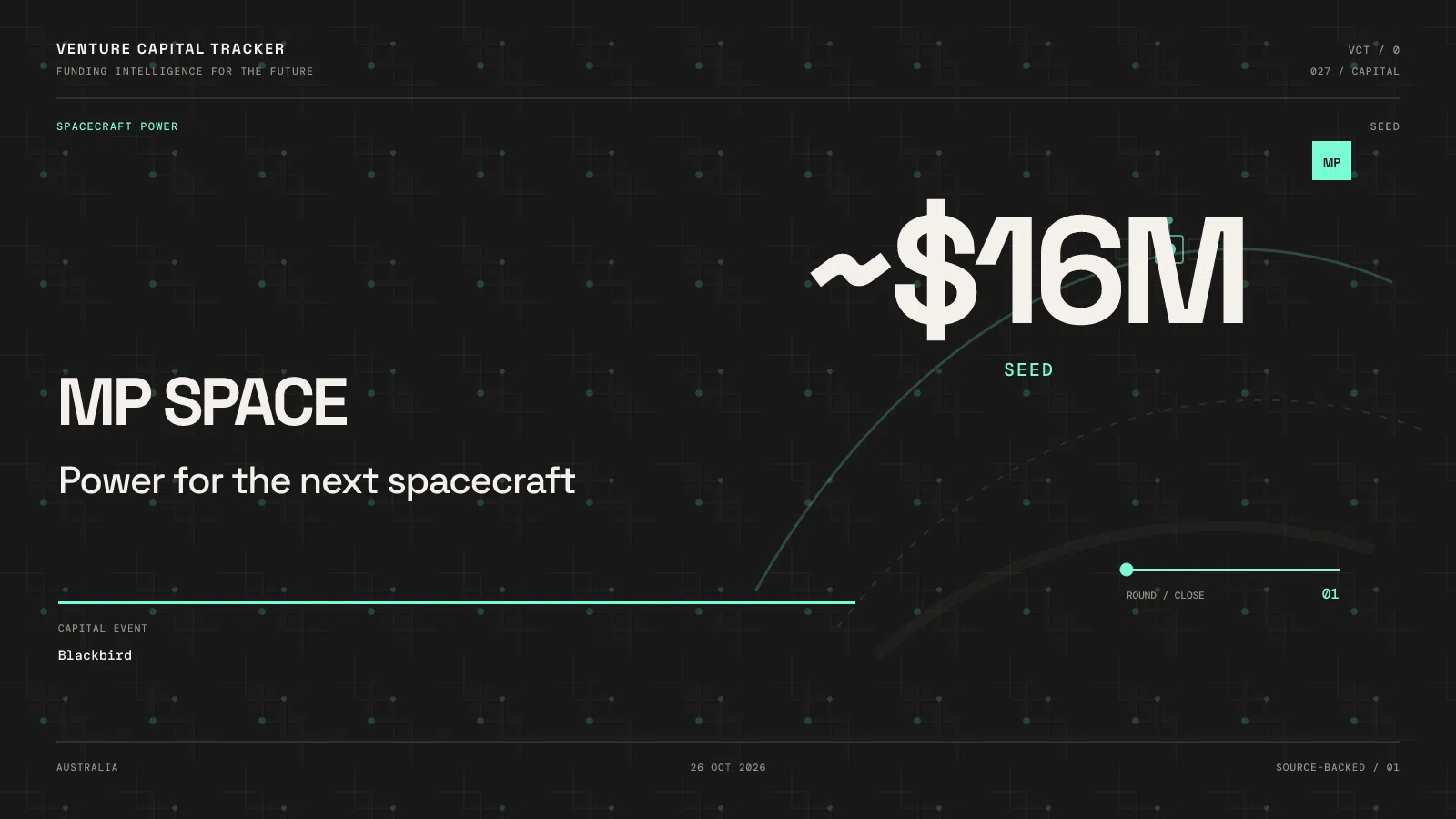
MP Space announced a seed round of about $16M (AUD23M) on October 26, 2026, led by Blackbird. The Sydney company is funding Australian manufacturing of spacecraft power hardware. The investment tests a practical proposition: satellite builders might buy standardized battery systems rather than engineer every power subsystem themselves.
The issuer’s announcement supplies the USD equivalent and names Systemiq Capital, Seraphim Space, Speedinvest and MFV Partners as participants. Valuation and individual investment sizes were not disclosed.
What spacecraft builders would buy
MP Space starts with batteries and plans a broader electrical power system. Its Pack2 product specifications describe integrated lithium-ion packs containing battery-management electronics, heaters, protections and a CAN communications interface. Two listed configurations provide 432 watt-hours at 2.4 kilograms and 864 watt-hours at 4.5 kilograms. Those are manufacturer specifications, not independently measured orbital performance.
The buyer is a spacecraft manufacturer or constellation operator assembling a mission. The commercial proposition is hardware supply; public materials reviewed disclose no unit price, gross margin or recurring software fee.
An illustrative workflow makes the value clearer. A satellite engineering team first specifies its energy needs, operating conditions and interfaces. Instead of designing a pack and its control electronics separately, it could evaluate an integrated product, test compatibility and order production units. The supplier still has to demonstrate reliability under the customer’s mission conditions. A catalogue component does not remove qualification work.
For the customer, the economic benefit would be engineering time saved and fewer integration problems. For MP Space, the challenge is making repeat orders profitable after testing, documentation, component procurement and support. Standardization helps only if mission-specific changes remain manageable.
Why investors see an opening
In comments hosted in the funding release, Blackbird’s Samantha Wong emphasizes the founders’ battery-manufacturing experience. Seraphim’s Lucas Bishop argues that a shortage of scalable independent suppliers pushes spacecraft makers toward building critical hardware internally. These are investors’ stated reasons for backing the company, rather than independent confirmation of its cost advantage.
Our analysis is that the opportunity lies in repeatable subsystems. More demanding spacecraft need dependable power, but each bespoke engineering project can absorb the manufacturing savings a supplier promises.
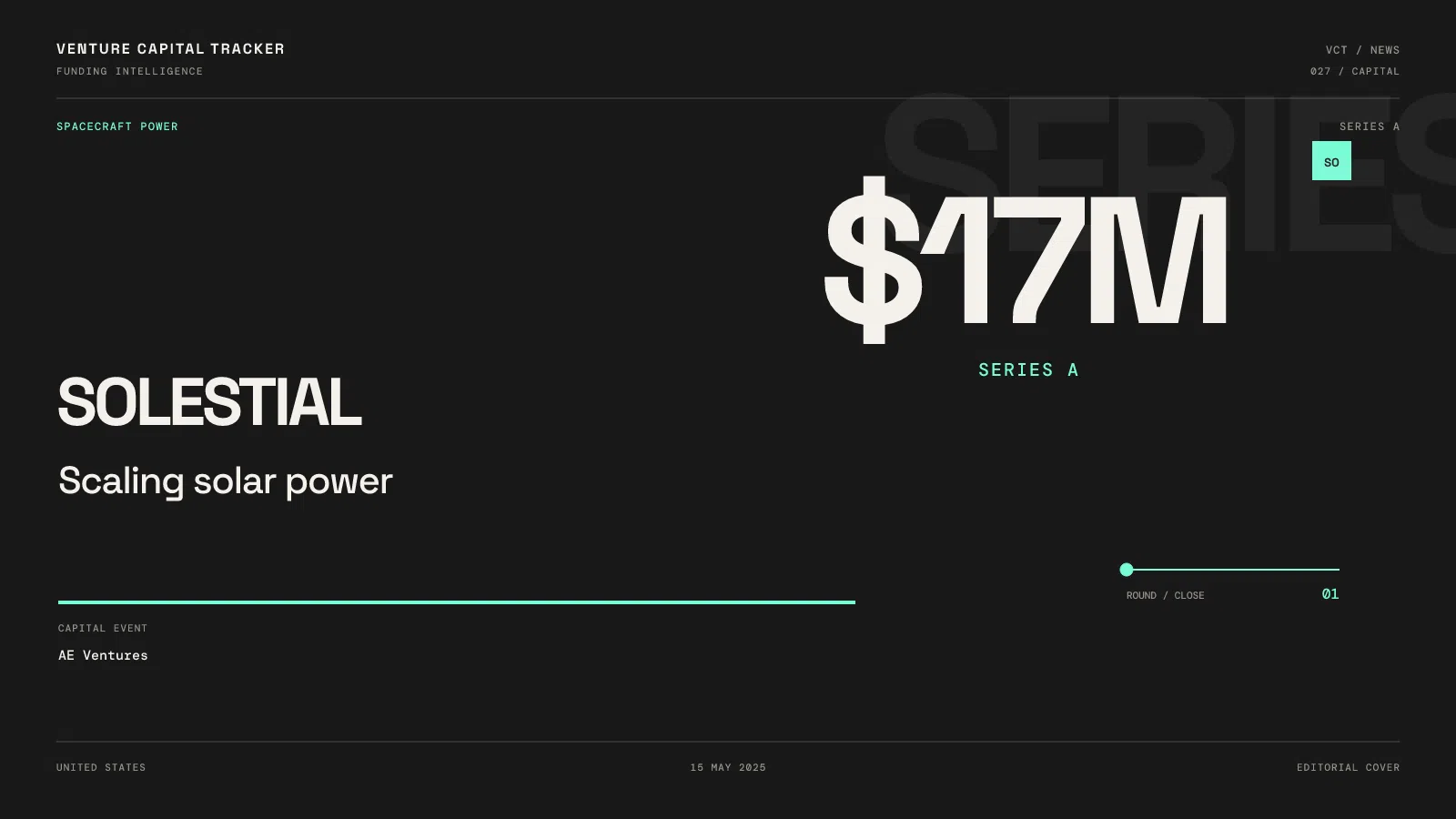
Solestial’s $17M Series A in May 2025 provides an adjacent comparison. It finances silicon solar-cell manufacturing: generating electricity rather than storing it. They supply different parts of spacecraft production. York Space Systems acquired Solestial on June 4, 2026, and says it continues supplying external customers. That adds a counterpoint to the independent-supplier thesis: spacecraft manufacturers can also buy a supplier to secure critical capacity.
Design selections are not flight results
The funding release says MP Space has been designed into missions covering more than 500 spacecraft. That is a company-reported design-selection figure, not evidence that 500 systems have shipped, flown or generated revenue.
Flight timing is also unresolved. The release describes hardware in orbit in October while its Blackbird quote says flight heritage will arrive that month. The company homepage instead labels flight heritage as Q3 2026. These statements do not establish one verified first-flight date, and no independent mission-performance results were available in the reviewed evidence.
The financing expands the capacity to manufacture. The stronger proof will be repeat deliveries, mission results and margins after qualification and support costs—not the number of spacecraft that might eventually carry the product.
Follow Venture Capital Tracker on Google
Add VCT as a preferred source to see more of our venture-capital reporting in Google Search.
Editorial note: AI tools assisted with research, structure, or drafting. Venture Capital Tracker retains human editorial responsibility for factual accuracy, relevance, and source quality before publication.