· Venture Capital · 17 sources · Verified
LangChain Raises $300M at $3B: Inside LangSmith's AI-Agent Business
Free developer tools helped LangChain spread; LangSmith is the commercial bet on making unpredictable AI agents testable, governable and reliable. We examine what customers actually buy, the costs behind its pricing, and the evidence still missing.

By VentureCapitalTracker Editorial
A customer asks an online retailer to exchange a damaged order. A conventional chatbot might explain the return policy. An AI agent could inspect the order, check inventory, issue a shipping label and update the customer's record. That sounds useful—until it refunds the wrong person or calls an internal tool without permission.
Deal details & investors
Funding event
LangChain
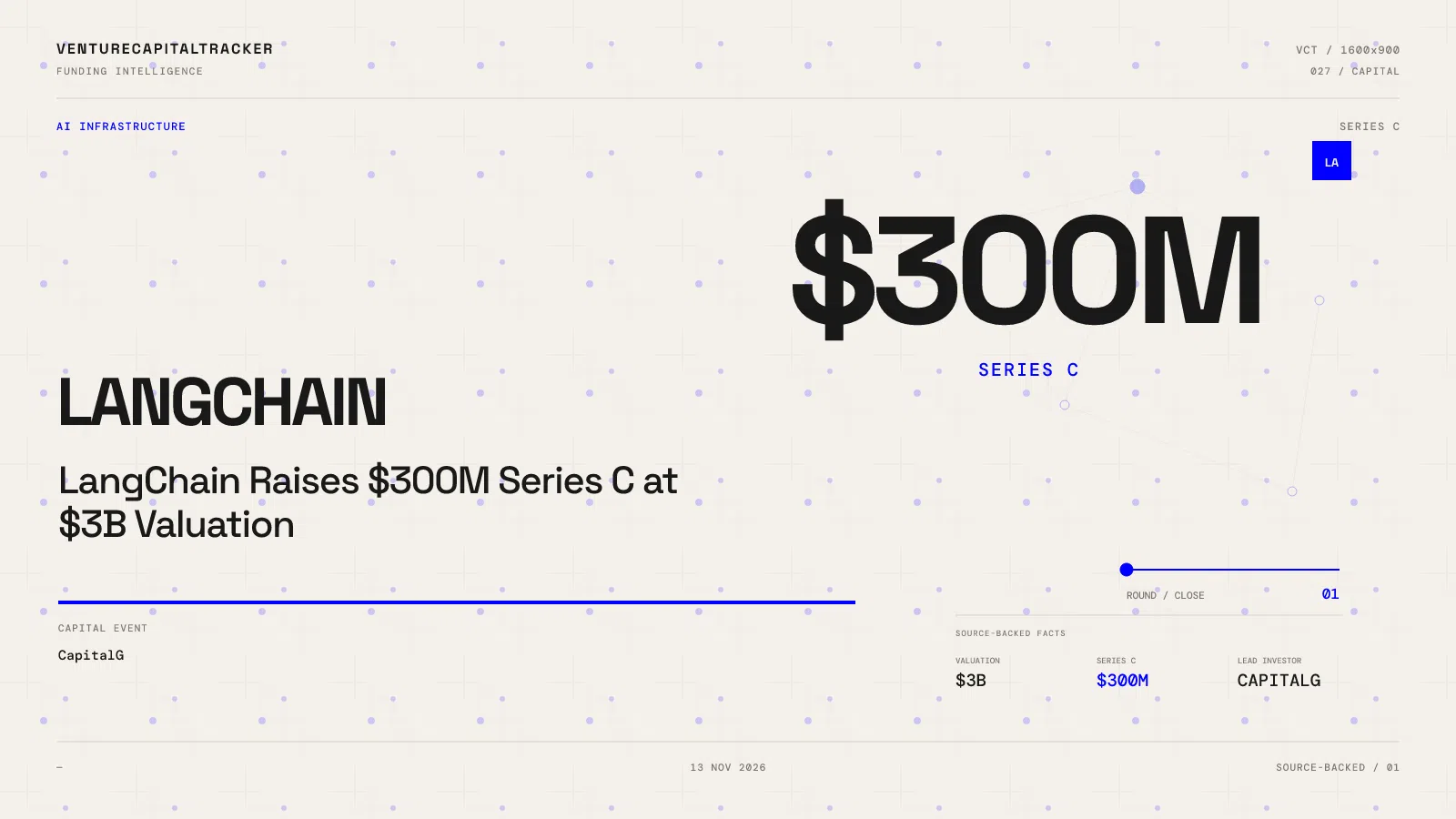
Led by CapitalG
Reported valuation $3B
This is the problem LangChain wants enterprises to pay to solve. The company does not sell a new frontier language model. It supplies open-source software for building agents and LangSmith, a commercial platform for watching what those agents do, testing changes before they reach customers, running them and controlling their access. The investment question is whether organizations will pay for that operational layer rather than assemble it themselves or accept one bundled with a model or cloud provider.
The November 13 financing, confirmed by LangChain founder Harrison Chase, gives the company resources to compete for that layer. The more meaningful test is not how many people download its code; it is whether real businesses adopt LangSmith deeply enough to become durable paying customers.
Four LangChain names, four different jobs
These products are often bundled together in funding reports, but they are not the same thing.
| Product | What it actually does | Business model |
|---|---|---|
| LangChain | Open-source building blocks for connecting language models, company data and tools. | Free framework; can lead developers toward paid services. |
| LangGraph | Open-source orchestration for multi-step, stateful agents, including retries and human approval. | Free framework; may be deployed with LangSmith. |
| Deep Agents | An agent harness with planning, files and subagents for longer tasks. | Open-source tooling; managed options are distinct. |
| LangSmith | Commercial tracing, evaluations, agent serving, governance and other managed services. | Seat subscriptions, metered usage and negotiated enterprise contracts. |
The distinction matters: a company can use LangChain or LangGraph without buying LangSmith. Conversely, LangSmith can trace applications built with other frameworks. That independence is useful to customers but also means open-source adoption cannot be counted as contracted revenue.
What does a customer actually do? Follow a support agent from prototype to production
Consider an illustrative retailer with 100,000 monthly support conversations. It wants an agent that checks order status, drafts replies and requests human authorization before issuing refunds. These steps reflect LangSmith's documented capabilities, not a test VCT performed or a claim about an actual customer.
- Build the agent and restrict its tools. Engineers connect a language model to a read-only order database and a returns API. A refund action gets an explicit permission and approval step. The model generates decisions; the company still defines what actions are allowed.
- Record the full trail. LangSmith traces the customer question, retrieved documents, model calls, tool arguments, timings and errors. An engineer can locate the step where the agent chose a nonexistent order rather than stare at one final chatbot answer. Sensitive data in those traces needs deliberate protection.
- Turn failures into tests. The team collects examples such as wrong-order matches, policy exceptions and attempted unauthorized refunds, then runs the agent against them before releasing a new prompt or model. Human reviewers and automated evaluators can score different failure types; a passing test set does not guarantee safety on every future request.
- Deploy with the right operating model. Engineers can manage the agent runtime themselves or use LangSmith Agent Server and related services. Enterprises with residency requirements may consider Bring Your Own Cloud: LangChain says AWS is generally available, while Azure and Google Cloud remained in beta in its November 3 announcement. The customer's cloud hosts the sensitive data plane; LangChain still manages a control plane.
- Watch production and improve. Teams monitor unexpected tool calls, accuracy, latency and cost; review bad runs; and add them to regression tests. LangSmith's Engine and gateway products can help find failures and enforce controls, but the customer remains responsible for policies, credentials and the consequences of an action.
This is why agent observability is more than ordinary website analytics. A page view can be counted; an agent might make five interconnected decisions, each with a different error mode and cost.
What does LangSmith cost? The $39 price is only the start
LangChain's public pricing page, checked November 13, lists a Developer tier at $0 per seat per month, with one seat and 5,000 included base traces. Plus starts at $39 per seat per month, with 10,000 included base traces, followed by usage charges. Enterprise pricing is negotiated and offers additional security and hosting choices.
For a small team with five Plus seats, the subscription floor is $195 per month (5 × $39). That is an illustrative seat-only calculation, not a quote for running the team's agents. A busy system may incur trace overages, extended retention, evaluator calls, agent-server compute and database charges, sandbox execution and model-provider tokens. LangChain measures several services in LangChain Standard Units (LSUs), at $1 per LSU, with separate metering schedules.
Why can this become important? Imagine the illustrative retailer records one top-level trace for each of 100,000 monthly support sessions. Its workload is already far beyond Plus's stated 10,000 included base traces—before accounting for its trace structure, retention requirements or any extra evaluations. The final bill cannot be responsibly calculated from conversation count alone: trace types, billing eligibility, deployment settings and model usage matter.
Two conclusions follow. For buyers, benchmark the entire bill at a realistic production workload, not merely the seat price. For investors, customers may generate recurring platform usage as agents become busier, but higher workloads can also bring storage, evaluation and support costs. LangChain has not publicly disclosed the revenue, margin or retention figures necessary to quantify the resulting economics.
What has actually been demonstrated?
LangChain reports more than 7,000 organizations using LangSmith and names Harvey, Rippling, NVIDIA, Toyota and Salesforce among customers or users in the Series C announcement. This is meaningful evidence of commercial interest, but 7,000 organizations is not a verified count of paying enterprise contracts, annual recurring revenue or net dollar retention.
One especially revealing example is Workday's November 10 case study. Workday built its own internal agent platform, wrapping LangChain in a company-specific SDK and using LangGraph and LangSmith with existing identity, retrieval and gateway systems. Its engineers said a prototype that once required four to five months could reach a staging environment in under one day on the new platform.
That is a substantial customer-reported improvement in time to prototype, not proof that every agent reaches fully approved production in one day. It also reflects Workday's own engineering effort and infrastructure, rather than a controlled experiment isolating the effect of LangSmith. The platform team started with four people and later grew to about 30—evidence of commitment, not a calculated reduction in staffing costs.
LangChain also highlights Clay, which it says monitors hundreds of millions of agent runs per month. That demonstrates an intensive operational use case, but neither the number of runs nor the volume of free framework downloads reveals Clay's contract value or LangChain's profitability. LangChain's company overview reports over one billion cumulative open-source downloads and more than one billion LangSmith events ingested daily; these are issuer-reported activity figures, not unique paying users or audited sales.
Who funded the company—and how much has actually been raised?
The company announced its $300 million Series C on November 13, 2026 at a stated $3 billion valuation. The Wall Street Journal reported the financing on November 12, a day before the issuer's own announcement. The exact legal closing date was not separately provided. CapitalG, Alphabet's independent growth-investing arm, led; new investors GIC and DFJ Growth participated alongside existing backers IVP and Sapphire Ventures. The issuer also named Salesforce Ventures, Insight Venture Partners, QuantumLight and MongoDB Ventures among new backers, with Sequoia, Amplify and Benchmark continuing their support.
There is an important lead-investor distinction in the history. LangChain's October 20, 2025 Series B statement says IVP led the $125 million round, at a stated $1.25 billion valuation; CapitalG joined that deal. CapitalG became lead for the new Series C, rather than having led both rounds.
| Announcement | New capital disclosed | Stated valuation | Lead |
|---|---|---|---|
| April 4, 2023 — seed | $10M | Not disclosed | Benchmark |
| February 15, 2024 — Series A | $25M | Not disclosed | Sequoia Capital |
| October 20, 2025 — Series B | $125M | $1.25B | IVP |
| November 13, 2026 — Series C | $300M | $3B | CapitalG |
The first two rows come from LangChain's own April 2023 seed announcement and February 2024 Series A and LangSmith launch statement. The later two rounds have their own primary company releases. The four announced financings sum to $460 million ($10M + $25M + $125M + $300M), matching the company's cumulative figure. $300 million alone is new Series C capital; $460 million is not money received this November. The stated valuation rose 2.4 times from the 2025 announcement to the 2026 announcement, but those valuations are issuer-stated, not transaction prices for every share. VCT's LangChain profile holds its company and canonical investment-event records.
A further caution matters for anyone modeling dilution: the public Series C statement does not identify the $3 billion figure as pre-money or post-money. Subtracting $300 million and declaring a $2.7 billion pre-money valuation—as some funding databases do—would require an assumption about the round's terms. Nor does a headline valuation reveal how much the founders own or what investors' preferences are.
Why CapitalG is backing this particular part of the AI market
The central wager is that businesses will use many models and many agents, while still needing one place to inspect, test and govern their behavior. As model capabilities shift, a retailer could change its underlying model but keep its internal approval rules, evaluation data and operational visibility.
That is a more defensible aspiration than simply being the most popular prompt library. The free frameworks can help LangChain reach developers cheaply; production agents can create repeat needs for tracing and test automation; enterprise governance can draw buyers beyond individual engineers. But that is VCT's business-model interpretation, not proof that open-source developers reliably convert to high-value contracts.
CapitalG initially invested in LangChain's 2025 Series B, as its portfolio record confirms. This year's lead role signals a larger commitment to the agent-infrastructure thesis. It does not establish LangChain's current revenue multiple, because the company has not disclosed the denominator.
What could companies use instead?
A buyer should compare the required job, not just feature checkboxes.
- Langfuse offers open-source, self-hostable tracing, evaluations, prompts and experiments, with managed-cloud options. It is a serious alternative for teams that want telemetry and testing under their own operational control. It does not provide the same integrated managed agent-hosting proposition as LangSmith. Importantly, calling Langfuse "tracing only" would be inaccurate.
- Arize Phoenix focuses on open-source AI tracing and evaluation. It deserves consideration if inspection and model quality, rather than a full agent runtime, are the main requirement.
- Braintrust competes in developer evaluation, experiments and observability. Teams should compare the evaluator workflow, production integrations and their own volume-based costs.
- Microsoft's Azure AI platform may appeal to organizations already standardizing on Azure identity, security, model services and agent infrastructure. That integration can reduce procurement complexity while increasing cloud-platform dependence.
- OpenAI's agent-building tools offer another route when a company is comfortable closely integrating with one model-provider ecosystem. They are not an identical drop-in replacement for the full LangSmith stack.
A practical procurement test is to replay the same 100 real or anonymized agent failures through two candidate systems: How long does setup take? Can reviewers identify the wrong tool call? Can the team export traces and evals? What is the 100,000-session monthly cost? Can it enforce tool permissions and residency? Those answers matter more than screenshots of dashboards.
The risks behind the $3 billion price tag
Open source does not remove commercial lock-in. A developer may be free to switch models while the organization becomes dependent on LangSmith's trace schemas, dashboards, evaluation datasets, runtimes, access policies and integration workflows. The switching cost moves up the stack.
Data sovereignty depends on the deployment. In LangSmith's November 3 BYOC architecture explanation, sensitive traces and deployments live in the customer's cloud data plane, while LangChain retains a managed control plane containing account and organizational metadata. Azure and Google Cloud were still beta at that date. Security teams should check their actual configuration and contracts rather than assuming "bring your own cloud" means absolutely no vendor control.
Agents remain unpredictable. Tracing can reveal a failure; evaluation can reduce repeat failures; neither proves an agent cannot be manipulated into misusing a tool. Human approval, access restrictions, redaction and testing remain necessary.
The incumbents own distribution too. Microsoft, Amazon, Google, OpenAI and other model or cloud providers can bundle observability and agent deployment into existing contracts. Open-source competitors can undercut parts of LangSmith's monitoring stack. A cross-model platform is valuable only if customers prefer its independent experience enough to pay separately.
Finally, the operating numbers that would test the valuation are absent: audited revenue, annual recurring revenue, paid-customer conversion, retention, gross margin after infrastructure costs and what share of the business comes from observability versus hosting and other products. A growing number of events ingested is a product-usage signal—not financial proof.
What to watch next
LangChain says it plans to reveal more LangSmith capabilities on November 20, 2026. Those future announcements should not be counted as features available on the Series C date. The more consequential milestones will be verifiable growth in paid enterprise adoption, public evidence of better agent outcomes, sustainable unit economics and multi-cloud deployment beyond today's beta boundaries.
For readers tracking the broader investment race, this financing illustrates a shift from paying only for models and compute toward paying for the operating systems around agents. Whether LangChain can capture that value is still an open commercial question. Its strongest argument is that enterprises need a reliable way to run agents regardless of which model wins; its biggest challenge is proving they will buy that independence at scale.
Editorial note: AI tools assisted with research, structure, or drafting. Venture Capital Tracker retains human editorial responsibility for factual accuracy, relevance, and source quality before publication.