· Venture Capital · 30 sources · Updated · Verified
Beyond Next-Token AI: NCM, Diffusion Models and the Startup Funding Race
Which startups can make AI generation faster without losing accuracy? An evidence-based look at NCM, Mercury 3, DiffuSpace Clover, Zyphra, funding rounds and commercial costs.

By Venture Capital Tracker Research
A model that writes an answer one token at a time has a built-in speed limit: each new piece of text depends on the previous one. In October 2026, Stanford researchers showed another route. Their **Next-Concept Modeling (NCM)** system writes a hierarchy of increasingly detailed representations, predicting many positions in parallel at each level. In selected experiments, that was 10–31 times faster than diffusion language-model baselines.
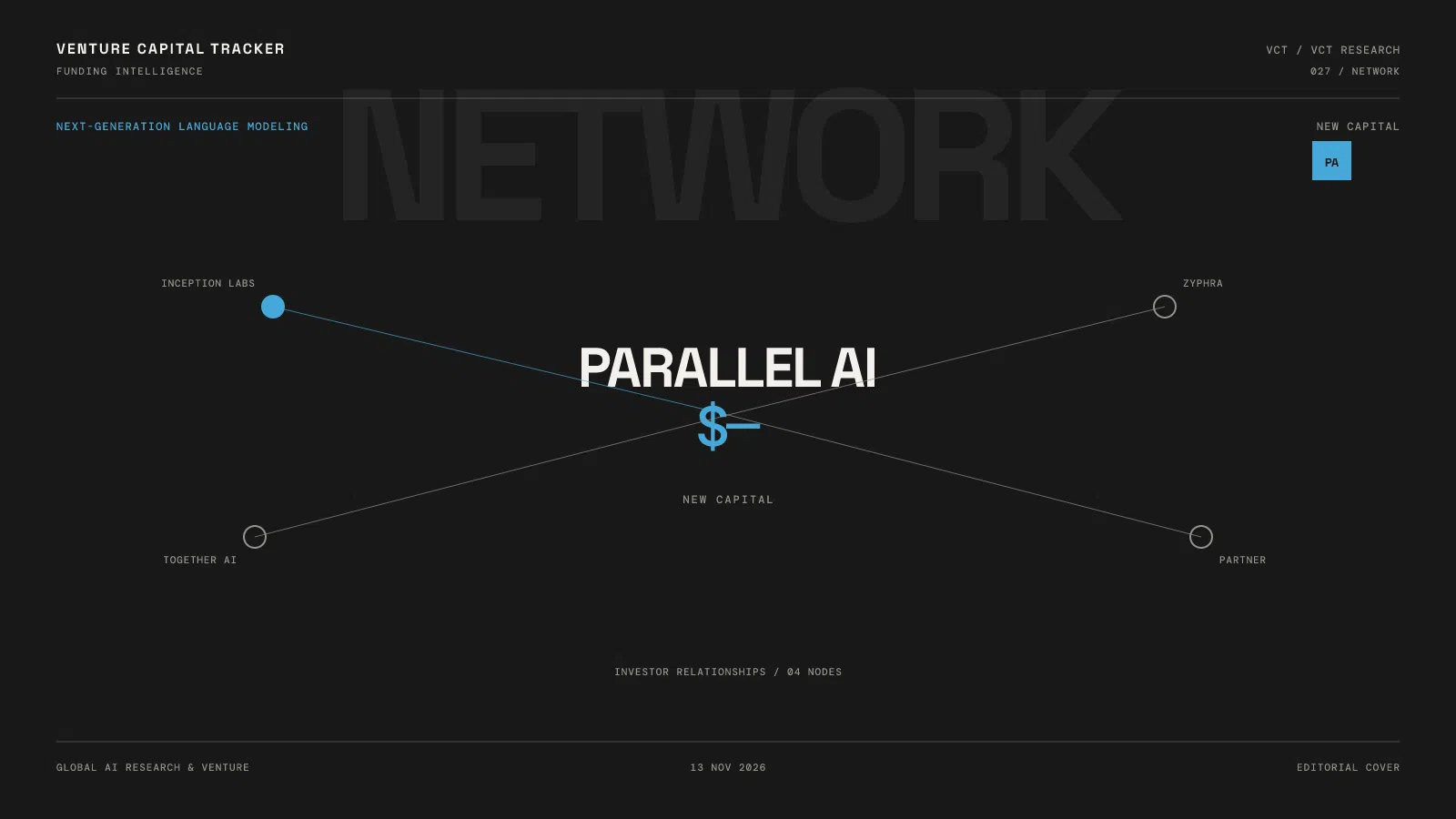
The announcement lands in a market that is already attracting venture money. Inception Labs sells a commercial diffusion model; China's DiffuSpace has raised capital and released an open model; Zyphra is experimenting with block-diffusion decoding. But there is a critical distinction between research performance, usable products, and investable companies.
The opportunity is not automatically a 31-fold reduction in the cost of AI. It is the possibility that some forms of text generation, especially repeated agent steps and other latency-sensitive work, can be done with fewer expensive sequential operations without sacrificing the answer that customers actually need.
Why AI companies want to escape token-by-token generation
Most widely deployed chat models are autoregressive: they predict the next token based on the tokens already generated. Hardware can process prompt context in parallel, and inference servers can batch requests, but generating a long answer still involves many sequential decoding steps.
Diffusion language models attack that bottleneck differently. They begin with masked or incomplete text and repeatedly refine multiple positions. This makes generation parallel within a block or sequence, but several refinement passes may be needed. The total bill depends on the work performed by every pass, not simply the number of output tokens.
NCM takes a third path. It first learns a multiscale, discrete representation of text and then predicts one representation level at a time, filling positions inside that level in parallel. Early levels are shorter and encode broad structure; later levels add detail. A decoder turns the completed hierarchy back into ordinary words. This is not simply asking an existing LLM to write an outline before producing an answer: the hierarchy is part of the model's learned representation.
| Approach | How text is produced | Main trade-off |
|---|---|---|
| Next-token / autoregressive | One new token follows previous output | Mature tooling and strong quality, with sequential decoding |
| Diffusion language model | Multiple token positions refined over repeated passes | Parallel work, but potentially expensive repeated computation |
| Block diffusion | Refines chunks while preserving earlier context | Better practical caching; still constrained by sampling and scheduling |
| Next-Concept Modeling | Predicts coarse-to-fine code levels, parallel within each level | Far fewer steps in early tests; not yet established at frontier scale |
The names are not interchangeable. Meta's Large Concept Model, for example, predicts sentence-level representations autoregressively in a semantic embedding space. It explores a related abstraction idea but is not Stanford's NCM and is not evidence that Meta invested in it.
What Stanford's NCM results actually show
The October 9 research paper and October 12 Stanford Hazy Research explanation report the following wall-clock comparisons on a single NVIDIA H100 SXM 80GB, against strong diffusion-language-model baselines:
| Benchmark | Reported NCM result | What was held comparable |
|---|---|---|
| LM1B language modeling | 21× faster | Similar or better generative perplexity |
| OpenWebText language modeling | 10× faster | Comparable generative perplexity |
| XSum extreme summarization | 31× faster | Comparable ROUGE-L |
| Training on LM1B / OpenWebText | About 4.9× / 4× fewer tokens | Compared with selected diffusion baselines, including tokenizer training |
The study also reports promising translation and Sudoku results and preliminary scaling experiments with 97M, 317M and 725M-parameter models. Code and research checkpoints have been released.
That evidence is substantial for a new method, but it has narrow boundaries. These are not 10–31× speedups over GPT-6, Claude or every conventional LLM. The paper does not establish equivalent frontier coding or agent performance at 7B–70B scale, production requests per second, net GPU-hours per successful task, or deployment on a 32GB consumer card at frontier-model quality. The training-token result is not the same as a measured 4–5× reduction in total training dollars.
The actual scientific comparison is also more nuanced than 'concepts beat diffusion.' Another 2026 ICLR paper, Hierarchy-dLLM, reports faster hierarchical decoding of diffusion models without retraining, up to 17× versus its vanilla diffusion baseline. It uses a different mechanism from NCM's learned multiscale tokenizer. A field can progress through both entirely new architectures and better inference schedulers.
The companies most directly exposed to parallel text generation
The clearest way to map the space is by technical relevance and evidence of commercial deployment, not by company valuation.
Inception Labs: the strongest commercial signal
Inception Labs, led by diffusion researcher Stefano Ermon, announced a $50 million seed round in November 2025, led by Menlo Ventures. Mayfield, Innovation Endeavors, Microsoft's M12, Snowflake Ventures, Databricks' venture arm and NVIDIA's NVentures participated.
Its Mercury line is a diffusion language model, not an NCM implementation. Inception released Mercury 3 in October 2026, claiming 1,068 tokens per second on NVIDIA GPUs, a one-million-token context window, and list API prices of $0.20 per million input and $0.70 per million output tokens (with a separate 50% launch promotion). The closed-weight model is sold through APIs, so buyers can evaluate it on their own workloads.
This is a commercial turning point: an actual product with a published price and developer access. It is not proof that diffusion wins on every task. Inception's headline throughput comes from its own tests, whose hardware and serving conditions differ from those used in academic NCM comparisons.
DiffuSpace: funding followed by an open 35B model
DiffuSpace was founded in Shenzhen in May 2026 by researchers associated with the University of Hong Kong's Dream diffusion-language-model work. Matrix Partners China, Shunwei Capital and Legend Capital were named as joint leads in two recently completed financings, with CAS Star, Huawei Hubble Investment and Horizon Robotics joining. Chinese reporting put the combined proceeds near €67 million (approximate conversion at the ECB's 9 October 2026 reference rate), but said the exact amounts were not company-disclosed. Dealroom shows a smaller individual entry; neither source establishes the detailed allocation between the two rounds.
The important development came October 30, 2026. DiffuSpace published Clover-35B-A3B-Preview, an open-weight Apache-licensed block-diffusion MoE model with 35B total and approximately 3B active parameters. The team released weights and code, with support for SGLang and llama.cpp. Its own tests claim 680 tokens per second on a single NVIDIA GB300 and 73.6 SWE-bench Verified. Those are useful testable claims, not independently verified cross-model performance guarantees.
Clover moves DiffuSpace from a startup with research credentials and financing to a company with a larger model that others can run, benchmark and criticize. That milestone matters more to investors than an unreproduced 'world's fastest' ranking.
Zyphra: a model can be converted rather than retrained from scratch
Zyphra explores efficient open models and an AMD-focused training and serving stack. In May 2026, its ZAYA1-8B-Diffusion-Preview demonstrated a conversion from an autoregressively trained MoE model into block diffusion.
It proposes 16-token blocks and reports a 4.6× acceptance/decoding acceleration with its standard lossless sampler and 7.7× with a faster mixed-logits sampler that introduces a quality trade-off. These are company-measured results; neither figure can be directly compared with NCM's wall-clock speedups or Mercury 3's API tokens per second.
Forbes, citing market data, reported $110 million in 2025 financing at about $1 billion valuation. In May 2026, Forbes reported Zyphra was raising a possible $500 million Series B at at least $5 billion. That is not a confirmed closed financing and does not belong in realized 2026 funding totals without additional evidence.
Zyphra is worth following because converting an existing model to a new decoding paradigm could be commercially cheaper than building a frontier model from scratch. Whether the added conversion training and inference engineering outweigh the savings remains a real question.
Together AI: direct research affiliation, not a dedicated NCM round
Together AI is the one venture-backed company with a clear author affiliation on the NCM paper: Simran Arora is credited with Together AI. Its research organization also includes Christopher Ré among its founders.
On July 1, 2026, Together AI raised $800 million in Series C funding at an $8.3 billion post-money valuation, led by Aramco Ventures, with NVIDIA, Vista Equity Partners, General Catalyst, Emergence Capital and other investors participating. That round finances a broad open-model training and inference infrastructure platform. It was not announced as an NCM-specific funding round, and no general-purpose NCM API is established by the academic publication.
For investors, the relevant connection is access to research talent and a potential route to commercialization. That is not the same thing as ownership of a proven NCM product.
The funding map: direct bets, adjacent research and infrastructure
The venture money here falls into three distinct groups. Combining them into one headline number would dramatically overstate capital allocated to NCM.
| Venture-backed company | Funding event | Investors / qualification |
|---|---|---|
| Inception Labs | $50M seed, Nov 2025 | Menlo Ventures led; direct commercial diffusion models |
| DiffuSpace | Two rounds, disclosed Oct 2026 | Matrix, Shunwei and Legend led; roughly €67M (converted estimate) is media-reported combined, not an exact company figure |
| Zyphra | $110M reported, 2025 | Market-reported model developer financing; proposed 2026 Series B not counted |
| Together AI | $800M Series C, Jul 2026 | Aramco Ventures led; entire AI cloud business, not NCM-specific |
Beyond those direct or closely related companies, other investors are financing different routes to efficient AI:
- Cartesia has raised a reported $191 million across its 2024–2025 financings. Its state-space and H-Net research is directly interesting for hierarchical modeling, but its commercial focus is real-time voice, and its work is not an NCM deployment.
- Liquid AI raised a $250 million AMD-led Series A in December 2024 to build efficient foundation models for enterprise and on-device use. That is a distinct architecture strategy.
- AI21 Labs builds Jamba hybrid state-space/Transformer models. Its $208 million Series C was the cumulative total after a 2023 extension; a widely reported $300 million 2025 Series D did not close, according to subsequent reporting.
- Sakana AI announced a $200M-equivalent Series B in November 2025 (the company's own USD equivalent) for nature-inspired model development and optimization. Its techniques are not diffusion or NCM.
- Pathway researches the biologically inspired BDH architecture alongside real-time data infrastructure. Its August 2026 disclosure describes $30 million cumulative seed funding, not a new $30 million round.
- NXAI develops xLSTM recurrent models; the founding ownership is reported, but a reliable priced cash-funding event was not verified. Subquadratic attacks attention scaling, while PrismML focuses on low-precision weights. Those solve different bottlenecks.
- Symbolica and Ndea pursue mathematical or program-synthesis reasoning alternatives; neither has disclosed an NCM product. The financing data for Ndea remains media-reported rather than company-confirmed.
These companies belong in the broader post-transformer and efficiency market map. They should not be summed as investment in the NCM method.
The big competitive threat comes from companies that do not need VC rounds
Three corporate research efforts help explain why the market cannot be judged only by startup funding totals.
Google DeepMind developed experimental Gemini Diffusion and released DiffusionGemma in June 2026, a 26B-parameter mixture-of-experts model activating roughly 3.8B parameters. Google reports up to 4× faster generation in selected tests and released model weights for experimentation. No new external venture round finances that particular lab project.
Meta's Large Concept Models operate at a higher semantic abstraction, including sentence representations. Their autoregressive sentence-level prediction makes them scientifically related to the conceptual abstraction story, but not equivalent to the hierarchical NCM decoder.
Ant Group, ByteDance and other corporate and university laboratories also have research programs in diffusion text generation. They are competitors for talent, open-source mindshare and eventual enterprise adoption; they are not automatically additional venture-backed startups.
The first useful independent commercial benchmark
Inception's Mercury 3 is one of the few models in this category that an independent organization has put through a comparable, production-style test.
On November 6, 2026, Plotly published its data-analytics benchmark. Its harness measured Mercury 3 at 35 of 43 tasks passed, versus 38 for GPT-6 Luna and 37 for Claude Haiku 5.5. Mercury's median task time was 9.3 seconds, faster than the others in that comparison, but its $0.41 list-price cost for the complete exam was higher than GPT-6 Luna's $0.13. The scores come from one model run on a specialized analytics task set, so one- or two-question gaps should not be overinterpreted.
That is the commercial trade-off in miniature: faster can be valuable even when it is not the cheapest or most accurate. A voice agent may favor response time. A finance agent asked to detect hidden patterns may prefer a slightly slower model that catches more issues. The right answer depends on workload, error cost and retrial rate.
Clover's open weights should make it easier for independent groups to repeat tests on standardized hardware. NCM's published checkpoints similarly permit verification of its research benchmarks. Neither route has yet yielded a universally accepted, frontier-scale cost-per-success benchmark across vendors.
Can 10–31× faster generation make AI 10–31× cheaper?
No direct inference follows. The Stanford results measure generation wall time on selected benchmarks, not an end-to-end cloud invoice. A diffusion API's token-per-second figure, a block model's acceptance rate, and an NCM research model's wall-clock benchmark answer different questions.
For a startup deploying an agent, a practical metric is:
Cost per successfully completed task = total model and orchestration spending, including failed attempts and retries, divided by the number of correct accepted results.
To compare two systems fairly, record:
- Quality at equal evaluation standards: exact task success, coding tests, constraint satisfaction, tool-use correctness and error severity.
- Latency distribution: time to first useful output, full-response median and p95, especially under real concurrency.
- True serving utilization: model initialization, KV-cache or recurrent-state memory, GPU occupancy, batching and preprocessing overhead.
- Inference cost per accepted result: API fees or GPU-hours, retries, validators and human escalation.
- Full training and adaptation cost: tokenizer and generator training, fine-tuning, conversions and reproducibility.
A model may generate more tokens each second but still spend too much compute on refinement passes. Another may require fewer steps but larger activations or a more demanding decoder. Conversely, better hardware use may make some tasks substantially cheaper. The evidence supports a promising change in the cost curve, not a single industry-wide discount rate.
Where parallel generation could make money first
The earliest attractive applications are those where small delays add up or long output can be checked automatically.
Interactive agents and coding. A browser or software agent might take dozens of model-and-tool steps. Reducing a repeated model response from several seconds to under a second can shorten the overall workflow, provided tool-call accuracy does not deteriorate. DiffuSpace is explicitly pursuing agentic coding with Clover; Inception offers model access for latency-sensitive developers.
Voice and real-time assistance. Conversation imposes tight turn-taking constraints, so speed can be noticeable even when responses are short. However, streaming speech-generation systems such as Cartesia and Gradium optimize different components of the experience.
Constrained outputs and repeated decisions. Structured editing, short-form summarization, software diffs and limited-choice classifications may reward parallel generation and verification more quickly than open-ended writing. That is a hypothesis for deployment tests, not proof that diffusion models are universally more coherent.
Enterprise-specific models. Providers such as Fireworks AI, Baseten, Inferact, RadixArk and Modal Labs can benefit from serving many kinds of model efficiently. They may capture part of the economic benefit regardless of which foundation-model architecture wins.
This infrastructure segment has attracted much larger financings: Baseten announced a $1.5 billion Series F in June 2026; Fireworks announced a $1.505 billion Series D in July. These are inference-platform financings, not a measure of investment into NCM or pure-play diffusion models. They also involve very different capital requirements and margin risks from research laboratories.
What could stop the new architectures from becoming mainstream?
Scale and quality. NCM's reported largest experimental model was 725M parameters. Competing with modern large commercial models on long, multi-step agent tasks is a different challenge. The decisive evidence would be comparable accuracy at substantially larger model sizes and total compute budgets.
The mature autoregressive ecosystem. Existing models benefit from years of improvements in attention kernels, quantization, continuous batching, speculation and caching. A new architecture must beat that moving target, not an unoptimized old baseline.
Hardware changes. Parallel generation can move work from memory-bandwidth constraints toward compute constraints, but that does not make hardware cost disappear. The economics shift with GPU memory, power, precision and throughput at each new accelerator generation.
Sampling and control. Diffusion scheduling is not a trivial implementation detail. Research surveys in 2026 highlight immature training-at-scale methods, caching, sampling strategies and production robustness. Even within Zyphra's preview, switching sampling strategy creates a speed-versus-quality choice.
Distribution and pricing. Even a technically superior open model may not capture most of the industry's profits. API distributors, cloud platforms, hardware vendors and application companies can pass through price savings or retain them, depending on competition and switching costs.
These risks explain why large funding rounds are not a verdict on which model will win.
The investor watchlist for 2027
There are three meaningful milestones to monitor.
First: independent performance at useful scales. Watch NCM replication beyond sub-billion-parameter models, Clover deployments on comparable GPUs, and Mercury's actual latency/accuracy under customer workloads. Comparisons must include failed tasks, not only raw output speed.
Second: production distribution. Watch for publicly documented paying deployments, sustained requests per second, support for tool calling, stable APIs, self-hosting economics and clear service-level commitments. An open checkpoint and a working developer platform signal different maturity levels.
Third: financing discipline. Check whether announced rounds are closed, whether valuations are pre- or post-money, and whether a raise includes secondary sales or infrastructure financing. In a market this new, investor exposure to efficient AI should never be labeled automatic ownership of the exact NCM method.
The investment thesis: if non-autoregressive generation delivers comparable quality with less compute per accepted task, a meaningful slice of the inference market could shift. Today the evidence is stronger for a growing set of commercially testable alternatives than for a single architecture having defeated next-token prediction.
Research methodology (November 13, 2026): VCT separates (1) peer-reviewed or preprint results, (2) developer-reported model benchmarks, (3) independent workload evaluations, (4) company-confirmed completed financing, and (5) financial-media estimates or proposed rounds. Currency translations are descriptive rather than additional financings. Funding attributed to infrastructure companies or adjacent model developers is not counted as NCM-specific capital.
- generative-ai
- ai-startups
- vc-explainers
- +1 more
Last updated:
Editorial note: AI tools assisted with research, structure, or drafting. Venture Capital Tracker retains human editorial responsibility for factual accuracy, relevance, and source quality before publication.