· Updated · Venture Capital Tracker Editorial · venture-capital
Homeward Raises $120M Series D and Adds $330M Debt for Agent-Led Home Finance
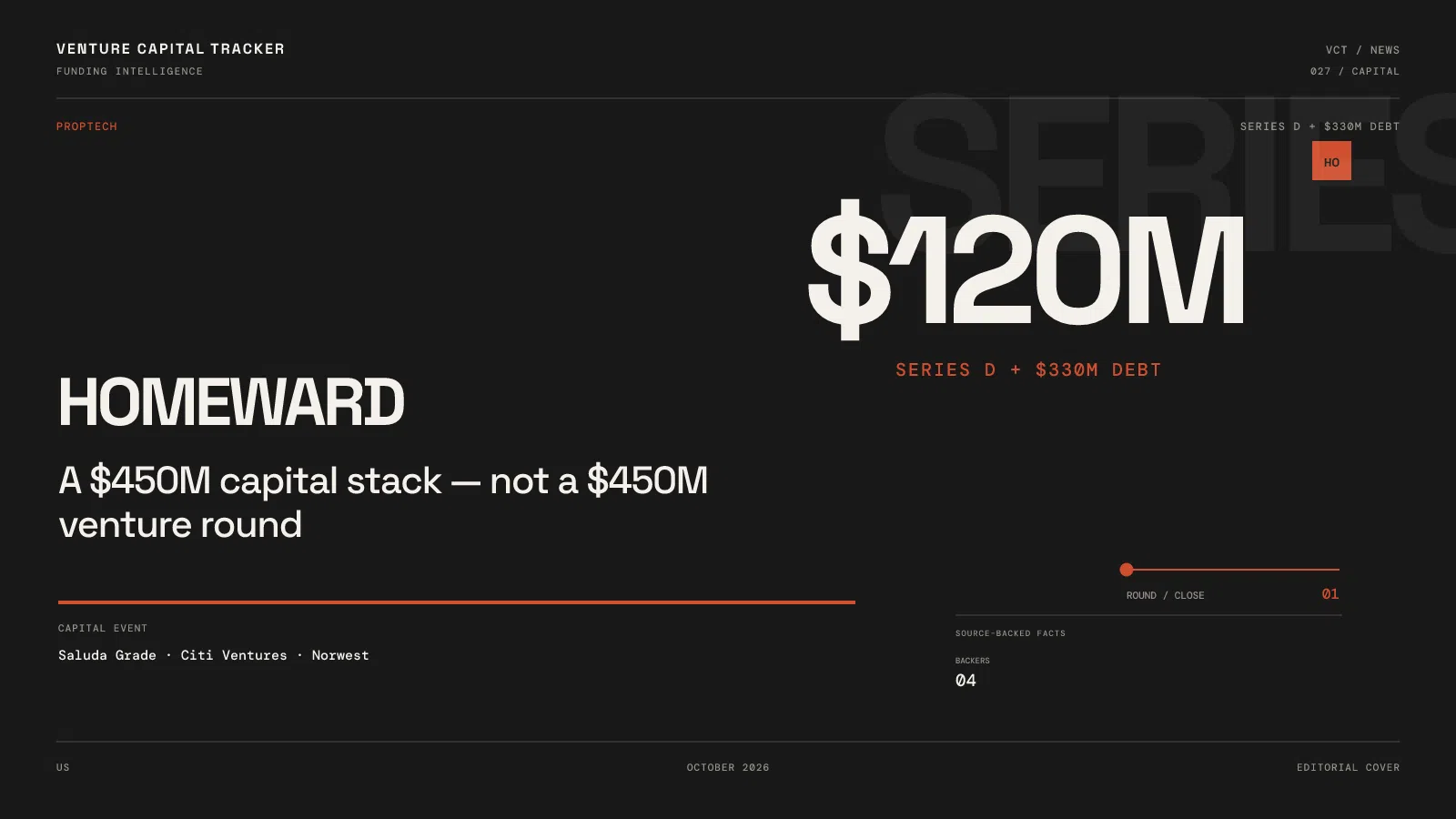
Homeward separated $120 million of new equity from $330 million of asset-backed debt, giving its agent-led home-finance platform capital for both company growth and transaction funding.
Homeward's latest financing is a useful example of why startup funding headlines need to separate corporate equity from asset-backed transaction capital.
On October 1, 2026, Homeward announced $120 million in Series D equity and $330 million in asset-backed debt facilities. The equity was led by Saluda Grade and joined by Continental General Insurance Company, Citi Ventures, Magnetar, Harmony Partners, Norwest, Adams Street Partners, LiveOak Ventures, Parker89, Era Ventures and Javelin Venture Partners. Homeward says the debt facilities will fund additional home transactions.
So the correct reading is $120M of new venture equity plus $330M of separate debt, not a $450M venture round.
Source: Homeward's October 2026 financing announcement.
Fast scan: what changed
| Item | October 2026 |
|---|---|
| New Series D equity | $120M |
| Asset-backed debt facilities | $330M |
| Combined announced capital | $450M |
| Equity share of announced capital | 26.7% |
| Debt share of announced capital | 73.3% |
| Debt / equity ratio | 2.75× |
| Lead equity investor | Saluda Grade |
| Company-reported agent network | 25,000+ agents |
| Company-reported transaction volume | $4B+ residential transactions |
The 26.7% / 73.3% split is calculated from Homeward's disclosed $120M equity and $330M debt figures. It is not a company-reported KPI.
What Homeward actually does
Homeward is an Austin-based real-estate financing company founded in 2018 by agent Tim Heyl. It works through real-estate professionals rather than positioning itself primarily as a consumer marketplace.
The company currently markets three related products:
- Buy Before You Sell gives homeowners short-term bridge financing and a backup offer so they can purchase their next home before the current one sells.
- Cash Offer gives sellers a cash-backed outcome while preserving potential upside when the property is later resold.
- Buy with Cash lets buyers submit a stronger cash-backed offer and refinance into a traditional mortgage after closing.
Homeward also combines mortgage and title services with the financing layer. That matters because the model is not just software. It depends on capital availability, underwriting, collateral management, transaction timing and the ability to recycle funding efficiently.
Why the $330M debt matters more than it looks
A power-buyer platform has two different capital needs.
Equity capital funds the company: product development, hiring, distribution, risk systems and expansion.
Asset-backed debt funds the assets or bridge loans moving through the platform. It is closer to working capital for transaction volume than to a venture investment in Homeward itself.
That distinction changes how investors should read the financing. The equity investors are underwriting Homeward's long-term enterprise value. The debt providers are much more exposed to collateral quality, time-to-sale, advance rates, loss protection and capital turnover.
The fact that Saluda Grade—an investor focused on asset-backed credit—led the Series D is therefore strategically interesting. Homeward's growth story increasingly depends on whether it can originate repeatable, financeable housing assets at scale, not just whether agents like the software.
The capital stack is becoming more debt-heavy
Homeward has used mixed equity-and-debt packages before.
In 2021, the company announced $371M of growth capital, split into $136M of equity and $235M of debt. That package was roughly 36.7% equity and 63.3% debt, for a debt-to-equity ratio of about 1.73×.
The October 2026 package is 26.7% equity and 73.3% debt, with a 2.75× debt-to-equity ratio.
| Financing package | Equity | Debt | Equity share | Debt share | Debt / equity |
|---|---|---|---|---|---|
| 2021 growth capital | $136M | $235M | 36.7% | 63.3% | 1.73× |
| 2026 Series D + facilities | $120M | $330M | 26.7% | 73.3% | 2.75× |
Source for the earlier package: Homeward's 2021 financing announcement.
This does not automatically mean Homeward is taking more corporate leverage. The 2026 debt is described as asset-backed facilities used to fund home transactions. But it does show that transaction financing is becoming a larger part of the capital required to scale the platform.
That is the more useful signal than the $450M combined headline.
Why the agent-led model matters
Homeward says it has partnered with more than 25,000 real-estate agents and facilitated more than $4B in residential transactions. Those figures are company-reported.
The distribution model is important because Homeward is trying to help agents close transactions rather than replace them. In theory, that can reduce channel conflict and customer-acquisition cost: one productive agent can send multiple transactions over time.
The trade-off is dependency. Agents have to understand the financing products, explain them accurately, and bring enough qualified volume for Homeward to keep its capital deployed.
That makes repeat usage per agent, approval rates, time-to-close and capital turnover more important operating metrics than a simple registered-user count.
Homeward vs. other power buyers
Homeward competes most directly with platforms such as Knock, Orchard and Flyhomes, which offer variations of buy-before-you-sell, bridge financing or cash-backed purchasing.
Opendoor is adjacent rather than identical. Its iBuyer model is more willing to become the direct home buyer, while Homeward emphasizes keeping the consumer's existing agent at the center of the transaction.
That makes Homeward's competitive thesis relatively clear: become the financing and transaction-infrastructure layer for agents instead of becoming the brokerage.
The advantage is alignment with the existing channel. The risk is that Homeward still carries financing and housing-market exposure without fully owning the customer relationship.
What the financing does—and does not—tell us
The announcement gives a strong picture of available capital but leaves several questions unanswered.
It does not disclose:
- Homeward's Series D valuation.
- Revenue or contribution margin.
- Credit losses or historical collateral performance.
- Average duration of bridge loans or funded transactions.
- Interest rate, maturity, covenants or advance rates on the $330M facility.
- The split of revenue among financing, mortgage, title and other transaction fees.
- How much of the announced debt is immediately drawable versus committed over time.
Those omissions matter because a financing platform can grow transaction volume while still producing weak economics if holding periods extend or losses rise.
What to watch next
For investors tracking Homeward, the most useful next disclosures would be:
- Capital turnover: how quickly the $330M facility can be recycled through completed transactions.
- Loss performance: defaults, resale losses and claims against backup offers.
- Agent productivity: transactions per active referring agent, not just total agents signed.
- Mortgage and title attach rates: whether Homeward captures multiple revenue pools per transaction.
- Geographic consistency: whether underwriting and conversion remain attractive as the company expands across the 48 contiguous states.
- Next valuation signal: a priced secondary, new equity round or acquisition could reveal how investors value the operating company separately from its asset-financing capacity.
Bottom line
Homeward's October 2026 financing is best understood as a $120M Series D supported by $330M of asset-backed transaction debt.
The equity funds Homeward the company. The debt funds more of the housing transactions moving through its platform.
Compared with Homeward's 2021 mixed financing, the 2026 package is materially more debt-heavy: debt represents about 73% of announced capital versus 63% in 2021. That makes the quality of Homeward's underwriting and capital recycling increasingly central to the investment case.
The headline is $450M. The more important story is how efficiently Homeward can turn $330M of transaction capacity into repeatable, low-loss volume through its agent network.
- series-d
- debt-financing
- proptech
- +3 more
Follow Venture Capital Tracker in Google
Add VCT as a preferred source to make our venture-capital coverage easier to find in Google Search.
Last updated:
Editorial note: AI tools assisted with research, structure, or drafting. Venture Capital Tracker retains human editorial responsibility for factual accuracy, relevance, and source quality before publication.