· Venture Capital · 4 sources · Verified
Homa Raises $5M Seed for AI Homebuying and Integrated Mortgages
Homa’s $5M seed round backs California expansion and mortgage integration. The investment case hinges on closing conversion and brokerage economics.

By Venture Capital Tracker
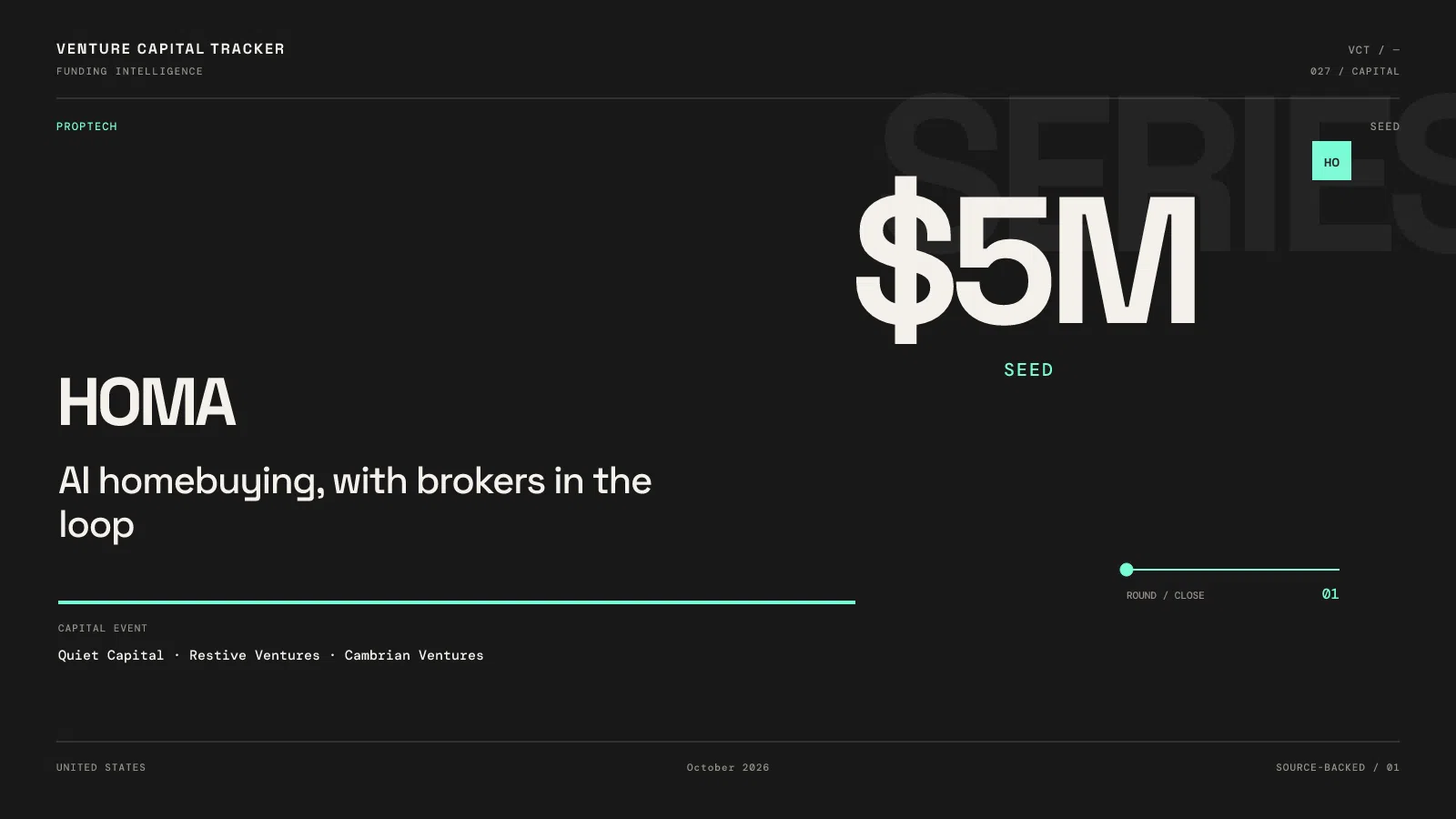
Homa announced a $5M seed round on October 15, 2026, led by Quiet Capital, with Restive Ventures and Cambrian Ventures participating. The company announcement ties the financing to California expansion and in-platform mortgage lending.
The interesting venture question is not whether AI can answer property questions. It is whether a broker-assisted platform can turn that information into completed purchases at attractive service costs.
Homa funding at a glance
| Item | Disclosed detail |
|---|---|
| Financing | $5M seed round |
| Announcement | October 15, 2026 |
| Lead investor | Quiet Capital |
| Other investors | Restive Ventures; Cambrian Ventures |
| Valuation | Not disclosed |
| Use of funds | California expansion and integrated mortgage offering |
This is company-disclosed startup financing, not a reported fundraising target. The announcement does not specify the exact legal closing date, individual investor allocations or financing instrument. The $5M is not a disclosed mortgage warehouse facility.
AI supports the transaction; brokers still matter
Homa presents its service as a combination of property research, tours, licensed brokers and transaction coordination. Software supports the process, but humans remain involved in offers and negotiations. That makes the business materially different from a self-service subscription tool.
The operating leverage therefore needs to show up in transactions. If better preparation reduces repetitive work, a broker may be able to handle more buyers. But tours, offer revisions and unsuccessful searches still consume resources. An engaged user is not yet a revenue-producing closing.
The buyer credit is conditional
The company describes a model in which it retains 1% of the purchase price from an available buyer-broker commission and credits the remainder to the buyer, potentially up to 2%. Its buyer-rebate guide describes a settlement credit subject to lender approval.
The distinction matters: “up to 2%” is not a guaranteed payment on every home. The available commission, transaction terms and lender approval affect the outcome. Readers should not treat the headline credit as cash available without conditions.
What would make the model defensible?
Our analytical view is that Homa needs to demonstrate a repeatable service engine, not simply a compelling AI interface. Three measures would be particularly useful:
- Completed-purchase conversion: How many qualified buyers reach closing, and how long does that take?
- Contribution per closing: What remains after credits, acquisition costs and the human work involved in both successful and unsuccessful transactions?
- Mortgage coordination: Does integrating financing reduce failed transactions or improve conversion enough to justify the added complexity?
Mortgage shopping can make a brokerage workflow more useful without establishing that the brokerage itself holds or funds the loans. The funding announcement does not disclose a loan-funding commitment, mortgage attach rate or transaction-level margins.
The seed round gives Homa capital to test that proposition across a wider footprint. The next convincing evidence would be cohort-level conversion and retained economics after service costs—not a larger count of searches or AI conversations.
Source note: Financing terms come from the October 15 company announcement; product and credit descriptions come from Homa’s website and buyer guide. Operating-economics discussion is VCT analysis, not a company forecast.
Follow Venture Capital Tracker in Google
Add VCT as a preferred source to make our venture-capital coverage easier to find in Google Search.
Editorial note: AI tools assisted with research, structure, or drafting. Venture Capital Tracker retains human editorial responsibility for factual accuracy, relevance, and source quality before publication.