· 9 sources · Updated · Verified
Garage Raises $41M Series B at Reported $225M Valuation: Fees, Fire Trucks and Marketplace Economics
Nov. 10, 2026: Garage raises $41M led by Invus. Fortune reports $225M value. We reconcile the funding, explain 10% seller fees and show why $100M platform sales are not revenue.

Editorial team
Funding event
Garage
Led by Invus Opportunities
Reported valuation $225M
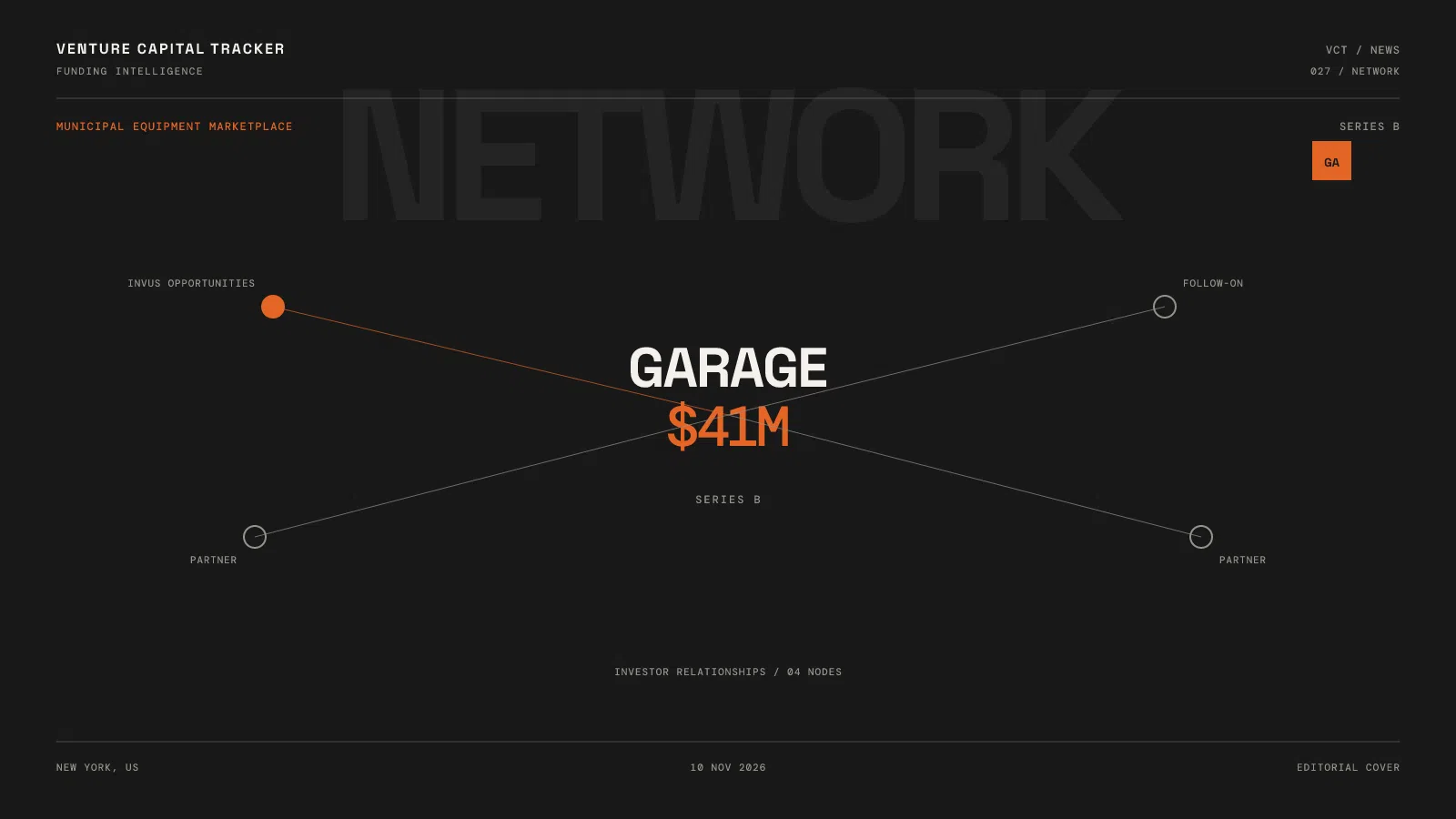
Garage raised $41 million in a Series B announced November 10, 2026, led by Invus Opportunities. The New York startup sells neither trucks nor software subscriptions to fire departments: it operates a nationwide online marketplace where local governments and essential-service operators buy and sell used fire engines, ambulances, refuse trucks and other specialist equipment. Fortune separately reported a $225 million valuation from the company; whether that valuation is pre- or post-money was not specified. The issuer describes roughly $60 million of cumulative financing and more than $100 million in annualized equipment sales through the platform. The last figure is transaction volume, not Garage's revenue.
| At a glance | Verified position |
|---|---|
| Financing announced | $41M Series B, November 10, 2026 |
| Lead / other investors | Invus Opportunities / Infinity Ventures, Initialized Capital, Y Combinator, Benchstrength, FJ Labs |
| Valuation | $225M, reported by Fortune; pre- versus post-money not established |
| Previously disclosed rounds | $4.5M seed; $13.5M Series A announced August 20, 2025 |
| Funding reconciliation | $4.5M + $13.5M + $41M = $59M identified; issuer rounds lifetime total to $60M |
| Platform activity | Over $100M annualized equipment sales, company claim; not annual revenue |
| Seller pricing | Standard contractual 10% platform/success fee, unless varied in writing; auction buyer premium separately reported by Fortune |
| Core buyers | Fire departments, public agencies and fleet operators; wider public-works/sanitation expansion planned |
The distinctive bet is not simply that a listing website can sell a fire engine. Garage is trying to turn an opaque, cross-state procurement process—vehicle condition, price, transport, financing, warranty and public-sector purchasing requirements—into a transaction a budget-constrained municipality can actually complete.
What Garage does: a real purchase and resale workflow
A department has one fire engine it no longer needs. Historically it might call neighbouring departments, ask a broker, or send the apparatus to an auction serving a relatively local buyer pool. Garage offers a national alternative. The company says more than 90% of its transactions cross state lines, with vehicles travelling about 1,400 miles on average. Both figures are management-supplied, not independently audited distribution data.
A representative illustrative transaction looks like this:
- Seller lists a surplus vehicle. A municipal fleet manager creates a self-serve listing, choosing fixed price or auction, or asks Garage to manage the listing. Garage says either route has no upfront listing charge. That is different from having no fee on a completed sale.
- Appraisal and buyer discovery. Garage's data-led appraisal helps set an asking price. The listing is marketed to buyers beyond the seller's immediate region; the eventual sale price, however, depends on condition, demand and the procurement constraints of the buyer.
- The buyer checks what they are buying. A rural fire chief considers inspection records, photos and videos and can arrange an optional third-party inspection. Garage advertises inspections that generally take about five to seven business days; neither inspection nor AI appraisal guarantees that a decades-old apparatus is defect-free.
- Total landed cost is calculated. The buyer requests a delivery quote, compares financing options and checks whether an optional warranty covers the vehicle and intended use. Garage facilitates but third parties supply transport, financing and warranty services, with their own conditions.
- Payment and handover. The parties close the transaction through the platform. The equipment remains seller-owned until sold; Garage is not a fire-truck manufacturer or an inventory-owning national dealership. Municipal buyers should check bid thresholds, cooperative purchasing eligibility, insurance and title transfer before committing.
This combination changes who can see the same truck and how much coordination is required. It does not eliminate mechanical inspection, legal requirements or post-purchase maintenance.
What the transaction actually costs: seller fee, auction premium and net proceeds
Garage's June 29, 2025 Terms of Service, section 8(a) state a 10% fee based on the displayed listing price for transactions via its service, unless the parties agree otherwise in writing. Its public selling page says there is no upfront listing cost. Fortune's November 10 reporting separately describes a 10% seller success fee on buy-now purchases and a 10% buyer premium on auctions. These statements may describe different transaction configurations; an individual buyer or seller should request the applicable written fee schedule rather than assuming every fee applies to every deal.
Illustrative fixed-price seller example (not an actual Garage sale):
| Item | Illustrative amount |
|---|---|
| Listed and sold fire engine | $150,000 |
| 10% contractual seller platform fee | $15,000 |
| Seller proceeds before other expenses | $135,000 |
| Additional items | Transport, inspection, taxes, financing, refurbishment and negotiated terms may differ |
The main comparison is not "$150,000 on Garage versus $150,000 elsewhere". It is net sale proceeds and total acquisition cost versus a local auction, a broker or direct departmental sale. A platform may justify a higher fee if it creates substantially more competition or faster disposition; equally, a vehicle with heavy repair costs can make a low-fee alternative superior.
There is a meaningful contractual constraint: section 6 of Garage's published terms restricts bypassing an introduced Garage transaction and extends this restriction 24 months after platform access ends. It expressly permits separate listings with other brokers or platforms in specified circumstances. Parties should understand both the restriction and its exceptions before taking a cross-platform offer.
Is $100M of platform sales Garage's revenue?
No. Garage says it has exceeded $100 million in annualized platform equipment sales and has grown that measure more than 400% year over year. Those are company-reported sales transacted through Garage, not revenue recognised by Garage. The issuer does not publish audited platform revenue, transaction count, average take rate or contribution margin.
For intuition only: 10% of $100 million is $10 million. That would be hypothetical gross platform fees only if the entire annualized sales figure converted to completed taxable transactions under that one uniform fee with no concessions and no other recognition differences. None of those assumptions is established. Because auctions can charge buyers differently and some terms can be negotiated, $10 million must not be represented as Garage's actual ARR, annual revenue or gross profit.
The company says 1,000-plus communities in all 50 US states and Canada use the marketplace. The number of distinct paying customers, marketplace repeat-purchase rate, net revenue retention and actual revenue remain undisclosed. Investors considering this as a vertical-marketplace model need those figures as much as the GMV headline.
Funding history: $41M new, not $60M new
Garage's $41 million Series B is the newly announced financing. The older $13.5 million Series A was disclosed on August 20, 2025, led by Infinity Ventures, and an original TechCrunch founder interview discussed a separate $4.5 million earlier seed led by Initialized Capital. Garage reported $18 million lifetime raised when it announced the Series A—consistent with $4.5 million plus $13.5 million. The precise seed closing date is not publicly established in those sources and should not be manufactured.
| Round | Disclosure/date | Amount | Investor evidence |
|---|---|---|---|
| Seed | Before August 2025; precise date unverified | $4.5M | Initialized Capital, contemporary media reporting |
| Series A | August 20, 2025 | $13.5M | Infinity Ventures led, Garage issuer announcement |
| Series B | November 10, 2026 | $41M | Invus Opportunities led, Garage issuer announcement |
| Reconstructed total | — | $59M | Approximately $60M rounded issuer total |
The extra $1 million between the reconstructed $59 million and Garage's rounded $60 million lifetime figure is an unresolved reconciliation difference—not proof of a missing round. The $225 million valuation was reported in Fortune's original interview, not included in the Series B press release. No post-money stake or dilution can be calculated responsibly without a confirmed valuation convention and capitalisation details.
Why Invus backed it—and why now
Invus Opportunities partner Bryan Kim positioned the thesis around transforming a fragmented secondary equipment market and Garage's ability to handle cross-state transactions with a relatively lean logistics operation. That is a named investor's thesis, not independent evidence of a defensible monopoly. Garage says it intends to use the Series B for hiring and entering more municipal public-works and private sanitation categories.
Timing matters for buyers. New purpose-built fire apparatus can be expensive and slow to procure; older specialised vehicles may still have value in smaller communities with tighter budgets. When one department retires an engine, another can sometimes put it to use much sooner than it could obtain a new vehicle. The opportunity for a two-sided marketplace is therefore not limited to e-commerce convenience: uneven municipal budgets and geographically fragmented inventory can create persistent mismatches between local surplus and local needs.
Garage, a graduate of Y Combinator's Winter 2024 programme, illustrates the proposition in its issuer release with South Charleston, West Virginia, which it says recovered more than $1.2 million from sales, and Burlington, Vermont, where it says two engines yielded an extra $80,000 over expected proceeds. These are selected supplier case studies. They are not a controlled comparison of market-clearing prices, do not isolate the effect of platform fees and should not be extrapolated into an independently validated national savings estimate. Garage's claim that it helped save municipalities $100 million-plus is similarly a company estimate.
Garage versus other ways to buy or sell a used fire engine
| Route | Core advantage | Tradeoff for a municipality |
|---|---|---|
| Garage | Specialist nationwide listings, AI appraisal, freight coordination, financing and optional inspection/warranty | Platform fees, vehicle-condition risk and transaction restrictions |
| Municibid | Established public-agency surplus auctions; its seller guide describes no seller charge | Buyer fees and seller-specific pickup, inspection and logistics still matter |
| GovDeals | Broad public-surplus auction marketplace with government-specific inventory | Condition varies by listing; buyer handles diligence and transport |
| Purple Wave | Large-equipment auction format and regional operator reach | General equipment focus, auction-specific terms and less integrated municipal fire-apparatus support |
| Specialist used-firetruck dealer or broker | Potential hands-on inspection, refurbishment, direct expertise and servicing | Dealer inventory, geographical reach, purchase price and markup can differ |
These are genuine procurement alternatives, not all equivalent substitutes. A fire department purchasing under strict bid or grant rules may choose differently from a private sanitation company disposing of a fleet. Buyers should compare the same equipment quality and delivery scope, not just listed prices.
What could go wrong: market and operating risks
The promise that software reduces transaction friction is plausible; the hardest parts of selling decades-old heavy machinery are still physical. Photos and an optional inspection may miss latent defects. Cross-state transport can be delayed or expensive. Financing, warranties and repair histories depend on third parties, and equipment may have special safety and certification requirements. Garage's terms allocate material equipment-condition responsibilities to sellers and buyers; the service is not an unconditional guarantee of the truck's working life.
For the company, higher transaction volume alone does not establish durable margins. Assisted sellers, dispute resolution, financing coordination, acquisition of specialised buyer traffic and claims on warranties can each add cost. Faster sales and more listings can build a network effect, but GovDeals, Municibid, industry dealers and direct auctions already have existing distribution. Expanding into sanitation or other heavy equipment could increase available inventory while diluting Garage's original fire-sector specialisation.
Bottom line: Garage's $41 million Series B and reported $225 million valuation are real financing news. The more interesting business question is whether a 10%-style marketplace fee buys enough nationwide liquidity and logistical certainty to improve net proceeds for sellers and fully delivered cost for buyers. Its $100 million-plus annualized merchandise volume suggests transaction activity; it does not yet reveal Garage's revenue or its unit economics.
Read the canonical Garage company and funding profile for investors, earlier rounds, competing marketplaces and the buyer workflow.
Last updated:
Editorial note: AI tools assisted with research, structure, or drafting. Venture Capital Tracker retains human editorial responsibility for factual accuracy, relevance, and source quality before publication.