Yellow Card's $40M: Standard Chartered and Sony Back Stablecoin Rails Beyond Africa
Yellow Card raised $40M from SC Ventures, Sony Innovation Fund, Polychain, and Blockchain Capital to scale Global USD Accounts — dollar + stablecoin treasury for businesses across 50+ local currencies.
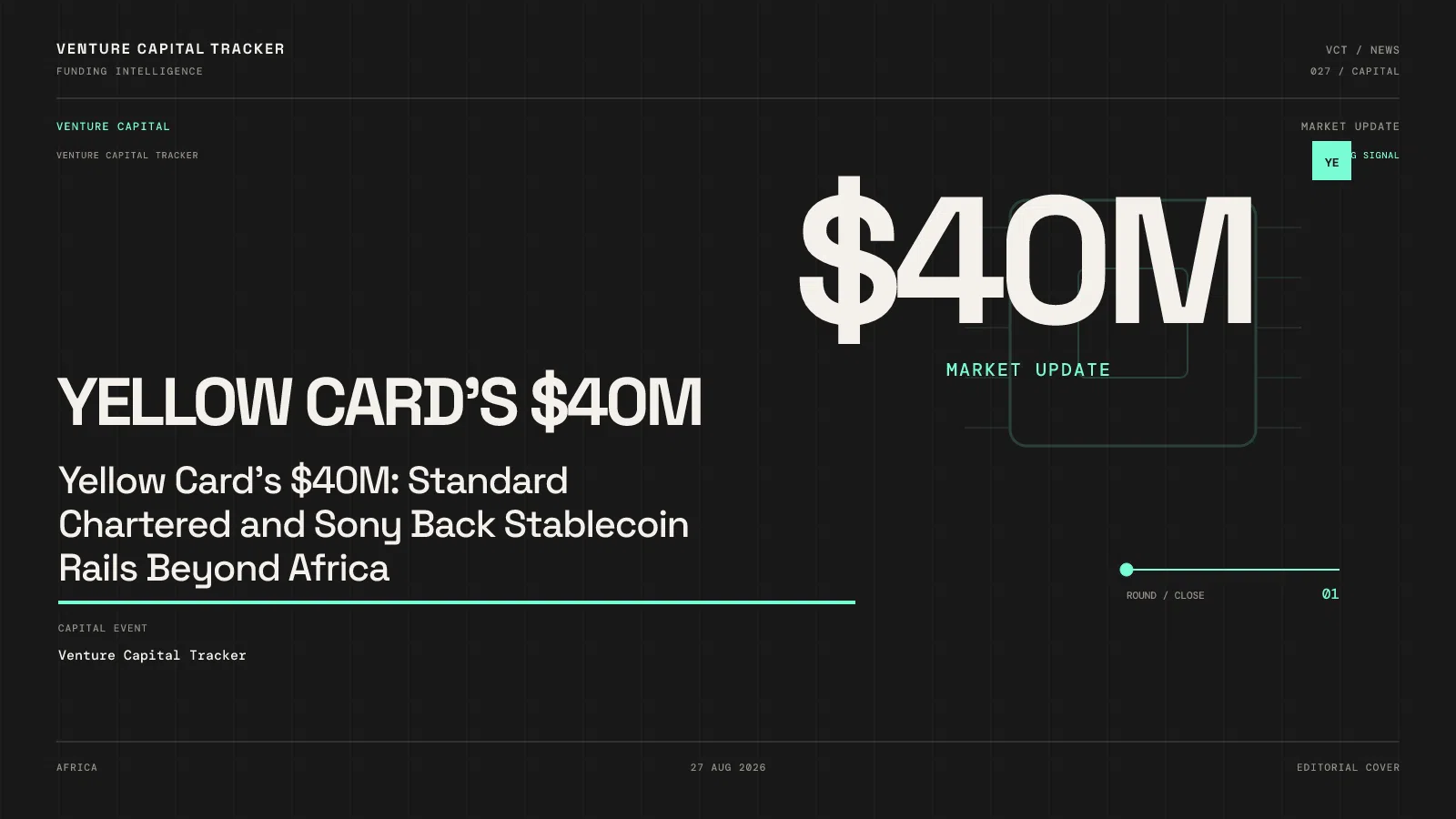
Yellow Card closed a $40 million strategic round on August 4, 2026, lifting total equity financing above $120 million. Investors include SC Ventures (Standard Chartered), Sony Innovation Fund, Polychain Capital, and Blockchain Capital. The product being scaled is infrastructure — Global USD Accounts — not a consumer trading app.
Deal snapshot
- $40M strategic equity
- Total equity: >$120M
- HQ roots: Africa-founded, Atlanta-based operations in coverage; licenses across 22 jurisdictions
- Scale claims (company): >$10B transactions facilitated; 50+ currencies; partnerships with Visa, Mastercard, PayPal, Coinbase
Who uses the product — and why
Users: Finance teams at businesses that need dollar liquidity and local payouts without stitching together correspondent banks in every market. Named customers using Global USD Accounts include Visa and Western Union.
Job: One account to hold USD, hold/swap stablecoins, run treasury, and collect/disburse on domestic rails in 50+ countries. CEO Chris Maurice frames the next chapter as banks plugging into stablecoin rails, not only crypto-native SMEs.
Why this is a live problem now
- Stablecoins cleared the “are they real?” debate for many treasurers; the open question is regulated infrastructure.
- Africa-built FX and compliance muscle is a wedge for other emerging markets (LATAM, APAC).
- Bank and corporate venture participation (Standard Chartered, Sony) is the signal — strategic capital often precedes distribution.
- Cross-border SME and platform payouts remain expensive and slow on legacy correspondent networks.
Why these investors fit (editorial)
| Investor | Likely reason |
|---|---|
| SC Ventures | Bank-adjacent digital asset and payments optionality in markets where Standard Chartered already thinks about corridors. |
| Sony Innovation Fund | APAC expansion + web3 stack investing; payments infrastructure as platform layer. |
| Polychain / Blockchain Capital | Crypto-native funds underwriting the stablecoin settlement layer as it institutionalizes. |
Competitive map
- Other stablecoin payment infrastructures (Bridge, BVNK, local EM players) — corridor and license coverage differ.
- Traditional correspondent banking / FX providers — incumbent rails Yellow Card aims to bypass or complement.
- Exchange on-ramps — consumer-heavy; Yellow Card pitches B2B accounts and bank partnerships.
Practical takeaways
- Founders: Licenses in 22 jurisdictions are the moat narrative — raise when compliance is already a product.
- Investors: Underwrite corridor volume and bank integrations, not token price beta.
- Operators: Ask which entities hold funds, which stablecoins are supported, and how fiat off-ramps fail closed.
When not to
- Strategic rounds can be smaller than growth equity — do not read $40M as a valuation event without disclosure.
- Regulatory regimes in Africa and beyond can reprice the business overnight; treat license count as necessary, not sufficient.
- Do not confuse Yellow Card with unrelated “Yellow” AI startups in our directory.
Sources
- Yellow Card blog (Aug 4, 2026): https://yellowcard.io/blog/yellow-card-secures-40-million-in-strategic-funding-to-further-global-expansion
- Fintech Global: https://fintech.global/2026/08/04/yellow-card-raises-40m-to-scale-stablecoin-rails-globally/
Follow Venture Capital Tracker in Google
Add VCT as a preferred source to make our venture-capital coverage easier to find in Google Search.
Editorial note: AI tools assisted with research, structure, or drafting. Venture Capital Tracker retains human editorial responsibility for factual accuracy, relevance, and source quality before publication.