· Venture Capital · 20 sources · Updated · Verified
Fal AI Raises $1.3B at a $16B Valuation: Funding History, Revenue and Inference Economics
Fal AI's $1.3B Series F doubles its valuation to $16B. Seven-round funding timeline, $800M revenue pace, API economics, competitors and investor questions.

By Venture Capital Tracker
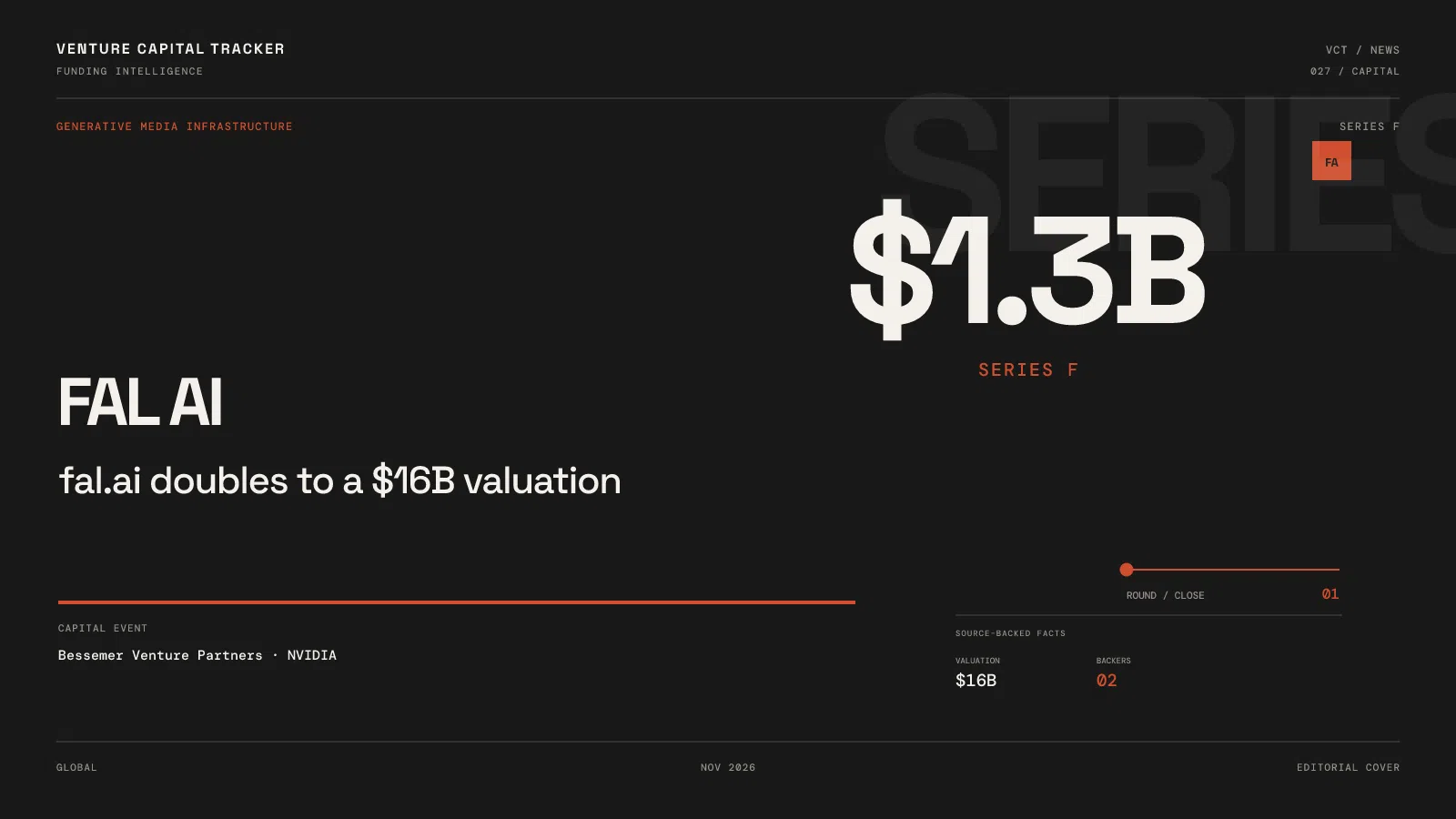
Funding event
Fal AI
Led by Bessemer Venture Partners
Reported valuation $16B
Fal AI (officially branded as fal) has doubled its valuation to $16 billion after a $1.3 billion Series F led by Bessemer Venture Partners. The financing closed in October 2026 and was announced November 3 alongside a separate $350 million Series E, led by Sequoia, that closed in April. Nvidia invested strategically. The two rounds total $1.65 billion; Fal's seven disclosed seed-to-Series-F rounds add to about $1.99 billion.
More important than the headline is why the company needed such a large financing. It sells the infrastructure used to run image, video, audio and other generative models after training. Demand grew quickly enough that Fal CEO Burkay Gur said the company had to rate-limit customers in summer 2026. Investors now face a harder question: can an inference provider convert rapidly growing GPU usage into sustainable gross profits?
Fal AI funding and valuation at a glance
| Metric | Figure | Important qualification |
|---|---|---|
| Series F | $1.3 billion | Bessemer-led; closed October and announced November 3, 2026 |
| Latest valuation | $16 billion | Reported private-financing valuation, not a public market capitalization |
| Series E | $350 million at $8 billion | Sequoia-led; April 2026 close disclosed in November |
| Series E + F | $1.65 billion | Two separate rounds, not one combined Series F |
| Total announced equity funding | Approximately $1.99 billion | Sum of seven reported rounds; excludes separate secondary share sales |
| Reported revenue | More than $800 million annualized | A revenue pace reported in 2026, not an audited full-year total or profit |
| Founded | 2021 | Burkay Gur and Gorkem Yurtseven, San Francisco |
| Listing | Private | No public Fal AI stock ticker |
Bloomberg reported the $1.3 billion Series F, $16 billion valuation and $800 million-plus annualized revenue pace. The company's own announcement and Bessemer confirm who led the two rounds. Neither released an audited income statement, company-wide gross margin, GPU-utilization data or full customer-retention cohort with the news.
What happened on November 3, 2026?
The company chose to disclose two transactions together: a $350 million Series E led by Sequoia, which closed in April at a reported $8 billion valuation, and a $1.3 billion Series F led by Bessemer, which closed in October at a reported $16 billion valuation. Bloomberg named Nvidia, Sound Ventures, HOF Capital and T. Rowe Price among the Series F participants. Bessemer partner Talia Goldberg joined the board.
There was also a follow-on announcement on November 4. Fal said PLUS Capital and athletes and cultural figures including Joe Burrow, Dak Prescott, Klay Thompson, Logan Webb and Shaun White participated in the latest combined financing. The company did not assign each participant to a specific Series E or F tranche in that statement. The celebrity component is more interesting as evidence of Fal's ambitions in sports and entertainment than as evidence of intrinsic value.
Fal says the capital will support compute supply, model research and expansion into 2027. Gur told Bloomberg that surging demand required more capacity and that customers had been rate-limited over the summer. The news outlet reported approximately 185 employees around the announcement. There is no public before-and-after measurement showing how much capacity the financing has already added or whether prior rate limits are completely resolved.
The complete Fal AI funding timeline, 2023–2026
| Round | Timing | New capital | Valuation reported at round | Lead investor |
|---|---|---|---|---|
| Seed | 2023; disclosed Sept 2024 | $9M | Not verified | a16z |
| Series A | 2024; disclosed Sept 2024 | $14M | Not verified | Kindred Ventures |
| Series B | Feb 2025 | $49M | Not verified | Notable Capital and a16z |
| Series C | Jul 2025 | $125M | $1.5B | Meritech Capital |
| Series D | Dec 2025 | $140M | $4.5B | Sequoia Capital |
| Series E | Apr 2026; disclosed Nov 3 | $350M | $8B | Sequoia Capital |
| Series F | Oct 2026; disclosed Nov 3 | $1.3B | $16B | Bessemer Venture Partners |
The initial $9 million seed and $14 million Series A were jointly announced in September 2024. Fal's February 2025 Series B company announcement identified a $49 million round and $72 million raised at that point. Its July 2025 announcement confirmed $125 million in Series C funding; a contemporaneous Kindred Ventures statement and Reuters reporting put that round's valuation at $1.5 billion. Fal and Sequoia confirmed the $140 million December Series D, while Bloomberg reported the $4.5 billion valuation. The April Series E and October Series F were publicly disclosed together in November 2026.
Funding arithmetic: $9M + $14M + $49M + $125M + $140M + $350M + $1,300M = $1,987M, or approximately $1.99 billion. This reconstruction is based on announced primary rounds rather than a company-certified capitalization table. Reporting on the December 2025 deal also described a secondary transaction in which existing holders sold shares; proceeds of a secondary do not automatically count as money raised by the company.
In roughly 16 months, Fal moved from a reported $1.5 billion valuation in July 2025 to $16 billion in October 2026. The latest mark is double April 2026's $8 billion and approximately 3.6 times December 2025's $4.5 billion. Remember that a preferred-stock financing valuation need not equal the price achievable by every common shareholder.
Read the continually updated Fal AI company profile, and VCT's investor profiles for Bessemer Venture Partners, Sequoia Capital, Andreessen Horowitz and Kleiner Perkins.
What does Fal AI actually do?
Fal is inference infrastructure, not another general-purpose consumer chatbot. It offers three complementary products, increasingly combined with its own media-model optimization.
1. Model APIs: generate media without operating GPUs
Developers call hosted image, video, audio, 3D and world-model endpoints using one platform rather than separately provisioning every model. Fal's inference website advertises more than 1,400 model endpoints, though the catalog is continuously changing. Outputs can power product photography, image editing, advertisements, video clips, audio or interactive creative products. Many models come from partner labs; Fal does not own all underlying model weights.
2. Serverless: run custom models on autoscaling GPUs
A team can deploy its own models or pipeline to Fal Serverless rather than using a standard hosted endpoint. Queues, concurrency controls, webhooks and GPU scaling reduce operations work. Billing for a custom GPU runner is based on its running time, unlike many hosted Model APIs that charge for successfully generated output.
3. Compute: dedicated GPU training and heavy workloads
Fal also offers GPU resources for model training and computationally heavy applications, with reserved capacity for workloads that need dedicated infrastructure. This broadens the revenue model beyond finished media outputs but also creates different capital and utilization requirements.
4. Post-training: optimizing the model and the serving stack together
Fal Research's H3 Max, announced in August 2026, is a post-trained version of MiniMax H3. Fal claims that five seconds of video can be produced in under three seconds in its own tests, with favorable human-preference results. This matters because optimizing the model and inference kernels together may improve throughput, cost and quality. The published performance results are company-reported, however, and should not be treated as an independently established service-level guarantee for all prompts.
Who are Fal AI's customers, and how does it make money?
Fal and its investors name companies including Adobe, Canva, Shopify, Quora/Poe, Amazon and World Labs as customers or partners. Commercial uses include producing many variations of an advertisement, localizing product images, generating previsualization for film, creating game assets and embedding media generation into another company's app. The individual customers' spending and share of Fal revenue have not been disclosed.
There are at least three economic relationships: developers buy model outputs, enterprises deploy custom inference on Fal's GPU fleet, and model developers gain distribution or commercial arrangements by listing and optimizing models. This creates a potential two-sided marketplace: more models attract application developers, and more demand attracts model creators.
That distribution advantage is real as a business hypothesis but does not prove a permanent moat. Labs can sell direct, developers can use several APIs, and cloud operators can offer similar models. Fal must keep earning customers through reliability, integrations, economics, performance and service.
Fal AI's $800M revenue pace versus its $16B valuation
Bloomberg reported that Fal had surpassed $800 million in annualized revenue earlier in 2026. This is a run rate, meaning revenue over some shorter period extrapolated to an annual pace. It must not be confused with audited 2026 recognized revenue, contracted annual recurring revenue, net income or cash flow.
Implied valuation-to-annualized-run-rate = $16B / $0.8B = approximately 20×.
That is not a conventional trailing price-to-sales multiple. Growth, profitability, customer retention, cap-table rights and revenue composition would all affect the economic interpretation.
The vital missing metric: gross margin
GPU infrastructure is costly. Providers pay to acquire or rent compute, power facilities or data-center services, manage capacity, serve models, handle failed and unused compute, and sometimes license models. A rising revenue number does not tell us what remains after those costs.
| Hypothetical gross margin | Gross profit on $800M revenue pace | $16B valuation / gross profit |
|---|---|---|
| 20% | $160M | 100× |
| 40% | $320M | 50× |
| 60% | $480M | 33.3× |
These are scenario calculations, not Fal's reported margins or a financial forecast. They explain why the $16 billion valuation is much easier to assess with verified gross profit and utilization figures than with the revenue pace alone. High utilization, software optimization and efficient model execution could improve economics; GPU scarcity, idle reservations, licensing charges and competitive price cuts could work the other way.
What does a video actually cost to generate?
Fal's publicly listed November 2026 rate for the H3 Max text-to-video Model API is $0.03 per generated video second. At that exact published model rate:
| Output workload | Illustrative customer bill |
|---|---|
| One five-second video | $0.15 |
| 10,000 five-second videos | $1,500 |
| 100,000 five-second videos | $15,000 |
This is API revenue per successful output, not Fal's profit, cost of goods sold or a price guarantee across all models. Other endpoints charge by video, megapixel or GPU time. Fal's documentation says hosted Model API customers do not pay for time in the queue or for server errors, while Fal Serverless charges for running GPU resources.
For a different perspective, Fal lists an H100 serverless GPU at $4.50 per hour before volume discounts. A hypothetical single H100 operating for 730 hours in a month would incur $3,285 in GPU list-price charges. You cannot infer a margin by comparing $0.15 per video to this hourly rate: frames per second, batching, memory requirements, model weights, additional resources, idle time and licensing are all unspecified. It demonstrates why buyers and investors must distinguish cost per useful output from cost per GPU-hour.
Fal versus Replicate, Modal, Fireworks AI, Baseten and RunPod
The providers overlap but solve somewhat different problems.
| Platform | Typical role | What to compare |
|---|---|---|
| Fal AI | Managed media model APIs, custom inference, dedicated GPU compute | Model coverage, cost per accepted output, latency and production support |
| Replicate | Hosted and custom model APIs | Same model version, prompts, price and turnaround time |
| Modal | General serverless CPU/GPU compute | Cost and engineering effort of deploying your own pipeline |
| Fireworks AI | Managed model inference infrastructure | Model coverage and serving requirements |
| Baseten | Enterprise model serving and optimized deployments | Control, performance, SLAs and dedicated capacity |
| RunPod / cloud hyperscalers | Raw or managed GPU infrastructure | Whether operating inference yourself saves enough to cover engineering effort |
A meaningful selection test uses the same prompts and model configuration, records p50 and p95 end-to-end time, total billed cost, failure/retry rate, output acceptance and the availability of fallback providers. Cheap list prices do not guarantee cheap accepted results.
What Reddit discussions reveal—and what they do not
Developers on Reddit repeatedly discuss practical questions that headline financing coverage misses.
Pricing transparency. In an August 2026 FalAI discussion, a user struggled to compare the costs and results of cheaper versus more expensive video models. A separate generative-AI thread debated Fal versus Replicate pricing, with conflicting reports across models. The useful lesson is to price the actual model and workload, not assume one provider is always cheapest.
Quality and reproducibility. Community users have described better results from some Fal-hosted LoRA training pipelines, while others prefer alternate providers or self-hosting. These are individual observations, not statistically sound quality benchmarks, and outputs may differ for reasons beyond the hosting provider.
Workflow and discoverability. In a Fal Sandbox thread, developers welcomed side-by-side model comparisons but requested aggregate model-usage trends to make an expanding catalog easier to navigate. Fal representatives acknowledged the suggestion. For production buyers, model discovery and API portability are part of the product.
To make those anecdotes actionable, a team should benchmark 20 fixed prompts across two or three equivalent provider/model combinations, track billed cost and latency, and blind-review output quality. Do not use scattered Reddit posts as proof of market share, average reliability or company-wide financial results.
Why the funding matters beyond Fal
The generative AI investment story is shifting from training frontier models to serving large volumes of useful work. For images, audio and video, memory management, diffusion steps, rendering speed, queueing and throughput matter differently from classic text-token serving. Fal has specialized in this layer and now also post-trains some models, bringing optimization closer to the source.
Nvidia participating strategically is relevant because GPU inference is a large market for its accelerators. That does not prove preferential chip pricing or guaranteed GPU allocation. Bessemer's investment thesis centers on the combination of specialist infrastructure and a distribution platform, but as an investor it is not a disinterested source.
A second angle is the rapidly growing market for commercial media production: consumer apps, creative agencies, film studios and e-commerce teams have opportunities to produce more assets, variants and interactive experiences. Whether demand sustains the reported revenue pace depends on customer retention and their return on media generation, not solely the novelty of the latest model.
Six investor questions to monitor in 2027
- Gross margin and utilization: How much of growing sales survives GPU and licensing costs, and how many billable outputs can each GPU deliver?
- Capacity and reliability: Are the summer-2026 rate-limit episodes behind the company, measured by queue times and throughput rather than assertions?
- Customer quality: How concentrated is revenue, and do major customers renew and expand in production?
- Model and partner dependencies: Can model labs bypass Fal or renegotiate distribution terms, and what keeps enterprises on Fal?
- Pricing power and competition: Will optimizations protect cost per accepted output as rival APIs and hyperscalers expand?
- Financial transparency and governance: Will disclosed numbers move from annualized revenue pace to recognized revenue, gross profit and cash generation?
The Series F increases Fal's resources, not the amount of evidence that it is profitable.
Frequently asked questions
What is Fal AI's valuation in 2026?
$16 billion, according to the reported Series F valuation announced November 3, 2026. The previous Series E valuation in April was $8 billion.
How much funding has Fal AI raised?
Approximately $1.99 billion from its seven announced seed-through-Series-F equity rounds; the latest two rounds total $1.65 billion.
Who are the investors in Fal AI?
Bessemer led the Series F, with reported participation from Nvidia, Sound Ventures, HOF Capital and T. Rowe Price. Sequoia led Series E; earlier backers include a16z, Meritech, Kindred Ventures and Kleiner Perkins.
What is Fal AI's revenue in 2026?
Bloomberg reported an $800 million-plus annualized revenue pace. That is not a verified full-year revenue number or audited ARR.
Is Fal AI profitable or publicly traded?
Its profits are not publicly disclosed. Fal is privately held with no public stock ticker; the $16 billion mark is a financing valuation.
Are Fal AI and fal.ai the same company?
Yes. Fal AI is a common search name; the official brand is lowercase fal, at fal.ai. The registered company name is Features & Labels, Inc., according to Fal's September 2026 terms of service; fal is the public brand.
Does Fal train its own models?
Fal primarily hosts, optimizes and serves models, including third-party offerings. It also does model research and post-training, including H3 Max, which differs from developing every frontier model in its catalog from scratch.
Is Fal cheaper than Replicate or self-hosting?
It depends on the particular model, workload, utilization, retries and operations costs. Compare equivalent jobs and cost per accepted output, not just sticker prices.
Research verified November 5, 2026. Figures marked as reported are attributed to named primary statements or financial journalism. Financial scenarios are illustrative and pricing is a dated official-page snapshot.
Follow Venture Capital Tracker on Google
Add VCT as a preferred source to see more of our venture-capital reporting in Google Search.
Last updated:
Editorial note: AI tools assisted with research, structure, or drafting. Venture Capital Tracker retains human editorial responsibility for factual accuracy, relevance, and source quality before publication.