· Venture Capital · 18 sources · Updated · Verified
Eve Legal AI: $164M Funding, $1B+ Valuation and EveOS Explained
Eve raised $164M in three rounds, not a new 2026 deal. Explore its $1B+ valuation, 350,000 cases, EveOS products, law-firm economics, prices and rivals.

By Venture Capital Tracker
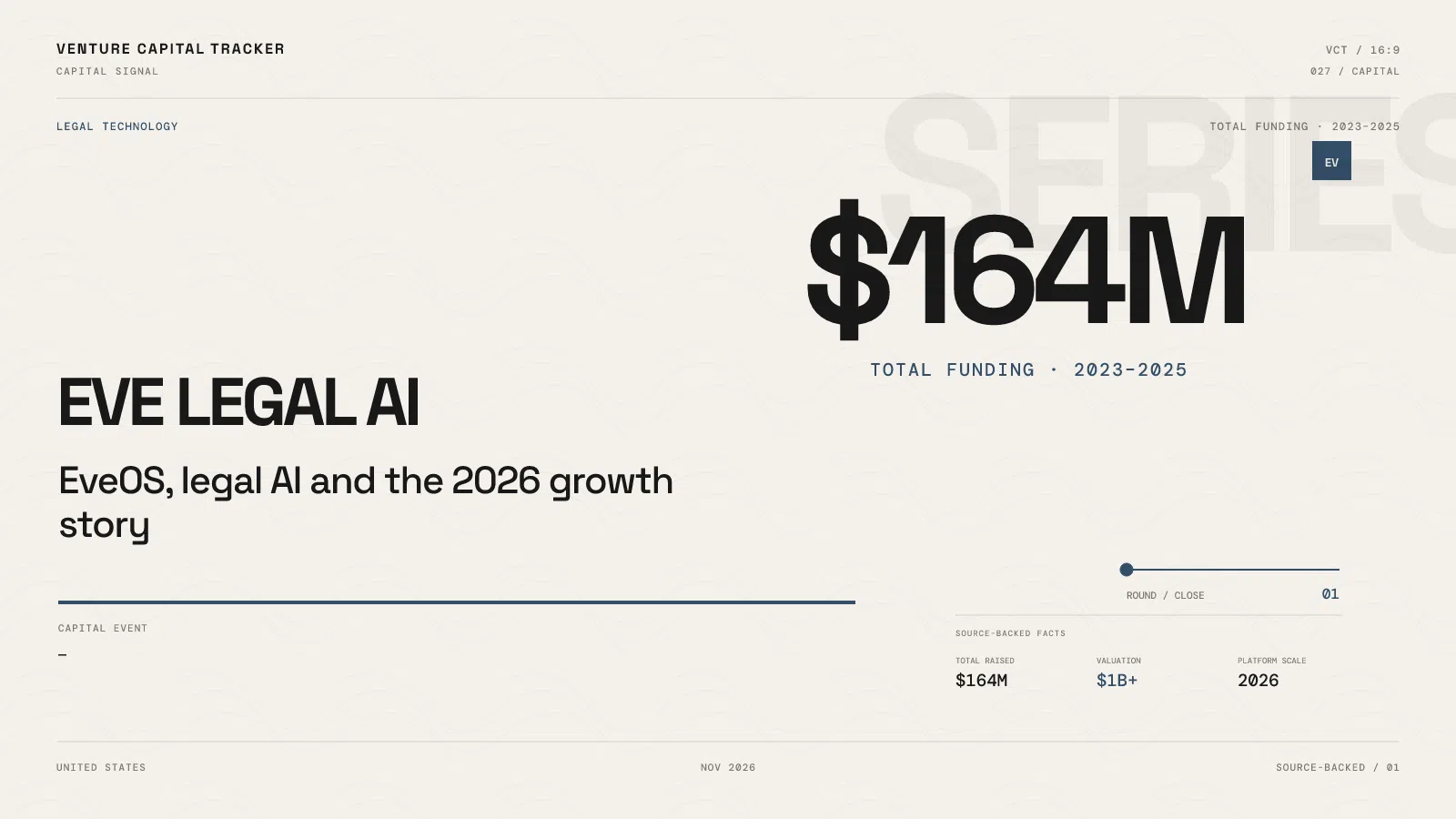
Eve Legal AI has raised $164 million in total, not in a new 2026 funding round. The plaintiff-law technology company last disclosed a $103 million Series B on September 30, 2025, at a valuation above $1 billion. Its other disclosed financings were a $47 million Series A in January 2025 and a $14 million seed round in October 2023.
What is new in 2026 is operating scale. In an October 28 announcement, Eve said that more than 350,000 plaintiff cases had been managed on its platform across nearly 2,000 law firms and 15,000 legal professionals by the end of September 2026. It also reported more than 50,000 closed cases and over $3.5 billion in aggregate client settlements and judgments. These are company-reported activity and client-outcome figures, not Eve's revenue.
The bigger question is whether EveOS — an AI layer spanning client intake, case records, legal drafting, case review and firm analytics — can turn better plaintiff-law workflows into a durable software business. Here is the funding ledger, a tour of what Eve actually sells, its competitors and the numbers that still need verification.
For the continually updated company and investor record, see VCT's Eve profile.
Eve legal AI: the key numbers, with dates
| Metric | Verified figure or best-supported disclosure | What it does not mean |
|---|---|---|
| Total disclosed funding | $164M, 2023–2025 | Not a new $164M round |
| Latest announced round | $103M Series B, September 30, 2025 | Not a 2026 raise |
| Latest disclosed valuation | Above $1B, September 2025 | No verified newer valuation |
| Firms using Eve | Nearly 2,000, end of September 2026, according to Eve | Not an independently audited customer count |
| Legal professionals | 15,000, company-reported September 2026 scale | Not 15,000 paying accounts |
| Cases on platform | More than 350,000, as of September 2026 | Not 350,000 cases won or closed |
| Closed cases | More than 50,000, Eve's October 2026 statement | Not a published win rate |
| Client recoveries | More than $3.5B in settlements and judgments | Not Eve's revenue or a proven AI-caused increase |
| Documents processed | 12.5M per month, in Anthropic's Eve customer case study | Not necessarily unique cases |
| Revenue growth | 6× year over year, as described by an investor and in reporting | No absolute ARR, margin or profit disclosure |
Sources include Eve's September 2025 financing release, the October 2026 case-count announcement, Anthropic's customer case study and Fortune's October 28 reporting. The dates and definitions matter when comparing those numbers.
Eve funding history: how the $164 million adds up
| Announcement | Round | Amount | Disclosed investors |
|---|---|---|---|
| October 25, 2023 | Seed | $14M | Lightspeed Venture Partners and Menlo Ventures |
| January 16, 2025 | Series A | $47M | Led by Andreessen Horowitz (a16z), with Lightspeed and Menlo |
| September 30, 2025 | Series B | $103M | Led by Spark Capital, with a16z, Lightspeed and Menlo |
| Cumulative disclosed financing | Three rounds | $164M | Sum of the rounds above |
The original 2023 launch release disclosed the seed funding. The 2025 Series A release and Series B release confirm the next two rounds.
There is no basis in these announcements to report a fresh $164M investment in November 2026. The $164M headline circulating in investor commentary is a lifetime total; the last identified priced round is the September 2025 Series B. The $1B+ figure is the valuation attached to that financing, not a new 2026 transaction.
For the investors' wider portfolios, see Spark Capital, Andreessen Horowitz, Lightspeed Venture Partners and Menlo Ventures.
What is Eve, and who uses it?
Eve is an AI software company serving plaintiff-side law firms: attorneys who represent people pursuing claims against employers, insurers, institutions or other parties. Common practice areas include personal injury, employment litigation and medical malpractice.
The business problem differs from Big Law. A plaintiff firm often gets paid on a contingency fee, usually after an outcome, while absorbing the upfront cost of records review, client communication, case analysis and drafting. If a case consumes too much staff time before the prospect of a settlement is clear, the firm may be unable to accept it.
Eve's pitch is to reduce repetitive casework so the same professionals can responsibly serve more clients. It is not a consumer chatbot that gives people legal representation, and it does not replace a licensed lawyer's judgment.
Eve was founded in 2020 by Jay (Jayanth) Madheswaran, Matt Noe and David Zeng, and emerged publicly in October 2023. The company is based in San Mateo, California. Its main product is now called EveOS.
How EveOS works: an actual law-firm workflow
A product description is easier to evaluate if you follow one hypothetical matter from first contact to settlement. This is an illustrative workflow assembled from Eve's published capabilities, not a verified customer case or a claim that every feature is enabled for every buyer.
Step 1 — A new client calls after an accident
A prospective client calls a small injury firm outside business hours. Eve Intake can answer the call, collect information, help qualify the lead, and send an engagement agreement for signature. Eve says its intake agent supports more than 28 languages. An attorney or authorized staff member still needs to decide whether the representation is appropriate.
Step 2 — Medical and insurance records arrive
The firm receives hundreds or thousands of pages of treatment notes, bills and correspondence. Atlas extracts and organizes case facts as documents arrive; staff can trace extracted fields to source records and review conflicting or higher-risk information. The goal is a current case file, rather than a one-off summary that becomes stale.
Step 3 — AI prepares drafts and flags missing facts
Eve Agents can prepare a medical chronology, demand letter, discovery response or other draft. Eve Research provides cited legal research. Auditor reviews matters and surfaces possible missing records, injuries or follow-ups. A lawyer should verify factual claims and legal citations before relying on the output.
Step 4 — The firm monitors its workload
Analyst aims to answer questions such as which practice areas have slower settlement cycles, where staff capacity is constrained and which matters need attention. Its business intelligence depends on the quality and completeness of the underlying case data.
This is more than a document summarizer. Eve wants to become part of the operating workflow across the firm's cases. Eve's platform description lists the components; its August 2026 product update provides additional detail about Atlas and Analyst. EveOS was introduced in June 2026, with additional components moving into general availability in August. Buyers should check availability for their practice area and existing case-management system.
What changed in 2026, beyond the fundraising headline?
The strongest new evidence is about usage rather than capital raised.
- April 2026: Eve announced it had passed 1,000 plaintiff-firm customers and supported more than 200,000 cases.
- June 2026: Eve introduced EveOS as a broader operating platform, moving beyond individual drafting tools.
- August 2026: Eve announced expanded general availability for Atlas and Analyst, although feature and practice-area access can vary.
- October 28, 2026: Eve said platform case volume had increased approximately 75% since June, reaching more than 350,000 managed cases by the end of September, across nearly 2,000 firms.
In an October 2026 interview with Fortune, CEO Madheswaran discussed the contingency-fee model and why smaller firms need better capacity. An Andreessen Horowitz LinkedIn post used the conservative wording 1,700+ firms, while Eve's October release said nearly 2,000. These are different lower-bound formulations, not evidence that the company lost 300 customers.
A useful caution about the $3.5B figure: Eve also used a $3.5 billion recoveries figure in its September 2025 financing announcement. It appears again in October 2026. Readers should not interpret the repeated number as an additional $3.5B won in 2026, nor as cash received by Eve. The announcements do not provide enough detail to reconcile the timing, attribution or independent audit scope.
Does Eve improve real legal outcomes? What the evidence shows
Eve highlights several named law firms in its October 2026 release:
| Law firm | Reported outcome | Evidence limitation |
|---|---|---|
| Spiros Law | Tripled the number of cases it could review and move toward settlement | Selected company-reported customer example; not a controlled comparison |
| Earley Law Group | Estimated up to two months cut from its 14-month average case timeline | Customer estimate, not an independently audited cohort |
| Ricci Law Firm | Used Eve as part of work on a case ending in a reported $101M verdict | Verdict belongs to the legal team and court process; no evidence AI caused that amount |
An Anthropic case study says Eve processes 12.5 million documents per month using Claude for complex workflows and reports some customers achieving faster settlements or increased case capacity. Anthropic supplies underlying AI technology and benefits commercially from the reference: these are vendor and customer claims, not a randomized assessment of legal outcomes.
The distinction is important. A favorable settlement, a closed case and a document processed are different measurements. The publicly disclosed data do not establish incremental settlements attributable solely to Eve, the quality of all generated documents or the number of errors avoided.
How does Eve make money, and what is its actual revenue?
Eve sells software and workflow capacity to law firms. It does not earn the $3.5B reported as recovered for claimants; that figure refers to plaintiffs' settlements and judgments.
Eve's own annual revenue, ARR, gross margin, net retention, customer acquisition cost and profitability have not been publicly verified in the materials reviewed for this article. A reported 6× year-over-year revenue increase establishes a growth multiple but not the revenue baseline. Six times $2 million and six times $20 million are very different businesses. Published third-party estimates should not be confused with company financial statements.
The bull case is that a vertical workflow platform can command recurring subscriptions and become harder to replace as a firm connects more case data and processes. The counterargument is that AI model costs, heavy onboarding, incumbent software integrations, human review requirements and competing vendors may constrain margins or retention.
What does Eve Legal cost?
Eve does not publish a standard public price list on its website. Buyers are directed to a sales conversation. A June 2026 Reddit participant described receiving an offer around $1,400 per month, with case-volume and contract-duration conditions. That is one unverified anecdote, not an official or representative Eve price; contracts, features and limits can differ.
For a useful quote, ask for the complete subscription price, included users and cases, overage charges, minimum term, onboarding fees, cancellation terms, model or document limits, and integration scope.
A practical break-even calculation for a firm
Illustrative unit economics only — neither the price nor labor rate below is an actual Eve quote.
Suppose a firm pays $2,000 monthly, saves 50 staff-hours through automation, but spends 10 hours reviewing or correcting the outputs. If each net saved hour is worth $60 of fully loaded staff capacity, the arithmetic is:
(50 − 10) × $60 − $2,000 = $400 net monthly capacity value.
At those assumptions, the subscription breaks even at about 43.3 gross hours saved per month, given the same 10-hour review load. That is capacity value, not guaranteed additional revenue or cash profit. A firm should measure actual billable or operating impact, errors, time to resolution, and workload redistribution over a representative trial.
Eve vs EvenUp vs Supio vs Harvey: which is really comparable?
| Provider | Primary customer or product angle | Where it overlaps with Eve | Buyer question |
|---|---|---|---|
| Eve / EveOS | Broad operating layer for plaintiff firms | Intake, case data, drafting, research, audit, operations | Can one platform improve the whole firm without costly migration? |
| EvenUp | Personal-injury AI and claim preparation | Medical records, demand letters, settlement workflows and broader PI casework | Does specialized PI execution or professional review work better? |
| Supio | Plaintiff and PI case-aware AI platform | Intake, medical chronologies, demand drafting, litigation workflows | Does its approach to source verification and litigation workflow fit the practice? |
| Filevine / Clio | Established practice and case-management systems | Matter records, workflows, integrations and expanding AI features | Would improving existing software avoid a second system? |
| Harvey | AI platform used broadly by law firms and in-house legal departments | Legal research, document analysis, drafting and agents | Is the work primarily plaintiff-case operations or broader legal knowledge work? |
The EvenUp demand product offers different levels of AI and professional review. Supio now markets agentic workflows across cases and firm operations. They should not be dismissed as simple one-feature tools. Harvey serves a wider legal market and is more often an adjacent choice than a direct equivalent for a small personal-injury firm.
A good comparison tests the same anonymized case packet across vendors: intake, missing-medical-record detection, chronology accuracy, drafting, citation traceability, data export, workflow integration and human review time. VCT has not run that hands-on benchmark. For the broader legal AI investment market, see our legal-tech sector overview and Harvey's company profile.
Is Eve secure enough for sensitive legal documents?
Eve says it maintains SOC 2 Type II certification, isolates customer data and does not use customer prompts or documents to train shared foundational models. Those are Eve's stated controls, not a VCT audit or a substitute for counsel's own diligence.
Before uploading live case files, a law firm should review: its contractual data-processing terms; data residency and subprocessors; encryption and access controls; privilege and ethical-wall handling; retention and deletion policies; incident notification; integrations; and the full SOC 2 report under NDA. It should also test whether answers cite the correct passage when many documents conflict.
Public discussion offers useful, but limited, reality checks. In r/paralegal, some users said Eve helped with discovery while others described problems interpreting bills and citations; a separate August 2026 discussion includes favorable reports from apparent users. These are self-selected, unverified accounts, not statistically representative evidence. The right safeguard is an attorney-reviewed pilot with known-answer test cases.
Why investors care — and what could go wrong
For venture investors, the interesting thesis is vertical AI with workflow distribution. If a firm uses the same software to bring in clients, process records, monitor cases and generate documents, the vendor may capture more recurring value than a standalone AI writing assistant.
Three questions determine whether this story develops into a durable platform:
- Retention and depth: Are firms expanding usage after the first contract, or simply trying AI tools as experiments? Published firm totals do not show cohort retention or paid-seat expansion.
- Unit economics: What are revenue per firm, gross margin after model inference and support costs, onboarding effort and payback period? Revenue growth without those measures does not establish attractive software economics.
- Trust and outcomes: Do firms see independently measurable improvement without unsafe errors, privacy compromises or mounting review costs? Client recoveries alone cannot answer that question.
A larger legal AI market also invites competition from vendors already embedded in a firm's case-management system and from law firms building narrower workflows using general-purpose models. Eve's 2026 adoption is evidence of demand for its category, not proof of a permanent winner.
Eve Legal AI frequently asked questions
How much money has Eve raised?
$164 million in cumulative disclosed financing: $14M seed in October 2023, $47M Series A in January 2025 and $103M Series B in September 2025. The funding history on VCT contains the round-by-round record.
Did Eve raise $164 million in 2026?
No new $164M round is established by the sources reviewed as of November 5, 2026. That number is the total of its three historical rounds, not a new financing announcement.
What is Eve's latest valuation?
The latest publicly disclosed financing valuation reviewed here is over $1 billion, attached to its September 30, 2025 Series B. There is no verified newer figure in this research.
Who founded Eve Legal?
Jay (Jayanth) Madheswaran, Matt Noe and David Zeng founded the company in 2020. Eve publicly launched in 2023.
How many law firms use Eve?
Eve reported nearly 2,000 plaintiff law firms as of the end of September 2026. Its website and an investor account also use 1,700+ firms; public figures are rounded and not independently audited.
Is the $3.5 billion settlement figure Eve's revenue?
No. It is a company-reported aggregate of settlements and judgments for clients represented by firms using the platform. It should not be treated as software revenue, additional 2026 recoveries, or proof of causation.
What is Eve Legal's price per month?
There is no verified public list price. Pricing is quote-based and can depend on scope and contract terms. A third-party anecdote is not an official rate.
Is Eve the same thing as Harvey?
No. Eve is designed around plaintiff-case operations and contingency-fee practice needs. Harvey serves a broader range of law firms and in-house legal teams, with more emphasis on general legal knowledge workflows.
Does Eve replace Filevine, Clio or another case-management system?
EveOS can operate alongside connected systems and has described broader operating-system ambitions. Whether it replaces a firm's existing platform depends on workflow, integrations, contract terms and its current product capabilities — not a universal promise.
Is Eve publicly traded?
No. Eve is privately held; the reported $1B+ valuation is a private financing figure, not a public-market stock price or accessible share price.
Bottom line
Eve's investor headline is a cumulative $164M raised and a $1B+ valuation established in 2025. The actual 2026 development is a substantially larger plaintiff-law AI platform. The company reports more than 350,000 cases on Eve by September, a wider EveOS product suite and rapid customer growth.
The strongest follow-up reporting would be independently verified revenue and customer-retention figures, transparent contract pricing, a representative quality benchmark and measured legal outcomes. Until those are public, Eve looks like a consequential venture-backed legal AI company — but its growth story should be read with the difference between financing, software revenue, case volume and client recoveries kept clear.
Last updated:
Editorial note: AI tools assisted with research, structure, or drafting. Venture Capital Tracker retains human editorial responsibility for factual accuracy, relevance, and source quality before publication.