· Venture Capital Tracker Editorial
CScale Raises $145M Series C for Fault-Tolerant Optical AI Interconnect
CScale emerged from stealth with $145 million to commercialize an optical scale-up fabric for gigawatt AI data centers, but customers, specifications and shipping dates remain undisclosed.
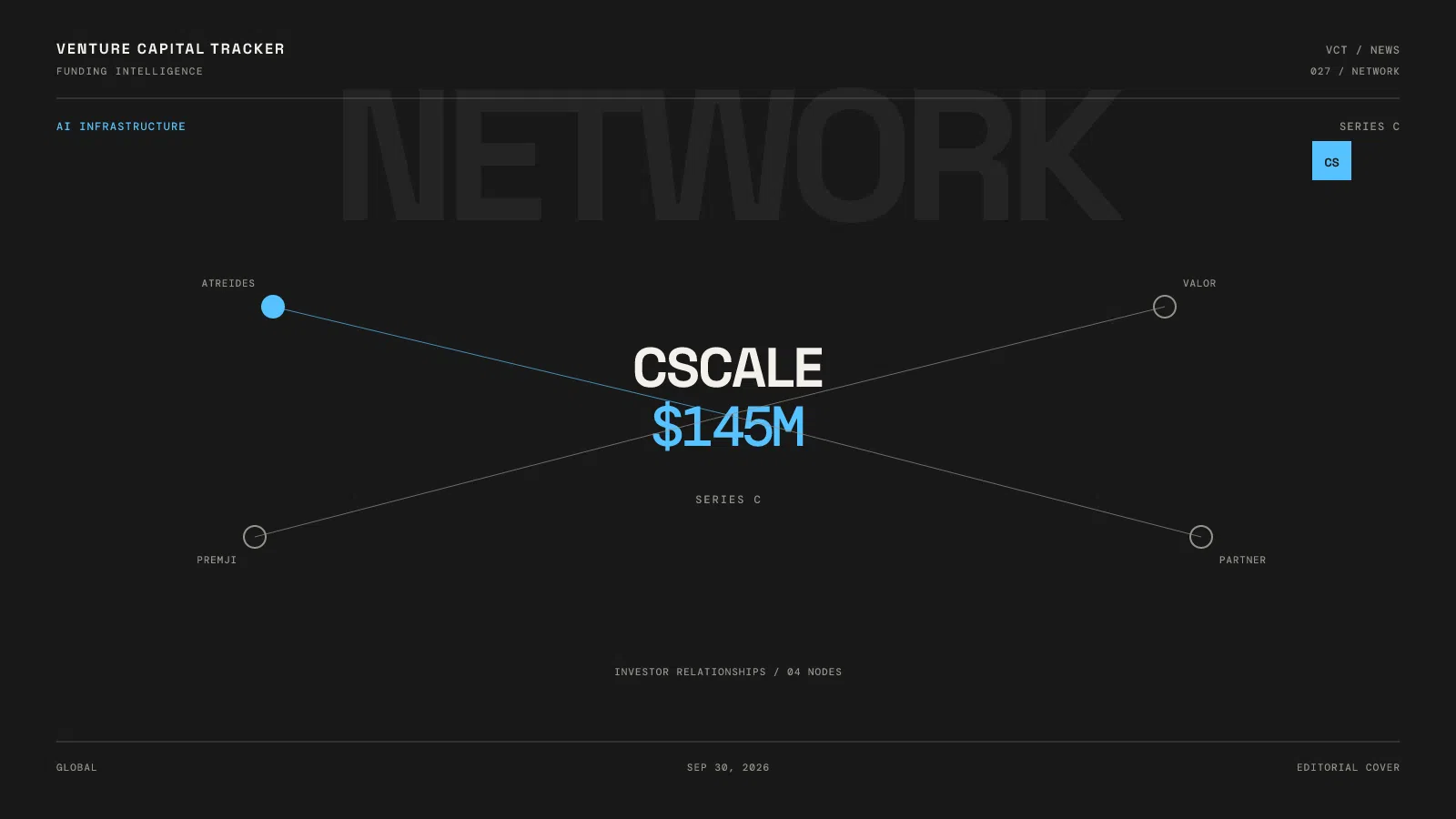
CScale has emerged from stealth with a $145 million Series C to build optical interconnect for scale-up AI systems. The financing brings its total funding to $188 million.
Atreides Management and Valor Equity Partners led the round, with Premji Invest joining as co-lead. Sutter Hill Ventures and Maverick Silicon returned, while NVIDIA's NVentures and Intel Capital became CScale's first strategic investors.
The size of the round reflects a specific infrastructure bet: as AI clusters expand across racks, the network connecting accelerators becomes part of the compute system rather than a peripheral transport layer.
What CScale is building
Scale-up networks connect accelerators so tightly that software can treat them as one larger machine. CScale is developing an integrated optical light engine for that job.
Its stated differentiator is fault containment. In a cluster containing thousands of accelerators and hundreds of thousands of optical links, even a low component-failure rate becomes a continuous fleet-level problem. CScale argues that its architecture can isolate optical failures without interrupting the rest of the compute domain.
That is an economically important claim. A failed optical link is not just a replacement-cost issue if it leaves expensive accelerators idle or forces a distributed training job to restart. Reliability, predictable latency and graceful degradation can therefore matter as much as headline bandwidth.
CScale has not disclosed bandwidth, latency, power consumption, supported interfaces, manufacturing partners or a product-shipping date. Its announcement also names no customers or design wins. Those omissions mean investors are funding an architecture and an experienced team before public commercial proof.
Why optical scale-up is attracting capital
Copper links become more difficult to extend as distances, bandwidth and rack counts increase. Optical links can carry more data over longer distances with different power and signal-integrity trade-offs, but they introduce lasers, packaging and optical components that must operate reliably at data-center scale.
CScale expects gigawatt-class AI data centers to contain scale-up domains spanning thousands of accelerators across dozens of racks. Whether deployments reach that configuration on the company's expected timetable is uncertain, but the direction is clear: networking is consuming a larger share of AI system design and spending.
The strategic investors reinforce that point. NVIDIA dominates the accelerator market, while Intel has businesses across compute, packaging, networking and foundry services. Their participation does not by itself establish a commercial contract, but it signals that CScale's work is relevant to platform-level road maps.
An experienced systems team
CScale was founded in 2023 and is headquartered in Palo Alto. It says it employs approximately 85 people globally.
Chief executive Martin Lund previously held senior roles at Broadcom, Microsoft, Cadence and Cisco, where he led the Common Hardware Group responsible for silicon, systems and optics. Founder and chief technology officer Sanjai Kohli previously built SiRF, a GPS-chip company, and founded Inovi, which Facebook acquired in 2014.
That background matters because optical interconnect is not a single-chip problem. The product has to integrate photonics, electronics, packaging, firmware and data-center operations while fitting into accelerator and switch road maps.
The competitive field
CScale is not entering an empty market. Broadcom and Marvell are entrenched suppliers of data-center connectivity silicon. Startups including Lightmatter, Ayar Labs and Celestial AI are pursuing photonic interconnect or optical I/O with different architectures and integration strategies.
The practical competitive questions are less about whether optics will be used and more about where it enters the system, who controls the interface, how it is packaged and whether customers can qualify it without redesigning their stacks.
CScale's fault-containment narrative is a useful distinction, but it will need evidence. The most valuable future disclosures would be:
- Measured bandwidth, latency and power per transmitted bit.
- Failure-injection data showing how the system contains faults.
- Supported accelerator and switch interfaces.
- Packaging and manufacturing partners.
- Named customer evaluations or design wins.
- Sampling and volume-production dates.
The financing signal
A $145 million Series C before public product specifications is unusually large. It gives CScale the capital to hire across multiple engineering disciplines, build prototypes, secure supply and support lengthy customer qualification cycles.
It also raises the execution bar. Optical components must work not only in laboratory conditions but across temperature, manufacturing variation and thousands of deployed links. A design that improves resilience but costs too much power, money or integration effort can struggle to win a production socket.
The investors are effectively underwriting a systems thesis: that AI-scale-up networking becomes valuable enough for a new architecture and that CScale's team can establish a position before standards and vendor relationships harden.
Bottom line
CScale has financing and team credibility, but the commercial case is still largely private. The $145 million round makes it one of the better-capitalized new entrants in optical AI infrastructure. The next decisive evidence will not be another description of gigawatt data centers; it will be disclosed specifications, customer validation and a credible path to volume manufacturing.
Follow Venture Capital Tracker in Google
Add VCT as a preferred source to make our venture-capital coverage easier to find in Google Search.
Editorial note: AI tools assisted with research, structure, or drafting. Venture Capital Tracker retains human editorial responsibility for factual accuracy, relevance, and source quality before publication.