· Updated · Venture Capital Tracker · investment-strategies
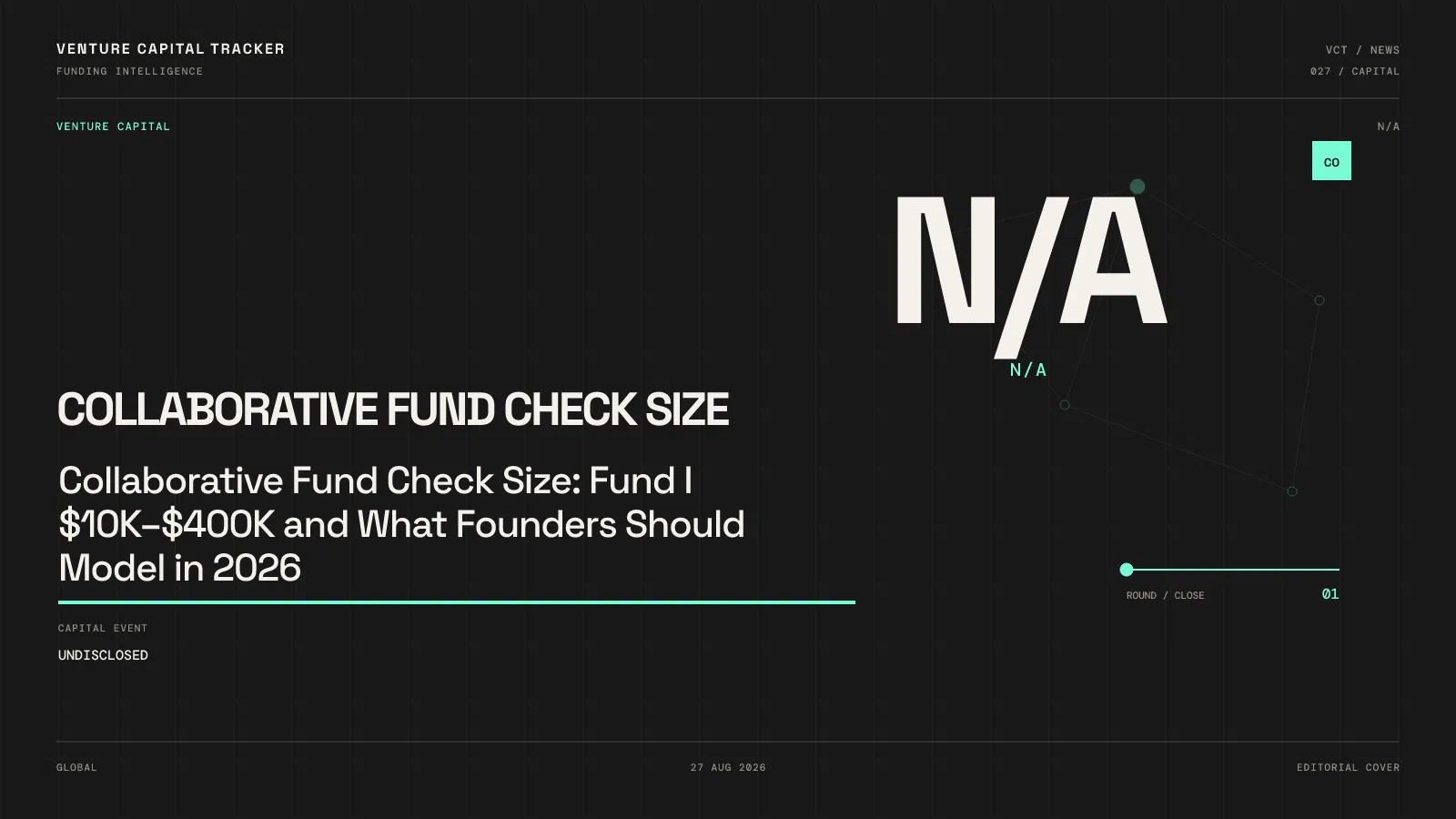
Collaborative Fund Check Size: Fund I $10K–$400K and What Founders Should Model in 2026
Collaborative Fund has a published historical Fund I range of about $10K–$400K, with an average near $100K. Here is how to separate that evidence from a current stage-based estimate.
TL;DR: Collaborative Fund’s clearest published check-size evidence is historical: its Fund I deployed about $10,000–$400,000 checks, averaging roughly $100,000 across 50 deals. That range is not a current guarantee. For a founder planning a current seed or Series A lead, Venture Capital Tracker uses a separate $1M–$10M stage-based estimate, clearly labeled as an estimate. Do not confuse Collaborative Fund with the unrelated collab.capital, and treat Collab SOS as a climate vehicle rather than a universal ticket.
The published Fund I numbers
Collaborative Fund’s own Fund I review gives the strongest public evidence for the historical range:
| Fund I fact | Published figure | How to use it |
|---|---|---|
| Fund I size | $8M | Historical vehicle context |
| Number of deals | 50 | Shows a high-volume, small-check early portfolio for that vehicle |
| Check range | $10K–$400K | Historical range, not a current quote |
| Average check | Approximately $100K | Historical average across the portfolio |
| Net DPI | 4.1x | Fund-level outcome reported by Collaborative Fund; not a prediction for a new company |
These numbers answer a different question from “What will Collaborative Fund invest in my 2026 seed round?” Fund I was a particular vehicle with its own size, period, and portfolio construction. A later vehicle can have different ownership targets, reserve policy, and check size.
What founders should model in 2026
For a current seed or Series A lead, VCT uses $1M–$10M as a planning band. This is a stage-based estimate derived from the stages the directory records—not a range Collaborative Fund publishes as a standard ticket.
| Founder situation | Planning assumption | Confidence |
|---|---|---|
| Historical Fund I comparison | $10K–$400K; average about $100K | Publicly described by Collaborative Fund |
| Current seed lead | $1M–$10M | VCT stage-based estimate; confirm directly |
| Current Series A lead | $1M–$10M, potentially higher with a larger round | VCT stage-based estimate; confirm directly |
| Follow-on participation | Case-by-case | Depends on vehicle, ownership, and reserves |
| Collab SOS climate opportunity | Vehicle-specific | $200M fund context does not equal a check-size quote |
The range is intentionally labeled. A founder should never present the VCT planning band as “Collaborative Fund’s published ticket.”
Why check size is not enough
Collaborative Fund’s fit is better understood through its thesis and the role it can play in a round:
- Climate and sustainability: climate technology, sustainable food, and systems that move the world toward measurable outcomes.
- Consumer health and mission-led brands: products where behavior, health, or culture matters alongside software or distribution.
- Early-stage leads: the directory records Seed and Series A as lead stages, with participation from Pre-Seed through Series B+.
- Vehicle choice: the core fund and Collab SOS can represent different entry points and decision criteria.
The right question is: What ownership and support does this specific partner want for this specific round?
Collaborative Fund versus collab.capital
The names are easy to confuse in search results. They are different firms and their check-size signals must stay separate.
| Firm | Context | What not to do |
|---|---|---|
| Collaborative Fund | New York mission-led venture investor; public Fund I history above | Do not treat Fund I as a current standard ticket |
| collab.capital | Separate investment firm with its own reported range | Do not merge its $500K–$2M range into Collaborative Fund coverage |
How to qualify your company before outreach
- Name the outcome: carbon, food, health, labor, or consumer behavior change in measurable terms.
- Match the stage: show whether you need a pre-seed, seed, or Series A lead and why.
- Explain the ownership need: target amount, target runway, and the ownership you are offering.
- Show the wedge: customer, product, distribution, or technical advantage that makes the mission commercially durable.
- Use relevant proof: portfolio adjacency such as WHOOP or climate investments is more useful than a generic “impact” label.
- Ask about the vehicle: core fund versus climate strategy, lead role, follow-ons, and decision process.
Questions founders should ask the firm
- Is this round a fit for the core fund or Collab SOS?
- Are you looking to lead, co-lead, or participate?
- What ownership range is the partner targeting?
- Does the team reserve capital for follow-ons?
- Which portfolio company or operating partner is closest to our customer problem?
- Are the Fund I numbers relevant to the current vehicle, or should we use a different planning model?
Read the Collaborative Fund profile, the Collab SOS climate-fund coverage, and the WHOOP Series G coverage next.
Check-size figures are for research and planning. Fund I results are not an offer, forecast, or guarantee; validate current terms directly with Collaborative Fund.
- collaborative-fund
- check-size
- seed-funding
- +2 more
Last updated:
Editorial note: AI tools assisted with research, structure, or drafting. Venture Capital Tracker retains human editorial responsibility for factual accuracy, relevance, and source quality before publication.