· Venture Capital Tracker Editorial · venture-capital
Protego Ventures Closes $125M Fund I for Israeli Defense Technology
Protego Ventures closed its first fund at $125 million to back early-growth Israeli defense technology companies, below its initial $150 million target.
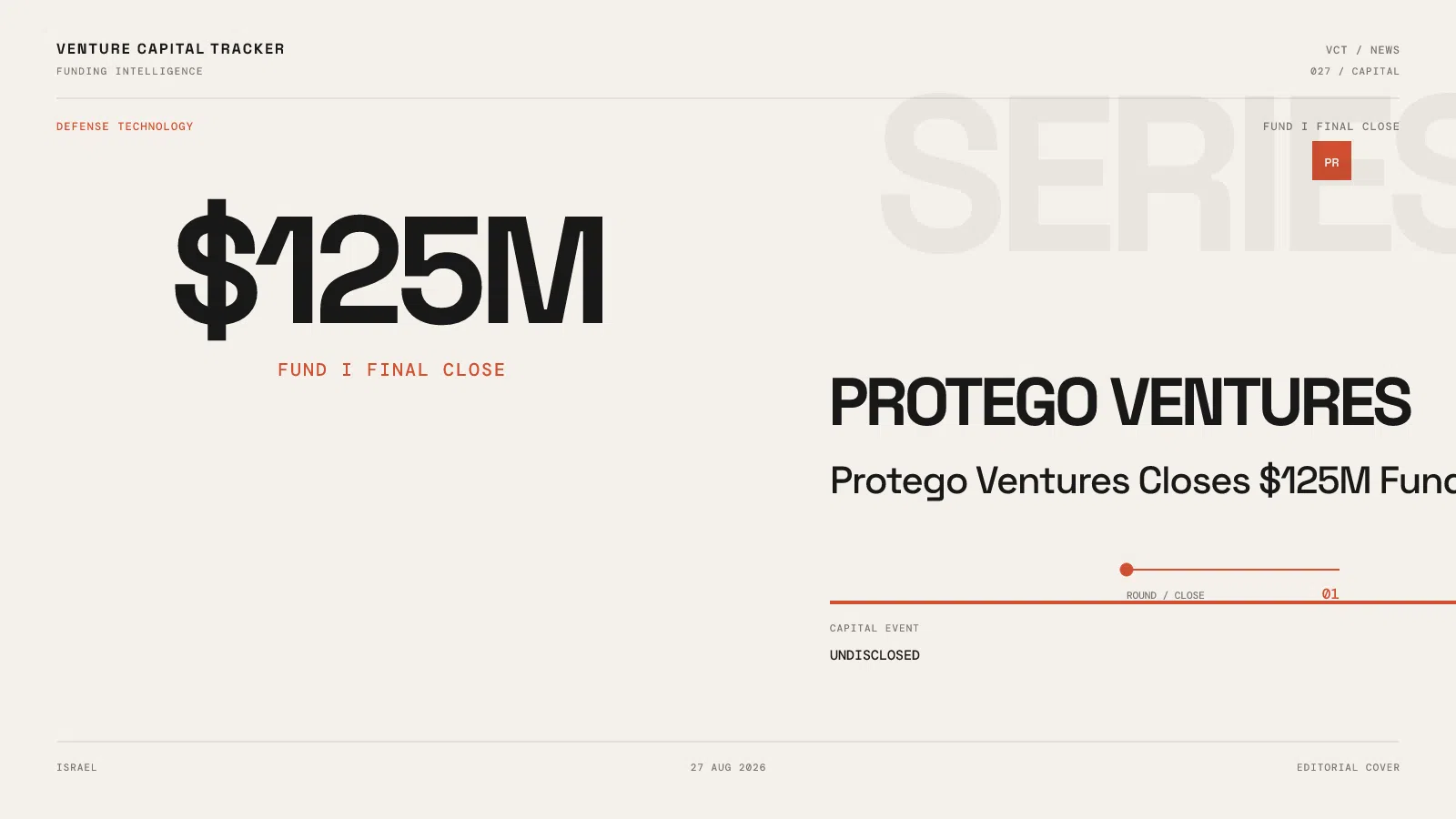
Protego Ventures has closed its first fund at $125 million to invest in early-growth Israeli defense technology companies. The final close combines an initial $70 million close with a further $55 million, according to Calcalist.
The fund had previously targeted $150 million. Protego says it chose to stop at $125 million after reaching the size it wanted for its strategy.
Fund-close facts
| Field | Detail |
|---|---|
| Manager | Protego Ventures |
| Vehicle | Fund I |
| Final close | $125 million |
| Reported target | $150 million |
| Strategy | Early-growth Israeli defense technology |
| Typical check size | $5 million to $15 million |
| Portfolio examples | XTEND, ASIO, Prisma Photonics and Rilian |
| Announcement date | September 29, 2026 |
Who backed the fund
TechCrunch reported that executives associated with Ares Management committed $30 million as limited partners. That wording matters: its corrected report says the executives invested, not Ares Management itself.
Protego did not publish a complete limited-partner list. As a result, the available disclosure supports the fund size and strategy but not a full analysis of its institutional investor base.
A narrower stage than the defense-tech boom suggests
Many new defense funds focus on seed-stage dual-use startups. Protego is aiming later, with reported checks of $5 million to $15 million for companies that have already moved beyond initial product development.
That positioning reflects a common funding gap in defense technology. A startup may prove a product with small contracts or pilot deployments but still require substantial capital to manufacture hardware, satisfy procurement requirements and expand internationally.
Protego's existing portfolio illustrates the range. XTEND builds autonomous and human-guided systems; ASIO develops navigation technology; Prisma Photonics uses fiber-optic sensing for critical infrastructure; and Rilian operates in adjacent defense technology.
The $125 million versus $150 million question
A final close below target is not automatically a failure. Fund managers can choose to stop fundraising when portfolio construction, deployment pace or market opportunity indicates that a smaller vehicle is sufficient.
Still, investors and founders should distinguish the $125 million actually closed from the earlier $150 million target. Protego's investable capital will also be lower than the headline after management fees, expenses and any reserves.
With checks reaching $15 million, the vehicle can lead or meaningfully participate in a limited number of early-growth financings. That concentration may help the managers support portfolio companies closely, but it also increases exposure to individual company and procurement outcomes.
Why this fund matters
Israeli defense startups have attracted more attention as governments accelerate spending on drones, autonomy, sensors, cyber systems and resilient infrastructure. The opportunity is real, but revenue can be lumpy and closely tied to government purchasing cycles.
A specialist manager can add value by navigating security clearances, export controls, military procurement and strategic partnerships. The same specialization creates geopolitical, regulatory and reputational risks that a generalist fund may avoid.
Protego's first fund is therefore best read as a targeted early-growth vehicle—not a broad early-stage venture fund and not $150 million raised.
Sources
Follow Venture Capital Tracker in Google
Add VCT as a preferred source to make our venture-capital coverage easier to find in Google Search.
Editorial note: AI tools assisted with research, structure, or drafting. Venture Capital Tracker retains human editorial responsibility for factual accuracy, relevance, and source quality before publication.