· Venture Capital Tracker Editorial · venture-capital
SiMa.ai Raises $150M Series C at $1.45B for Physical AI Silicon
SiMa.ai raised a $150 million Series C co-led by Fidelity and Amplify Partners at a $1.45 billion valuation to expand its edge-AI silicon and software platform.
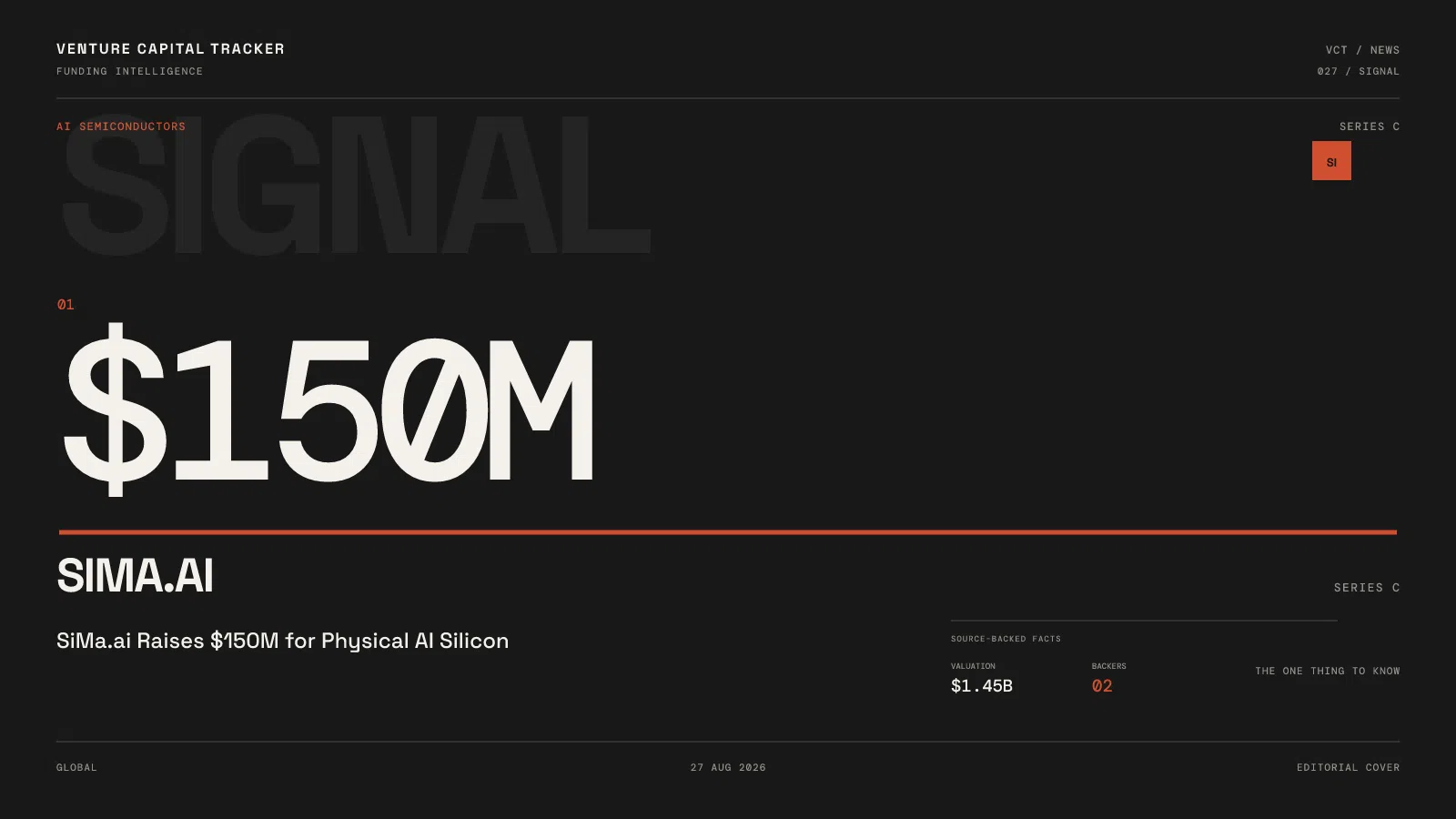
SiMa.ai has raised a $150 million Series C at a $1.45 billion valuation, taking total funding to $500 million. Fidelity Management & Research Company and Amplify Partners co-led the financing.
The company is positioning its chips and software as infrastructure for “physical AI”: inference systems inside robots, vehicles, drones, aerospace equipment and industrial machines where power consumption and response time matter.
Deal terms
| Field | Detail |
|---|---|
| Company | SiMa.ai |
| Financing | $150 million Series C |
| Valuation | $1.45 billion |
| Co-leads | Fidelity Management & Research Company and Amplify Partners |
| Other investors | Alter Venture Partners, Dell Technologies Capital, Maverick Capital, +ND Capital, Point72, StepStone Group, AllianceBernstein, Baron Capital, J.P. Morgan and the State of Michigan |
| Total funding | $500 million |
| Announcement date | September 28, 2026 |
The Times of India reported that the round consists entirely of primary capital, meaning the proceeds go to the company rather than selling shareholders.
The physical-AI thesis
AI at the edge has different constraints from workloads in a data center. A robot or autonomous system may need to combine camera, radar or sensor data with very low latency while operating inside a fixed power and thermal budget.
SiMa.ai's approach combines purpose-built machine-learning processors with its Palette software platform. The pitch is that developers can deploy models across edge devices without rebuilding the software stack for each hardware configuration.
The company names customers and partners across industrial, aerospace and automotive markets. That makes the financing more grounded than a purely pre-product semiconductor bet, although detailed revenue and customer concentration are not public.
A roadmap that still has to ship
SiMa.ai says revenue quadrupled from 2024 to 2025. It also targets the first half of 2028 for next-generation hardware capable of 1,000 dense tera operations per second.
Both figures require context. The growth rate is company-reported and starts from an undisclosed base. The 2028 performance target describes a future product, not silicon available to customers today.
Semiconductor roadmaps carry execution risk across architecture, software, foundry capacity and customer qualification. A delay can be especially costly in AI hardware because competing platforms improve quickly and developers tend to consolidate around mature software ecosystems.
Why the syndicate matters
Fidelity adds a large institutional growth investor, while returning co-lead Amplify Partners has backed the company through earlier stages. Dell Technologies Capital provides strategic credibility in enterprise infrastructure.
The wider group—spanning public-market managers, venture firms and strategic capital—suggests investors see SiMa.ai as a potential scaled computing platform rather than a narrow component supplier. The $1.45 billion valuation places the company in the unicorn category but remains far below the largest data-center AI chip companies.
What to watch
The critical milestones are production shipments, software adoption, design wins that convert into recurring volume and progress toward the 2028 chip.
If SiMa.ai can make deployment easier across heterogeneous physical systems, it could occupy a valuable layer between AI models and device manufacturers. If customers remain tied to incumbent hardware and software platforms, the company may find that technical efficiency alone is not enough to dislodge an ecosystem.
Sources
Follow Venture Capital Tracker in Google
Add VCT as a preferred source to make our venture-capital coverage easier to find in Google Search.
Editorial note: AI tools assisted with research, structure, or drafting. Venture Capital Tracker retains human editorial responsibility for factual accuracy, relevance, and source quality before publication.