· Venture Capital · 6 sources · Updated · Verified
Bedrock Robotics Raises $600M at $4.1B to Scale Autonomous Excavators
CapitalG and Emergence co-led Bedrock’s confirmed $600M Series C. Paid excavator deployments shift the test toward reliable job-site capacity and support costs.

By Venture Capital Tracker Editorial Team
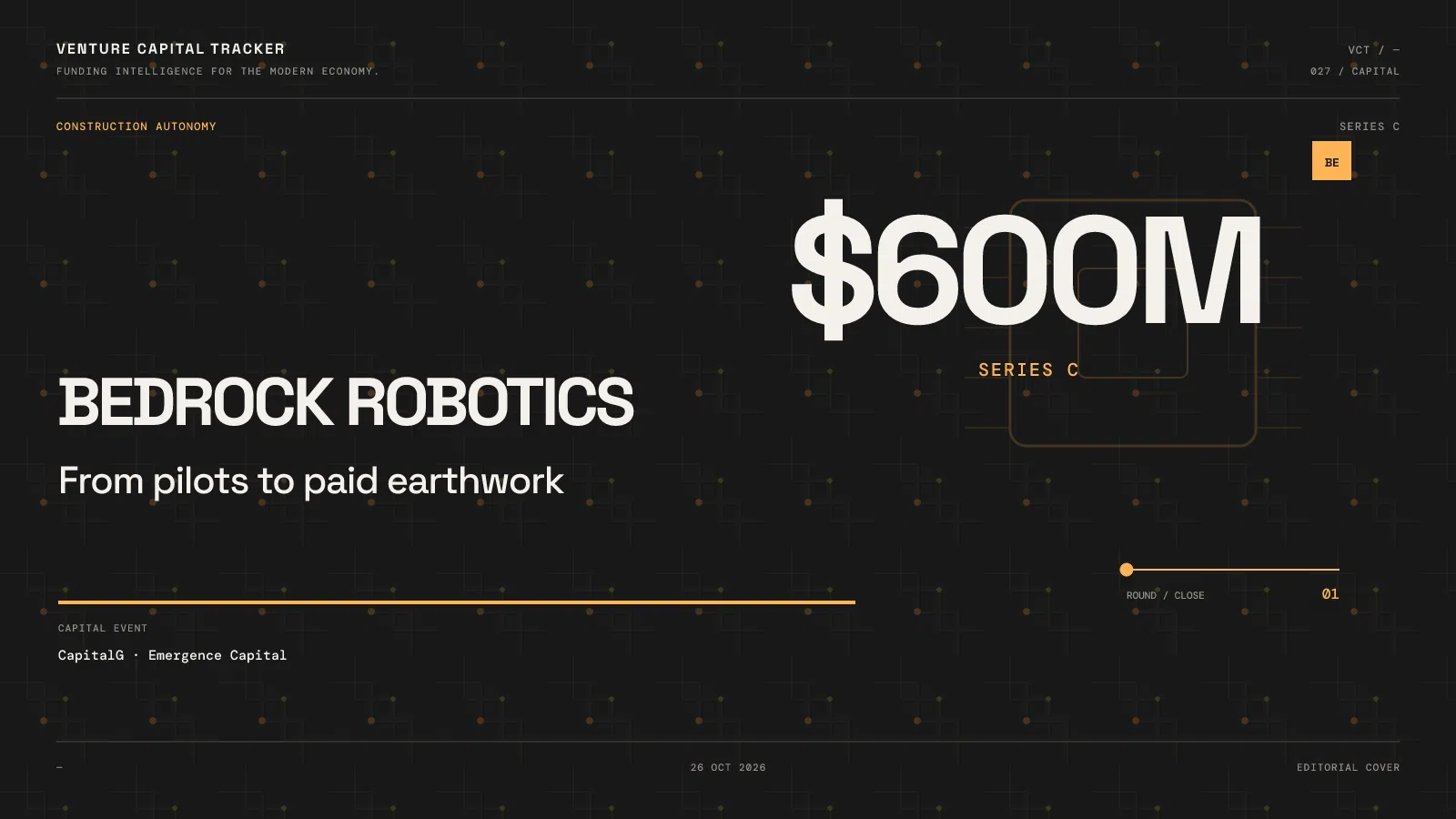
Bedrock Robotics announced a $600M Series C at a $4.1B post-money valuation on October 26, 2026, co-led by CapitalG and Emergence Capital. The company announcement confirms the financing previously reported as talks.
Deal details & investors
Funding event
Bedrock Robotics
Led by CapitalG , Emergence Capital
Reported valuation $4.1B
Bedrock says its autonomous excavators have performed paid work on live commercial sites since mid-August. The investment funds the next operating challenge: making that capability dependable for more contractors.
What contractors are buying
Bedrock’s Operator system adds autonomy to existing heavy equipment, starting with excavators. Contractors retain machines they already own while changing how work is performed.
Bessemer Venture Partners’ investment memo describes a concrete example its team observed in Texas: autonomous CAT 352 excavators loading a human-driven dump truck. That is an investor’s account of an observed deployment, not an independent productivity audit. It illustrates why removing the person from the excavator cab does not remove people from the wider workflow.
The retrofit changes procurement. Bessemer says installation takes a couple of hours, is reversible and requires no permanent machine modifications. A contractor could add capacity without replacing its whole fleet. Pricing, contract length and the split between equipment and recurring service charges were not disclosed in the reviewed financing materials.
An illustrative economic test is to compare the system and field-support costs with the additional work completed. Extra digging hours help only if trucks, grading crews and downstream tasks can keep up. Autonomy that shifts a queue elsewhere does not necessarily finish a project sooner.
Why investors are backing expansion now
In CapitalG’s October 26 memo, Derek Zanutto and Conner Lovely point to paid deployment and customers’ difficulty staffing equipment. Their longer-term thesis is coordinated fleets: contractors specifying an outcome and multiple machine types completing it together.
That remains a broader ambition than today’s excavator deployments. Bedrock’s website distinguishes current excavators from future coordination across different equipment. The distinction matters when assessing what the financing has already achieved.
CapitalG’s rationale concerns construction capacity as much as labor cost. Our view is that contractors will judge the service by whether it lets them accept and complete work they would otherwise defer. For Bedrock, that creates a field-operations business alongside the software: installation, maintenance, training, incident response and customer support all affect margins.
The financing in context
The issuer names USIT, Bessemer and Temasek as new investors, alongside returning backers including 8VC, Georgian, Valor Equity Partners, Xora, Eclipse, Perry Creek Capital and NVIDIA. It puts cumulative funding at nearly $1B, separate from the $600M round.
The earlier report used $3.5B pre-money. The confirmed $4.1B post-money figure includes the new capital. Those figures describe different points in the financing calculation, rather than a $600M valuation increase between announcements.
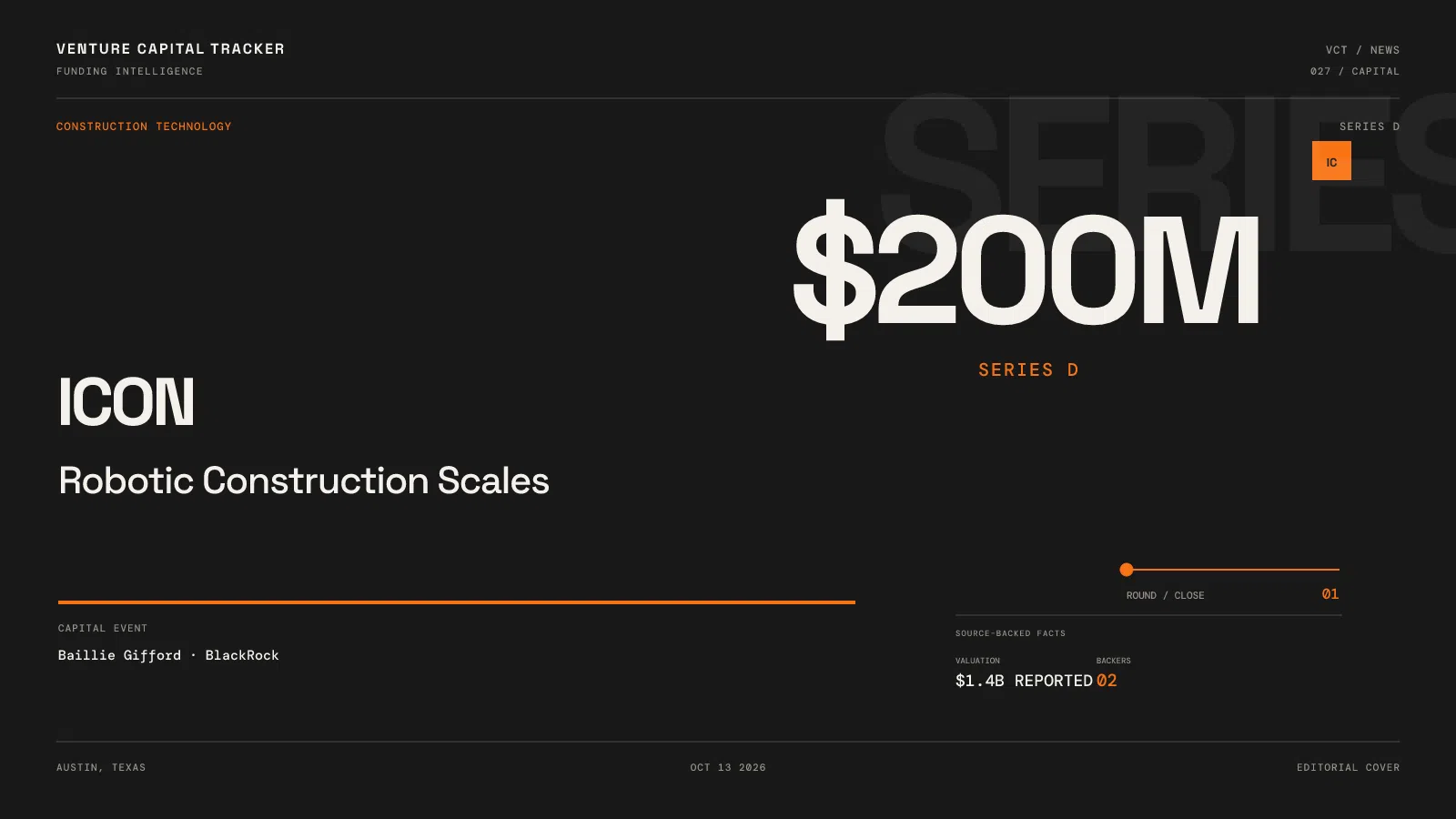
The closest comparison is Gravis Robotics’ $200M Series A, announced August 17, 2026, with SoftBank investing. Gravis also retrofits heavy machinery and targets mixed fleets. Both are competing to turn contractors’ installed equipment into autonomous capacity.
Eka Robotics’ $150M Series A on October 20 offers an adjacent comparison, focused on dexterous manipulation rather than excavation. Factory tasks and outdoor worksites require different evidence of reliability; the companies are not direct substitutes.
Revenue, deployed fleet size, utilization, support costs and independently established safety performance remain undisclosed in the reviewed financing materials. Repeat deployments at acceptable margins will show whether Bedrock can scale an operating service as successfully as it has raised capital.
Follow Venture Capital Tracker on Google
Add VCT as a preferred source to see more of our venture-capital reporting in Google Search.
Last updated:
Editorial note: AI tools assisted with research, structure, or drafting. Venture Capital Tracker retains human editorial responsibility for factual accuracy, relevance, and source quality before publication.