· 15 sources · Updated · Verified
Azure Capacity Problems in Europe: Failed Deployments and 2027 Prices
Why a healthy Azure region can still reject new infrastructure, how cheap Burstable options are affected, and what the 2027 price notice really covers.

By Venture Capital Tracker
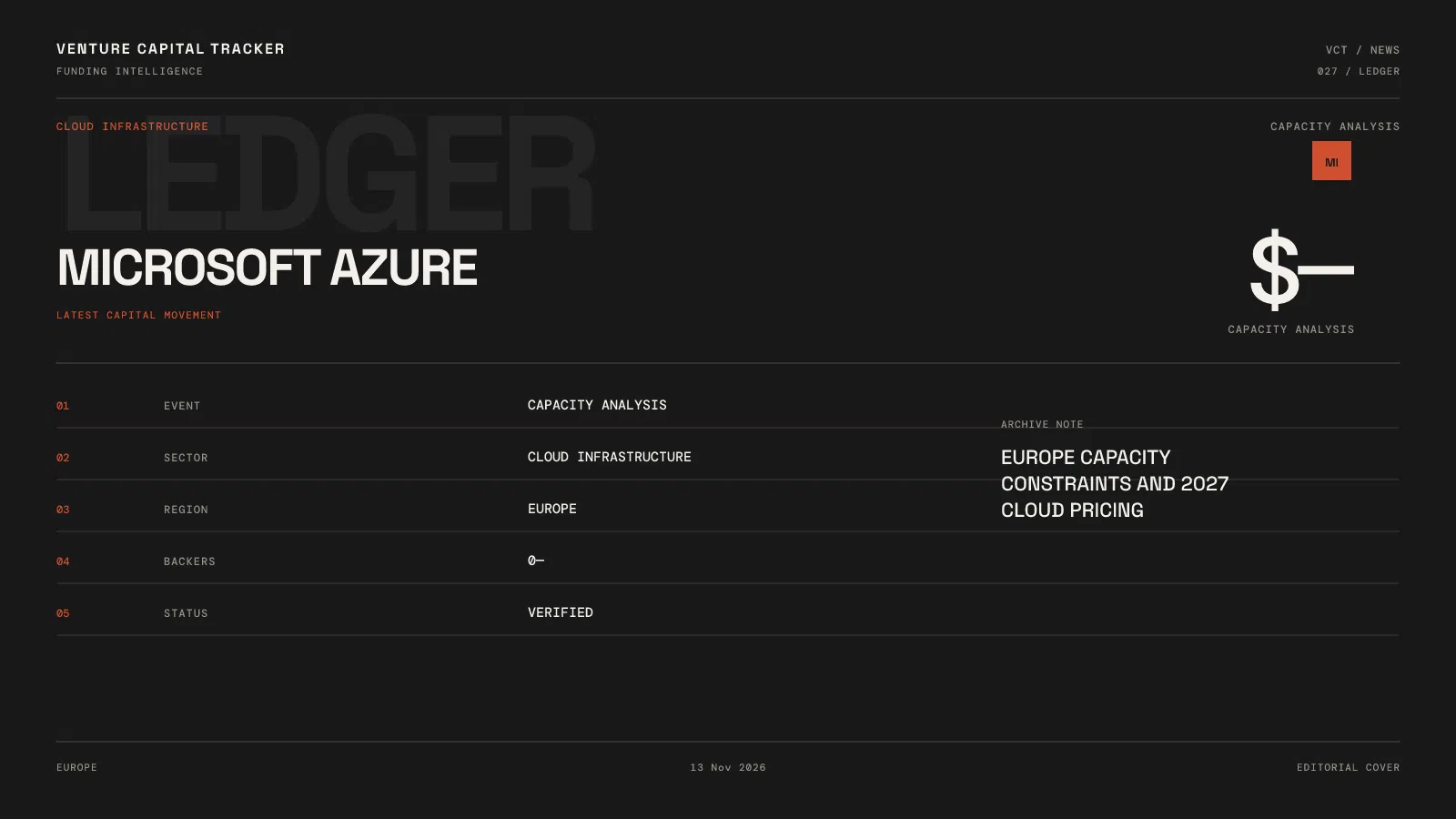
Microsoft has confirmed problems provisioning new Azure resources in parts of Europe. In West Europe, customers faced Container Apps deployment failures and Microsoft engineers confirmed capacity problems with some Managed Redis configurations. In North Europe, a separate Redis SKU also ran into allocation restrictions.
These are new-deployment problems, not evidence that every running application in those regions went offline. The risk is that an existing platform stays healthy while its next database, node pool or container environment cannot be created.
A separate change is approaching: Microsoft has notified customers of February 2027 increases for selected VM and storage prices. The rate changes do not cause the capacity failures, but both can make the next phase of a company's cloud expansion more expensive.
Where Azure capacity problems have been documented
| Region | Documented example | Evidence |
|---|---|---|
| West Europe (Netherlands) | Container Apps environment provisioning failed with ManagedEnvironmentCapacityHeavyUsageError; Microsoft separately confirmed Managed Redis backend capacity failures. | Microsoft notice, March; Microsoft Q&A, May; AKS-backed deployment case, June |
| North Europe (Ireland) | A requested Azure Managed Redis SKU could not be provisioned. Microsoft support confirmed a regional capacity restriction for that configuration. | Microsoft Q&A, July |
| Germany West | Named alongside West Europe in a Container Apps product-team announcement about high demand. | Microsoft notice, March |
| UK South | Customers described refused VM quota requests and delayed migrations. | Computer Weekly investigation |
One West Europe Redis customer tried several small sizes, including B0 and B1, without success. Microsoft suggested another region or a larger B10 configuration because some larger requests were succeeding. The cheapest workable size may change when capacity is constrained, even if its published list price has not.
These incidents occurred in different months and products. They establish real allocation problems, not a live percentage of spare capacity or proof that every restriction remains active today.
Why a green Azure status page can still mean a failed deployment
| Term or error | What it actually means | What to do |
|---|---|---|
| Quota exceeded | Subscription cannot request more of that resource family | Request more quota; reduce your allocation |
| Capacity or AllocationFailed | Azure cannot currently place the requested resource in a region/zone | Check compatible SKU, zone or region and contact support |
| Legacy VM family restricted | New deployments or extra quota for a retiring generation are limited | Check the family lifecycle notice and eligible replacements |
| Product/SKU unavailable | Resource isn't offered or allowed under those settings, or placement isn't possible | Check region support, subscription eligibility and underlying family restrictions |
| Service health incident | An existing running workload or service is experiencing an incident | Track Service Health/Resource Health and follow the incident |
Quota is permission; capacity is availability. Microsoft’s Container Apps documentation distinguishes them explicitly. You can have enough quota and still fail to deploy. The Azure public status page reports broad incidents, not a live stock count for every resource size.
What Azure engineers reported in the field
In a May West Europe AKS discussion, engineers explained why switching regions is not a simple configuration change: established networks depend on gateways, firewalls, DNS, private connectivity and data already stored nearby. One operator reported that retrying later succeeded, but that is not a capacity guarantee.
A June North Europe discussion showed a second risk: a region chosen as a workaround can encounter constraints too. Sweden Central and Germany West Central came up as alternatives, not guaranteed sources of spare capacity. These discussions are firsthand reports, not a statistical survey.
Why cheap Burstable sizes are harder to plan around
The problem is availability before retirement. Azure's VM lifecycle guidance lists B-series v1 for retirement on 15 November 2028, but capacity-growth restrictions began in July 2026. New subscriptions cannot deploy affected legacy VM families; existing subscriptions may be able to deploy within already-approved quota, but only where inventory remains. That means a size being documented, priced or listed does not guarantee it can be newly provisioned.
What about Azure Database for PostgreSQL Flexible Server?
The distinction matters because a managed database does not necessarily follow the same lifecycle policy as a customer-managed VM. Microsoft's compute documentation still lists small Burstable choices such as B1ms (1 vCore, 2 GiB) and B2s (2 vCores, 4 GiB). In a July Microsoft Q&A exchange, a moderator said new Burstable PostgreSQL provisioning or scaling may be constrained where it depends on restricted hardware. The exchange did not establish a universal PostgreSQL retirement or a confirmed replacement timetable. A later October PostgreSQL provisioning case documents both B2s and B1ms failing with SkuNotAvailable, even though the SKUs appeared in a regional list. That particular example was outside Europe, so it shows the mechanism, not proof that every West Europe tenant has the same restriction.
The takeaway: a small PostgreSQL size may appear in the product catalogue yet fail in a particular region or subscription. Check actual provisioning before committing to a design. Don't assume a failed managed database was caused by the B-series VM retirement policy: regional stock, service-specific configuration and subscription eligibility also matter. Existing Burstable databases are not automatically shut down.
February 2027: which Azure prices increase?
An October Microsoft Q&A discussion reproduces a Service Health notice sent to affected customers. It announces 1 February 2027 adjustments to selected Azure Virtual Machine and Azure Storage meters in seven regions—not every Azure service.
| Region | Announced increase for affected meters |
|---|---|
| North Europe (Dublin) | 17% |
| West Europe (Netherlands) | 9% |
| France Central | 11% |
| France South | 11% |
| Norway East | 9% |
| Norway West | 9% |
| Southeast Asia (Singapore) | 8% |
The notice excludes specified VM families—including Bv1, several older generations and selected v7 sizes—and named storage products. Do not apply the headline percentage to an entire Azure bill. A Managed Redis or PostgreSQL charge does not automatically rise by 9% or 17% just because it runs in the region. Check the affected meter IDs and your effective contract rates.
Example: A company spends €10,000 monthly in West Europe, but only €4,000 is on affected, undiscounted meters. The 9% change adds €360 per month, not €900. With the same eligible spend in North Europe, a 17% increase adds €680 per month. Reservations, discounts and usage changes can alter the actual bill. Microsoft's notice cited regional market conditions and infrastructure investment; it did not say that the provisioning failures caused the price increases.
Why changing Azure regions can cost more than it saves
A new isolated service may be easy to launch in Sweden Central or North Europe. Moving a mature production platform is different. You may need new gateways, private endpoints, DNS, security controls, replicated storage, backups and application changes. Data residency and transfer costs can further limit the choices.
Compare the total three-year cost, not just the VM hourly rate. Confirm the destination can provision your specific resource before rebuilding the surrounding network.
Six steps to reduce Azure deployment and pricing risk
- Capture the failed operation: service, SKU, region, availability zone, subscription, UTC timestamp and correlation ID.
- Separate quota from actual capacity: a quota increase won't fix a shortage of allocatable hardware.
- Test the least disruptive alternative: another eligible size or zone before moving a workload to a different region.
- Check small database SKUs separately: do not equate a displayed B1ms or B2s listing with a successful PostgreSQL deployment.
- Price the actual meters: identify eligible VM and storage charges from the February notice, then apply reservations and discounts.
- Plan critical capacity: for eligible VMs, on-demand capacity reservations can secure successfully allocated capacity. Ordinary Reserved VM Instances are billing discounts, not a guarantee of hardware. Ask Microsoft support about persistent failures.
Where to check status and availability
| Resource | What it does—and does not show |
|---|---|
| Azure public status | Broad incidents, not real-time spare inventory |
| Azure Service Health | Customer/region-specific incidents and pricing advisories |
| Azure Resource Health | Health of existing resources |
| Azure products by region | Product support, not guaranteed allocation |
| Container Apps product-team notice | Historical first-party provisioning evidence |
| Microsoft Azure capacity guidance | Meaning of errors and supported recovery choices |
What this means for startup costs
Cloud budgets need three separate estimates: the cost of the intended resource, the extra cost of a viable substitute, and the one-off plus ongoing cost of a regional move. Each can affect launch plans and gross margins differently. For related market context, see VCT's AI infrastructure funding and market map.
Broadcom's VMware licensing changes could add cloud demand, but there is no evidence that VMware migrations caused these capacity restrictions. The November 12–13 Microsoft 365 outage was a separate incident affecting Microsoft's running services.
Last updated:
Editorial note: AI tools assisted with research, structure, or drafting. Venture Capital Tracker retains human editorial responsibility for factual accuracy, relevance, and source quality before publication.