· Venture Capital · 4 sources · Verified
Allswell Raises $7M Seed for LGBTQ+ Behavioral Health
Allswell’s $7M seed backs LGBTQ+ behavioral care expansion. The investment case depends on clinician capacity, payer access and reimbursement—not funding alone.

By Venture Capital Tracker
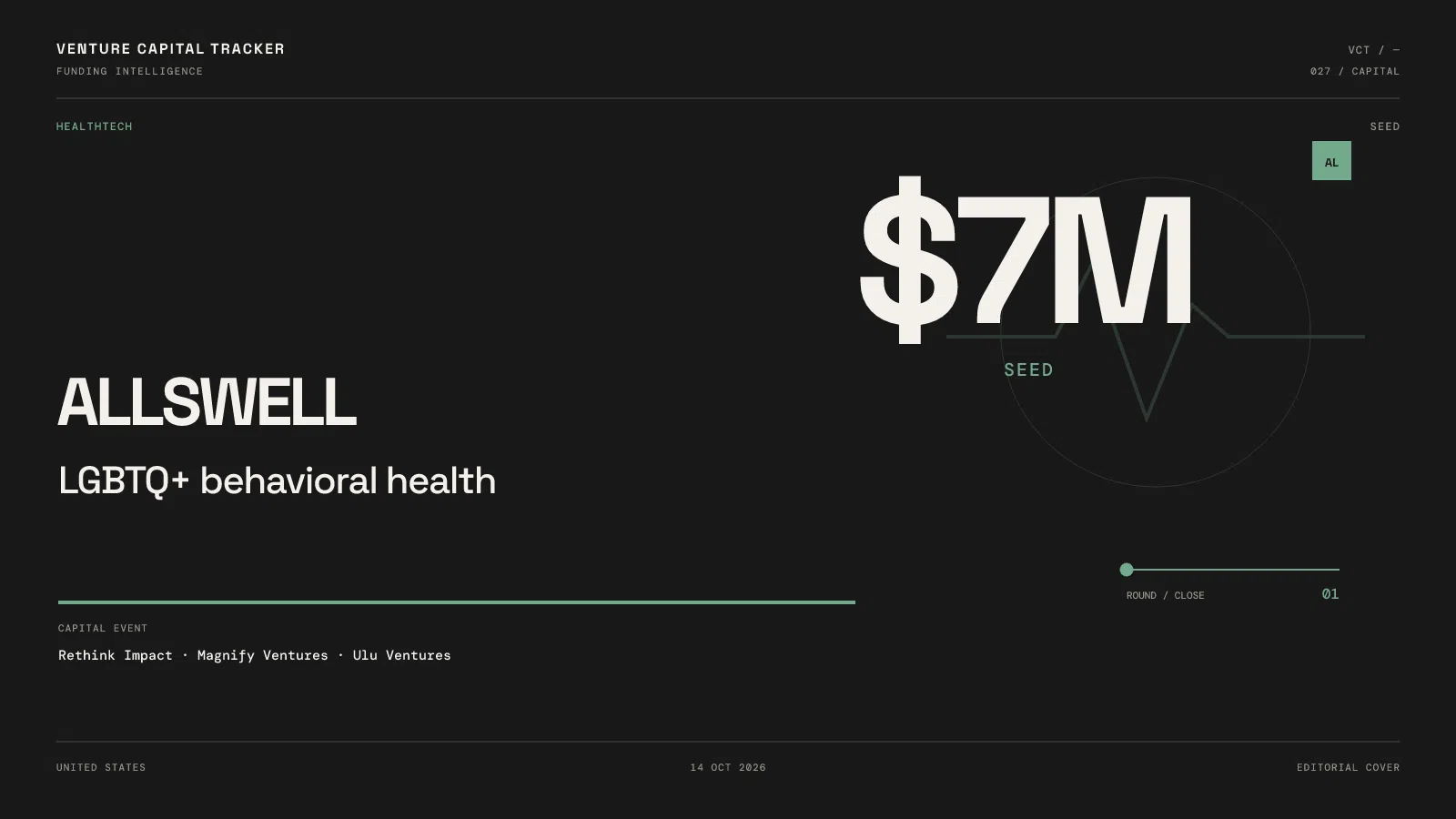
Allswell announced a $7M seed round on October 14, 2026, led by Rethink Impact, with Magnify Ventures, Ulu Ventures and Hopelab Ventures participating.
The company release positions the financing around expanding insurance-covered behavioral healthcare for the LGBTQ+ community. This is an announced seed financing, not a debt facility, grant or acquisition. The precise legal closing date and individual investor allocations are not disclosed.
What Allswell raised
| Item | Disclosed detail |
|---|---|
| New financing | $7M seed |
| Lead investor | Rethink Impact |
| Other named round participants | Magnify Ventures; Ulu Ventures; Hopelab Ventures |
| Announcement date | October 14, 2026 |
| Planned expansion | Additional states, clinician training and medication management |
| Valuation | Not disclosed in the announcement |
The new round is distinct from Allswell’s earlier $1.3M pre-seed. Techstars’ announcement places cumulative funding at $8.3M; that is not the amount newly raised. Earlier backers Techstars and Amboy Street Ventures should not automatically be counted as new-round participants without an explicit allocation or participation disclosure.
A specialist care model, not just a therapy marketplace
Allswell’s current offering combines individual virtual therapy with group support. Its website lists services in Washington, DC, Maryland and Virginia, and accepts Medicaid and commercial insurance subject to plan and location.
The financing supports expansion beyond that footprint and development of clinical training. Psychiatric medication management is planned for 2027, according to the announcement; it is not an existing service to include in current revenue assumptions.
Our analytical view is that specialization could help the company build a recognizable patient and referral proposition. But the competitive test is more demanding than attracting website visits. It must make qualified clinicians available, match patients appropriately and get paid reliably for care delivered.
Where the economics will be tested
Insurance participation can widen access, but a covered session is not the same as collected cash. Payer contracting, credentialing, claim acceptance, reimbursement rates and payment timing all affect working capital.
Expansion also requires clinical capacity. Training and supervision may support consistency, yet they consume time before a new clinician’s schedule produces revenue. A useful diligence question is whether adding another state becomes a repeatable process or recreates substantial local operating work.
Longer patient relationships need careful interpretation. Continuity can be valuable when clinically appropriate; longer treatment is not automatically a superior outcome. Revenue retention should be assessed alongside patient needs, access, experience and documented progress—not treated as a substitute for them.
The next milestone is evidence of repeatable delivery
The most informative follow-up measures would include time to first appointment, clinician utilization, collected revenue per session, claim-denial rates and the cost of opening each market. These are analytical diligence criteria, not performance figures disclosed by Allswell.
Clinical improvement claims also need cohort definitions, follow-up rates, measurement methods and appropriate comparisons before they establish effectiveness. This article does not treat promotional outcome figures as independently validated findings.
The seed round gives Allswell resources to develop a broader care offering. The investment thesis will be strengthened if it can show that specialist access and reliable reimbursement expand together, without weakening care quality.
Source note: Financing facts are company-disclosed and corroborated by Techstars and healthcare reporting. Operating-economics discussion is VCT analysis. Planned services are distinguished from current availability.
Follow Venture Capital Tracker in Google
Add VCT as a preferred source to make our venture-capital coverage easier to find in Google Search.
Editorial note: AI tools assisted with research, structure, or drafting. Venture Capital Tracker retains human editorial responsibility for factual accuracy, relevance, and source quality before publication.