Yazen Raises €50M to Scale Digital Obesity Care Across Europe
Swedish digital-health company Yazen secured €50 million led by Verdane, with Evli Growth Partners participating, to expand its medication-plus-clinical-support obesity model across Europe.
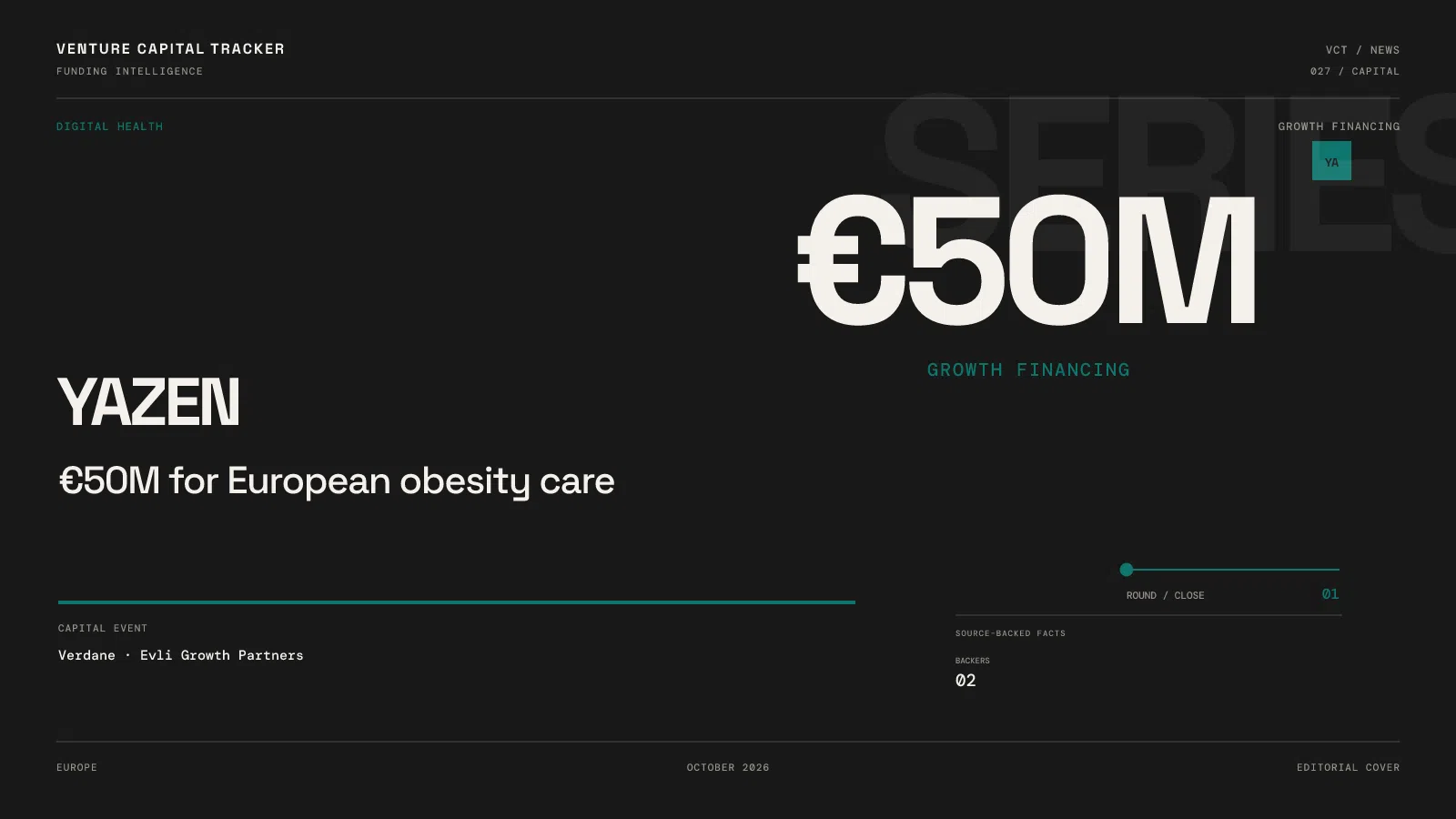
Yazen has secured €50 million of growth financing to expand its digital obesity-care platform across Europe. European growth investor Verdane led the transaction, with previous lead investor Evli Growth Partners participating.
The company and investors did not disclose a conventional round label, valuation, ownership percentages or whether the transaction contains secondary shares. It should therefore be reported as a €50 million growth financing, not a Series C or buyout.
Financing at a glance
| Field | Detail |
|---|---|
| Company | Yazen |
| Amount | €50 million |
| Stage | Growth financing; formal series label undisclosed |
| Lead investor | Verdane |
| Participant | Evli Growth Partners |
| Valuation | Undisclosed |
| Announced | October 8, 2026 |
| Status | Confirmed financing |
What the capital backs
Yazen treats obesity as a chronic disease rather than a short prescription cycle. Its service combines modern weight-loss medication with continuous digital care from doctors, health coaches, dietitians, psychologists and physiotherapists.
The company operates in Sweden, Norway, Denmark, the Netherlands, the United Kingdom, Germany, Switzerland and Spain. Verdane said Yazen has more than 50,000 patients currently in treatment and has treated over 70,000 in total. Those figures are company-provided and have not been independently audited.
The new capital will support expansion into additional European markets and a broader cardiometabolic-care offering. That strategy increases Yazen's addressable market, but it also expands regulatory, clinical and reimbursement complexity.
The investment case
The GLP-1 drug cycle has created enormous demand for medical weight management. The durable opportunity, however, is not simply prescribing medication. Digital providers must show that they can acquire patients economically, retain them after initial weight loss and improve outcomes while medications, reimbursement rules and supply conditions change.
Yazen's multidisciplinary model is designed around adherence. The company cites a 2025 study showing 70% of patients remaining in treatment after 12 months, compared with reported discontinuation rates of 20% to 50% across the broader market. The comparison is directionally useful, but investors should examine study design, patient selection and whether outcomes remain strong across countries.
A more defensible business would combine:
- low-cost patient acquisition;
- reliable physician capacity;
- measurable adherence and clinical outcomes;
- recurring revenue beyond the initial medication phase;
- country-specific reimbursement and regulatory compliance; and
- a broader cardiometabolic pathway that increases revenue per patient without weakening care quality.
Why Verdane matters
Verdane invests flexibly across minority growth, replacement capital and control transactions. The firm has raised €10 billion and completed more than 200 investments, according to its announcement.
That flexibility also means the round's structure matters. Neither Yazen nor Verdane disclosed whether the €50 million is entirely primary capital, whether existing shares changed hands, or whether Verdane gained control rights. Until those terms are public, the entire amount should not automatically be counted as fresh operating cash.
Evli Growth Partners' participation provides continuity from Yazen's previous institutional financing. The syndicate gives Yazen capital and experience for expansion, but European healthcare remains fragmented: clinical licensing, advertising, prescribing, data protection and reimbursement vary by market.
Competitive pressure
Yazen competes with local digital obesity clinics, scaled telehealth companies and conventional providers adding virtual care. Drug manufacturers and insurers may also build or finance adherence programs directly.
The strongest moat is unlikely to be an app interface. It will come from longitudinal clinical data, regulated operations, physician networks, outcomes evidence and retention. A company that merely routes prescriptions risks margin compression as medication access becomes more common.
Milestones to watch
The next evidence should include:
- active-patient growth by country;
- 12- and 24-month retention;
- weight-loss and cardiometabolic outcomes;
- revenue and contribution margin per patient;
- clinician utilization and care quality;
- reimbursement mix; and
- the primary-versus-secondary split of the financing.
Editorial view
This is a meaningful European digital-health financing because it moves capital toward the care layer surrounding obesity drugs. The key question is whether Yazen can turn medication-led demand into a durable, outcomes-based healthcare platform.
The €50 million amount is confirmed. The stage, valuation and capital structure are not, and should remain described as undisclosed.
Editorial note: AI tools assisted with research, structure, or drafting. Venture Capital Tracker retains human editorial responsibility for factual accuracy, relevance, and source quality before publication.