Wiremind Raises €35M After 12 Years of Bootstrapped Growth
Profitable French travel-software company Wiremind raised its first outside capital: €35 million from IronWave, Bpifrance Large Venture and Seaya Andromeda.
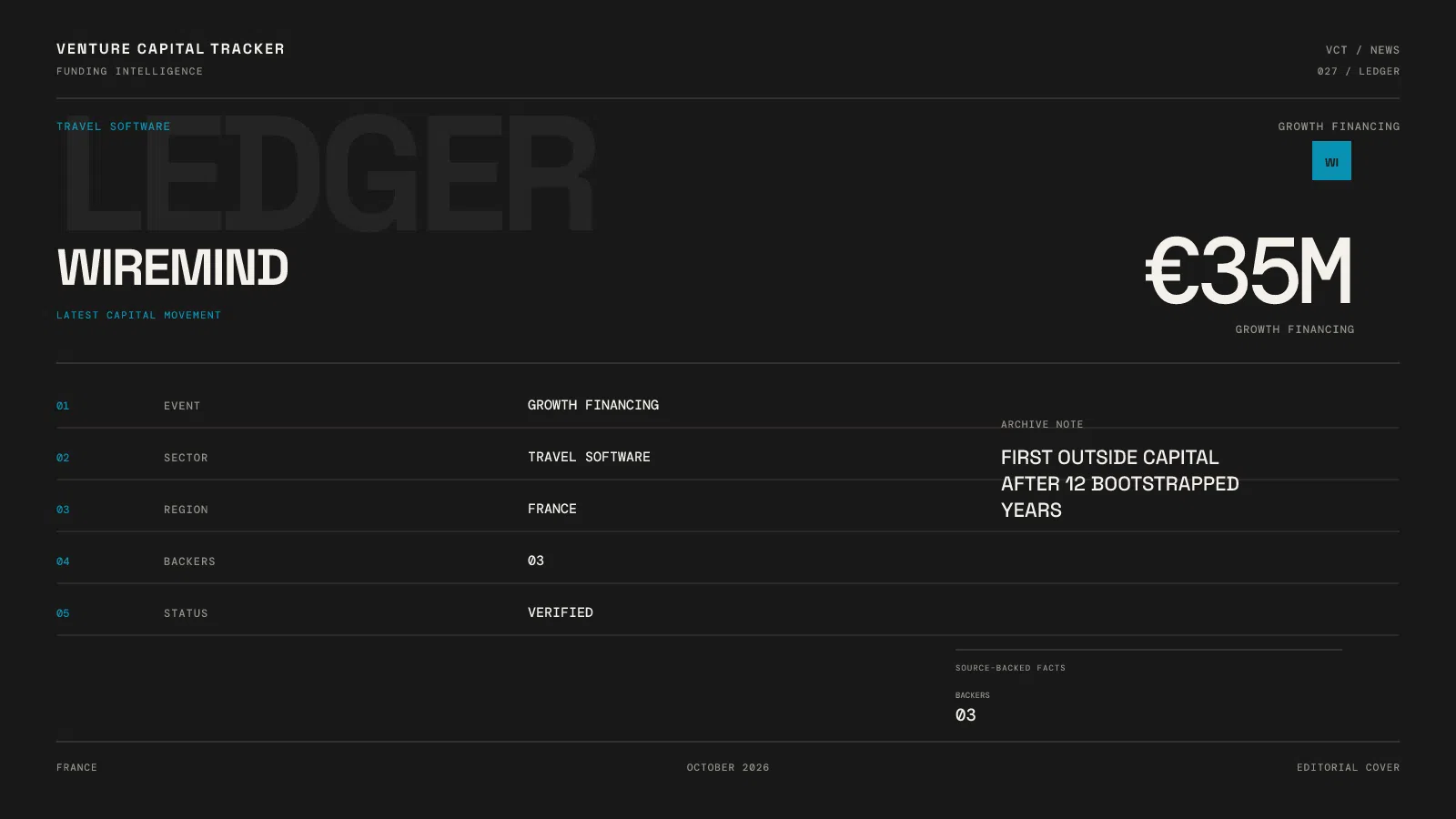
Wiremind has raised €35 million in its first external financing after 12 years of bootstrapped growth.
The Paris company brought in three new investors: IronWave, formerly Wendel Growth; Bpifrance Investissement through its Large Venture fund; and Seaya Andromeda. Wiremind did not label the transaction as a conventional venture series or disclose a valuation.
Financing at a glance
| Field | Detail |
|---|---|
| Company | Wiremind |
| Amount | €35 million |
| Stage | First external growth financing |
| Investors | IronWave, Bpifrance Large Venture, Seaya Andromeda |
| Valuation | Undisclosed |
| Control | Founders remain majority shareholders |
| Announced | October 6, 2026 |
What Wiremind does
Wiremind develops revenue-management, inventory and distribution software for passenger transport, air cargo and live events.
Its product portfolio includes CAYZN for revenue management, PAXONE for passenger distribution, CARGOSTACK for air cargo and EVENTORI for entertainment ticketing. Customers named in company and investor reporting include SNCF, Eurostar, Trenitalia, OUIGO España and Alsa.
The company says it grew revenue by 67% in 2025, added 23 customers and serves more than 80 customers in total. Those figures are company-reported and not independently audited.
An unusual financing profile
Wiremind says it was profitable and self-funded from its 2014 founding until this transaction. That creates a different risk profile from a venture-backed SaaS company using equity to cover operating losses.
The financing is intended to accelerate international expansion and deepen investment in technology and AI. Spain will be a priority and a route into Latin America, while Wiremind also plans to expand in the Middle East and Asia-Pacific.
Bootstrapped history can signal capital discipline and product-market fit. It can also mean that systems, sales processes and governance must change quickly as the company shifts from founder-funded growth to institutional expectations.
Revenue-management economics
Revenue-management software becomes valuable when small pricing or capacity improvements produce large gains across trains, flights or venues.
A strong product should demonstrate:
- incremental revenue or load-factor improvement;
- reliable forecasts across volatile demand;
- integration with inventory and distribution systems;
- low operational latency;
- explainability for pricing teams;
- retention and expansion among large operators; and
- implementation economics that do not depend on extensive services.
Wiremind's industry specialization creates domain depth. The trade-off is concentration: transport and events are exposed to travel cycles, regulation and large-enterprise procurement.
AI opportunity and risk
Wiremind plans to incorporate large language models into systems managing revenue, capacity, inventory and distribution. Natural-language interfaces can make complex optimization tools easier to use, but they do not replace forecasting, mathematical optimization or operational controls.
AI claims should be judged by measurable improvements in forecast accuracy, analyst productivity and revenue—not the presence of an assistant. Pricing decisions can have customer, regulatory and reputational effects, so human oversight remains important.
Investor fit
IronWave supplies European growth capital. Bpifrance Large Venture adds a long-duration French institutional investor. Seaya Andromeda brings experience in Spain and Latin America.
The founders remaining majority shareholders protects continuity. The undisclosed valuation, ownership stakes and security terms limit assessment of how the three investors priced a company that says it is profitable.
Competitive landscape
Wiremind competes with established revenue-management vendors, travel-retailing platforms and in-house systems. Incumbents have deep integrations and long procurement relationships.
Wiremind's advantage is an integrated, modern product suite built specifically for passenger transport, cargo and events. Its challenge is proving that expansion does not erode implementation quality or margins.
Editorial view
The most important feature of this financing is not the €35 million headline. It is the decision by a profitable, 12-year-old software company to accept outside capital to accelerate international growth.
Investors should watch whether Wiremind preserves capital efficiency while increasing sales and R&D spending. The round amount is confirmed; the stage, valuation and investor ownership remain undisclosed.
Editorial note: AI tools assisted with research, structure, or drafting. Venture Capital Tracker retains human editorial responsibility for factual accuracy, relevance, and source quality before publication.