Healthleap Discloses $38M Across Seed and Series A for Clinical AI
Healthleap disclosed $38 million across seed and Series A financings from Sequoia, First Round and Hummingbird to expand AI screening for undiagnosed hospital conditions.
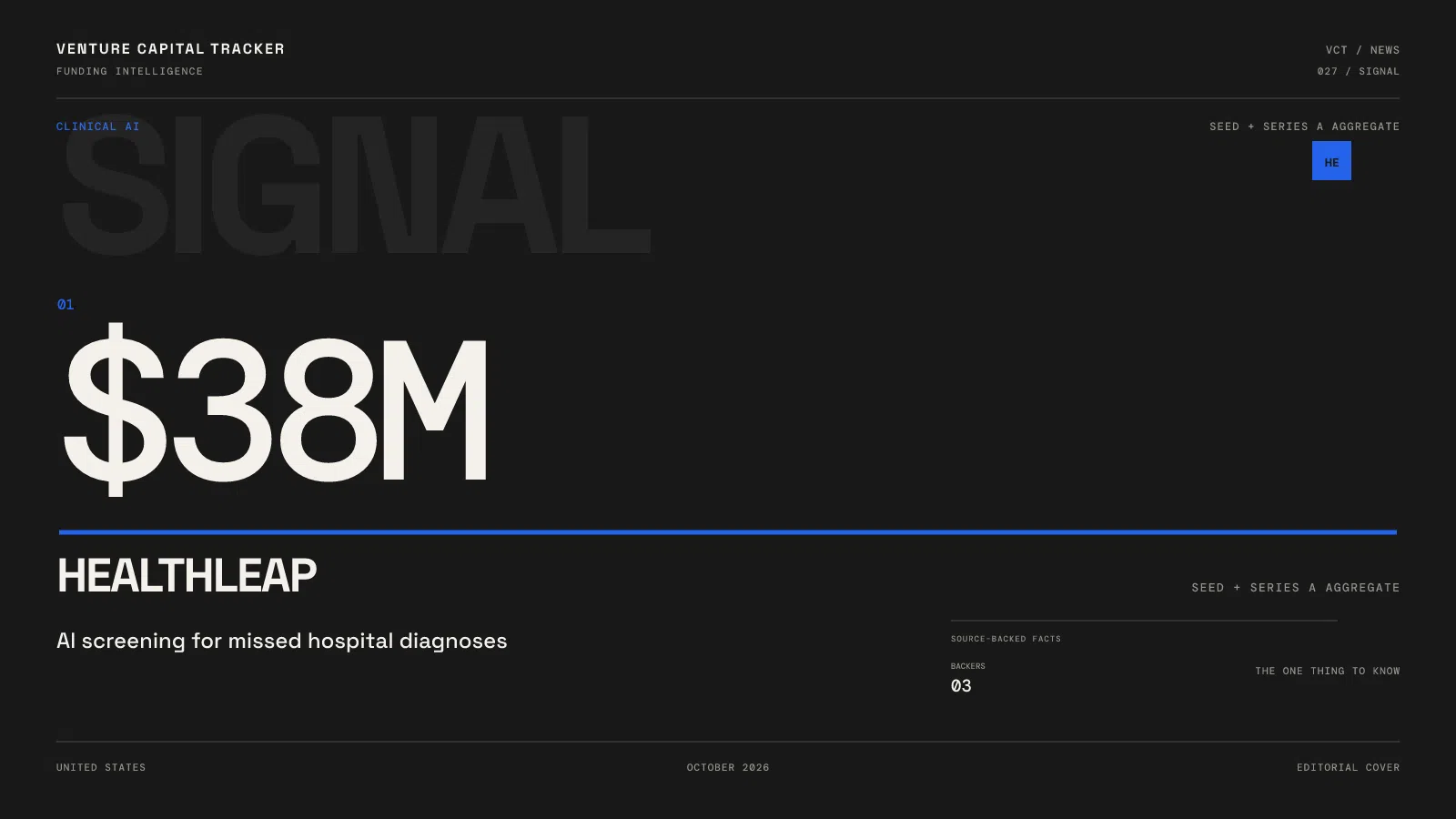
Healthleap has disclosed $38 million in combined seed and Series A funding from Sequoia Capital, First Round Capital and Hummingbird Ventures.
The amount aggregates more than one financing. Healthleap did not publish the seed-Series A split, identify a single lead for the combined total or disclose a valuation. The correct classification is therefore $38 million across seed and Series A, not a new $38 million Series A.
Financing at a glance
| Field | Detail |
|---|---|
| Company | Healthleap |
| Disclosed funding | $38 million aggregate |
| Stages | Seed and Series A |
| Investors | Sequoia Capital, First Round Capital, Hummingbird Ventures |
| Valuation | Undisclosed |
| Announced | October 7, 2026 |
| Status | Confirmed aggregate disclosure |
What Healthleap sells
Healthleap's clinical AI reads inpatient records every morning and flags patients who may have conditions that clinicians have not yet identified. It begins with malnutrition, analyzing notes, laboratory results, vital signs, orders and problem lists inside hospital workflows.
The company says its software screens adult inpatients at more than 20 hospitals, including Penn Medicine, Houston Methodist, Cedars-Sinai and Emory Healthcare. It plans to expand to more conditions and hire across engineering, product, sales and customer success.
This is not a general diagnostic chatbot. The product is closer to an EHR-integrated screening and prioritization layer. That distinction matters because deployment depends on clinical validation, data access, workflow integration and measured alert quality.
Economics for hospitals
Healthleap frames its value proposition around both outcomes and reimbursement. Malnutrition is frequently missed, and a documented severe diagnosis can change care plans and support additional reimbursement.
The company cites one Penn Medicine hospital where it says the platform generated $23.8 million annually through incremental reimbursement and shorter lengths of stay. It also cites a health system that identified 39% more malnutrition cases and generated $11 million of incremental revenue.
Those are company-reported examples. They provide a strong sales narrative but are not the same as independent, multi-site evidence. Buyers should test whether gains persist after adjusting for case mix, coding practice, implementation cost and alert burden.
The clinical-AI hurdle
Screening software can create value only if clinicians trust it and can act on it. False negatives leave patients undiagnosed. False positives create alert fatigue and additional work.
Important evidence includes:
- prospective validation across diverse hospitals;
- sensitivity, specificity and positive predictive value;
- changes in treatment, not only documentation;
- effect on length of stay and readmission;
- clinician adoption and override rates;
- integration time and ongoing support cost; and
- performance drift as hospital data and workflows change.
Healthleap's move into additional conditions broadens the commercial opportunity but increases validation burden. A model that works for malnutrition does not automatically transfer to sepsis, kidney disease or other risks.
Competitive position
Healthleap competes with EHR-native decision support, specialist diagnostic-AI vendors and internal analytics teams. Epic and other incumbents control core workflows, while hospitals are increasingly wary of adding separate dashboards.
Healthleap's advantage would be a validated product that produces measurable clinical and financial gains with minimal workflow friction. Its risk is that large EHR vendors reproduce the functionality or that reimbursement changes weaken part of the ROI.
Why the funding structure matters
A headline saying "$38 million Series A" would overstate the latest round. The company described combined seed and Series A funding, without a tranche breakdown.
That ambiguity affects analysis. Investors cannot determine how much capital is newly available, the price of the Series A, dilution or the financing cadence. The aggregate still signals strong institutional backing, but it should not be used as a direct benchmark against single-round Series A financings.
Milestones to watch
- the exact Series A amount and date;
- expansion beyond malnutrition;
- independent clinical validation;
- hospital retention and deployment time;
- revenue linked to software versus services;
- accuracy and alert-acceptance rates; and
- evidence that reimbursement gains translate into durable contracts.
Editorial view
Healthleap has a credible wedge because it connects clinical AI to a measurable hospital problem. The investment case is stronger than generic "AI for healthcare" positioning, but its claims need multi-site validation and careful attribution.
The $38 million aggregate is confirmed. The amount attributable to the Series A, the lead investor and the valuation remain undisclosed.
Editorial note: AI tools assisted with research, structure, or drafting. Venture Capital Tracker retains human editorial responsibility for factual accuracy, relevance, and source quality before publication.