Aphias Capital Closes $1.05B-Plus Debut Buyout Fund
Aphias Capital closed its inaugural healthcare and essential-services private equity fund above $1.05 billion, exceeding its $900 million target and hard cap.
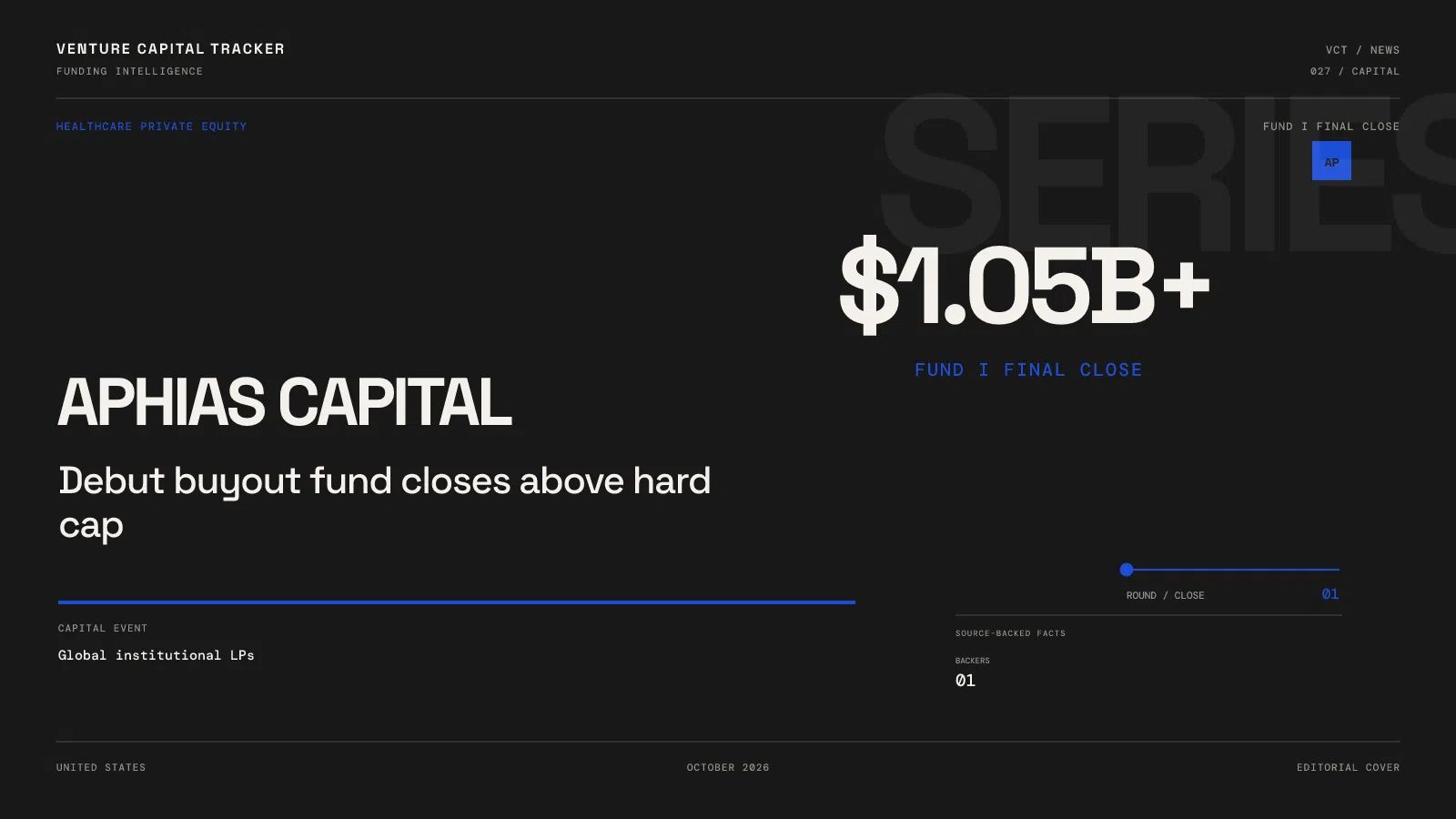
Aphias Capital has closed its inaugural private equity fund with just over $1.05 billion in total commitments.
Fund I exceeded its $900 million target and the firm's stated hard cap. The vehicle attracted public pension plans, health systems, insurers, endowments, foundations, family offices, funds of funds and other institutions. Individual limited partners and commitment sizes were not disclosed.
Fund at a glance
| Field | Detail |
|---|---|
| Manager | Aphias Capital |
| Vehicle | Aphias Capital Fund I |
| Final close | Just over $1.05 billion |
| Target | $900 million |
| Strategy | Lower-middle-market buyouts |
| Sectors | Healthcare services and essential services |
| Geography | North America |
| Announced | October 8, 2026 |
This is private equity, not venture capital
Aphias makes control investments in established North American services companies. It targets businesses with $5 million to $30 million of EBITDA and typically becomes their first or second institutional investor or acquires corporate carve-outs.
The vehicle belongs in VCT's investment-news coverage because it is a large debut fund close and competes for institutional capital and growth assets. It should not be classified as an early-stage venture fund.
That distinction changes how performance should be assessed. Fund I will depend on entry multiples, leverage, operational improvements, add-on acquisitions and exit markets—not startup graduation rates.
Why the close is notable
New managers have faced a difficult fundraising market as limited partners concentrate commitments with established firms. Aphias exceeded a $900 million target with a debut vehicle in roughly a year, according to specialist reporting.
The team is new as a firm but experienced as a group. Nine professionals previously worked together at H.I.G. Capital, many for more than a decade. Aphias founder Rob Wolfson formerly led H.I.G.'s global healthcare practice.
That history helps explain LP demand. Investors are effectively backing an established deal team inside a new platform rather than an untested group.
Investment model
Aphias focuses on healthcare services and essential services with recurring demand. The firm says it will use operational resources, technology and strategic growth to build larger businesses.
The attractive part of the lower middle market is the number of founder-owned and smaller institutionalized companies. Entry valuations can be lower than in large-cap buyouts, and operational changes can materially affect earnings.
The risks are equally important:
- smaller companies can have concentrated customers and management teams;
- healthcare reimbursement and regulation can change economics;
- add-on acquisition strategies create integration risk;
- leverage can amplify operational setbacks; and
- exit multiples may be lower when assets mature.
Fund construction questions
The announcement does not disclose target check sizes, number of platform investments, reserve policy, fee terms, carry, recycling provisions or fund life.
A $1.05 billion fund investing in companies with $5 million to $30 million of EBITDA could support a concentrated portfolio of platforms plus follow-on capital for acquisitions. The exact concentration and leverage policy will determine risk.
LPs should also distinguish gross operating improvements from returns generated by leverage or multiple expansion. A debut fund will need several years before realized-return data becomes meaningful.
Service providers
PJT Park Hill served as exclusive placement agent and Kirkland & Ellis acted as fund counsel. The LP base spans multiple institutional categories, but no named investor was disclosed in the fund announcement.
Competitive landscape
Aphias competes with specialist healthcare buyout funds, generalist lower-middle-market managers and strategic buyers. Its healthcare network and team continuity can improve sourcing, but competition for quality services assets remains intense.
The strongest differentiator would be proprietary deal flow and repeatable operating value creation. Branding an approach does not replace evidence; the first portfolio companies and subsequent exits will test the model.
Editorial view
Aphias Fund I is one of the more notable debut-manager closes of 2026. It demonstrates that institutional LPs will still back a new platform when the team brings a long shared track record.
The classification must remain precise: this is a $1.05 billion-plus lower-middle-market private equity fund, not a venture fund and not capital committed directly to startups.
Editorial note: AI tools assisted with research, structure, or drafting. Venture Capital Tracker retains human editorial responsibility for factual accuracy, relevance, and source quality before publication.