· Venture Capital Tracker Editorial
Stuut Raises $52.5M to Automate Order-to-Cash
Stuut raised a $52.5 million Series B led by Insight Partners to expand AI agents across collections, payments and enterprise order-to-cash.
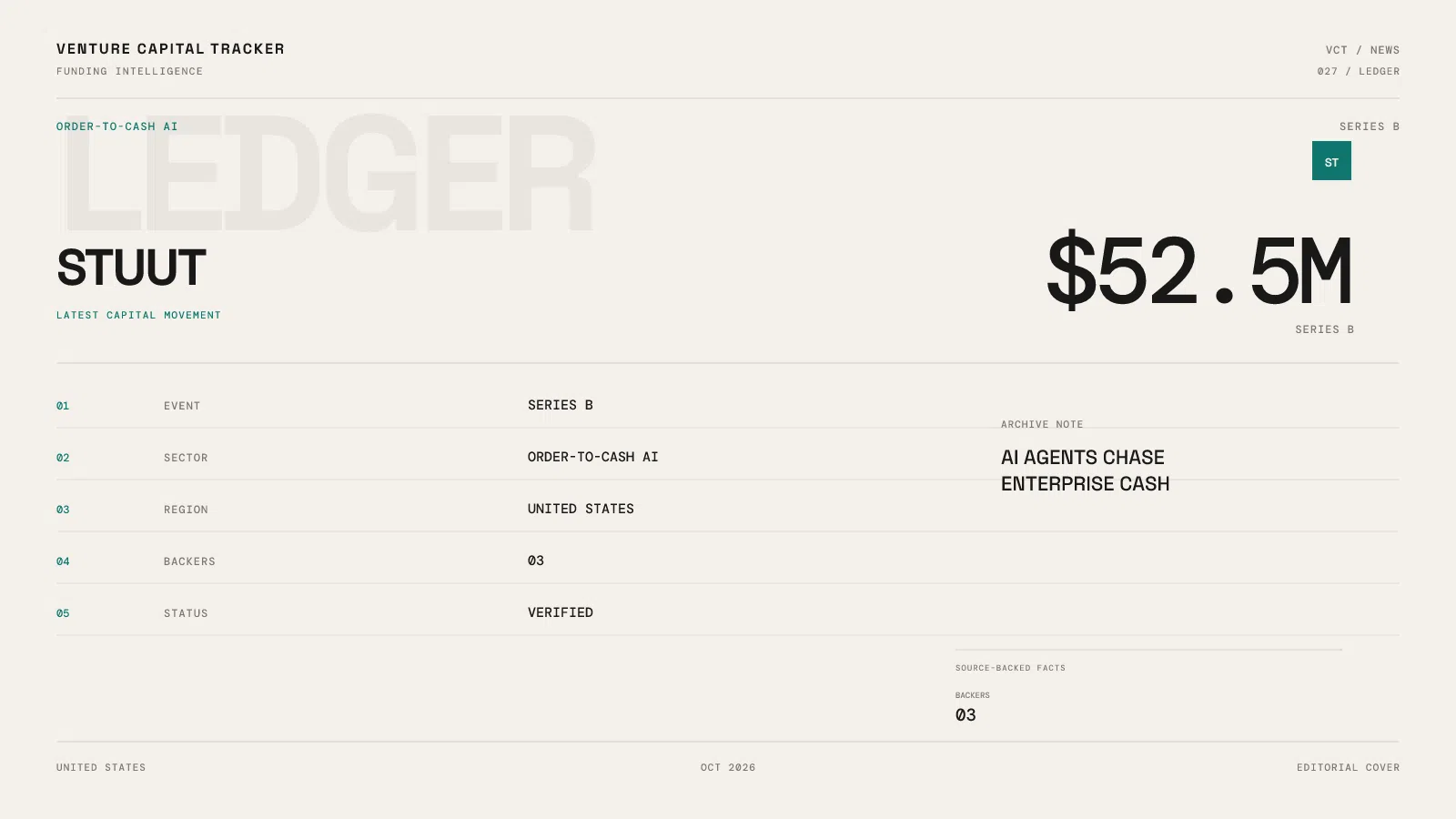
Stuut has raised a $52.5 million Series B led by Insight Partners to expand its AI-driven order-to-cash platform. Andreessen Horowitz, M12 and Activant Capital participated, bringing the company’s total funding to $93 million.
The financing comes about ten months after Stuut announced $29.5 million of combined Series A funding. It gives the company more capital to move beyond collections into the financial infrastructure surrounding enterprise transactions.
Stuut Series B at a glance
- Financing: $52.5 million Series B
- Lead investor: Insight Partners
- Other investors: Andreessen Horowitz, M12 and Activant Capital
- Total funding: $93 million
- Sector: Enterprise finance automation
- Status: Company-announced and confirmed
Stuut says revenue has grown more than 90% quarter over quarter and that customers have unlocked as much as 40% more cash. Those are company-reported performance figures. The useful question is whether its AI agents can sustain those results across many enterprise accounting systems and customer policies.
Why order-to-cash attracts AI capital
Order-to-cash covers everything between accepting an order and receiving the money: invoicing, collections, disputes, deductions, payments and cash application. Large companies often manage these steps across spreadsheets, email, ERP systems and specialized software.
The workflow is expensive because exceptions require human judgment. A customer may dispute an invoice, short-pay it, apply an old credit or send a payment without enough information to match it. Stuut’s agents are designed to investigate those cases, communicate with customers and update financial systems.
That makes accounts receivable a practical market for agentic AI. Outcomes are measurable in days-sales-outstanding, recovered cash and staff time. Buyers can compare the product’s cost with the working capital it releases.
The platform opportunity—and the risk
Stuut is expanding from collections into a broader order-to-cash platform. That increases its potential contract value and embeds it more deeply in customers’ finance operations. It also pushes the company into competition with established vendors such as HighRadius, Billtrust, Versapay and enterprise ERP suites.
Incumbents have integrations, historical data and long customer relationships. Stuut’s advantage is an AI-native architecture intended to complete workflows rather than merely recommend the next task. The challenge is proving that the agents can handle unusual cases without creating accounting errors or damaging customer relationships.
Finance teams need detailed audit trails, approval controls and predictable escalation to humans. Enterprise deployments also depend on integrations with systems such as SAP, Oracle and Microsoft Dynamics. A fast pilot is useful, but durable revenue requires reliable operation across many subsidiaries, currencies and payment methods.
Why the syndicate matters
Insight Partners has extensive experience scaling enterprise-software companies. Andreessen Horowitz led Stuut’s earlier financing, while M12 adds a strategic connection to Microsoft’s enterprise stack. Activant brings expertise in commerce and transaction infrastructure.
The investor group fits Stuut’s ambition to become more than a collections tool. Management has discussed moving into credit, lending and the movement of funds. Those adjacent products could increase revenue, but they also introduce underwriting, regulatory and balance-sheet questions that pure software does not face.
What to watch after the Series B
Four metrics will show whether Stuut is becoming a category leader:
- Cash impact: Independently verifiable improvements in collection rates and days-sales-outstanding.
- Deployment speed: Time required to integrate with complex enterprise finance systems.
- Human intervention: The share of exceptions agents resolve without manual work.
- Platform expansion: Revenue from payments, cash application, disputes and credit beyond core collections.
The company also needs to show that its rapid growth is efficient. High-touch implementation and customized workflows can make enterprise AI look like software while producing services-like margins.
The bottom line
Stuut is attacking a large, measurable financial problem: companies waiting to be paid. The $52.5 million Series B gives it the resources to broaden from accounts-receivable automation into an order-to-cash platform. Its opportunity is significant because released working capital has immediate value. Its execution risk is equally clear: financial agents must be accurate, auditable and trusted before enterprises allow them to act autonomously.
Editorial note: AI tools assisted with research, structure, or drafting. Venture Capital Tracker retains human editorial responsibility for factual accuracy, relevance, and source quality before publication.