· Venture Capital Tracker · venture-capital
Ledgebrook Raises $200M for AI Specialty Insurance
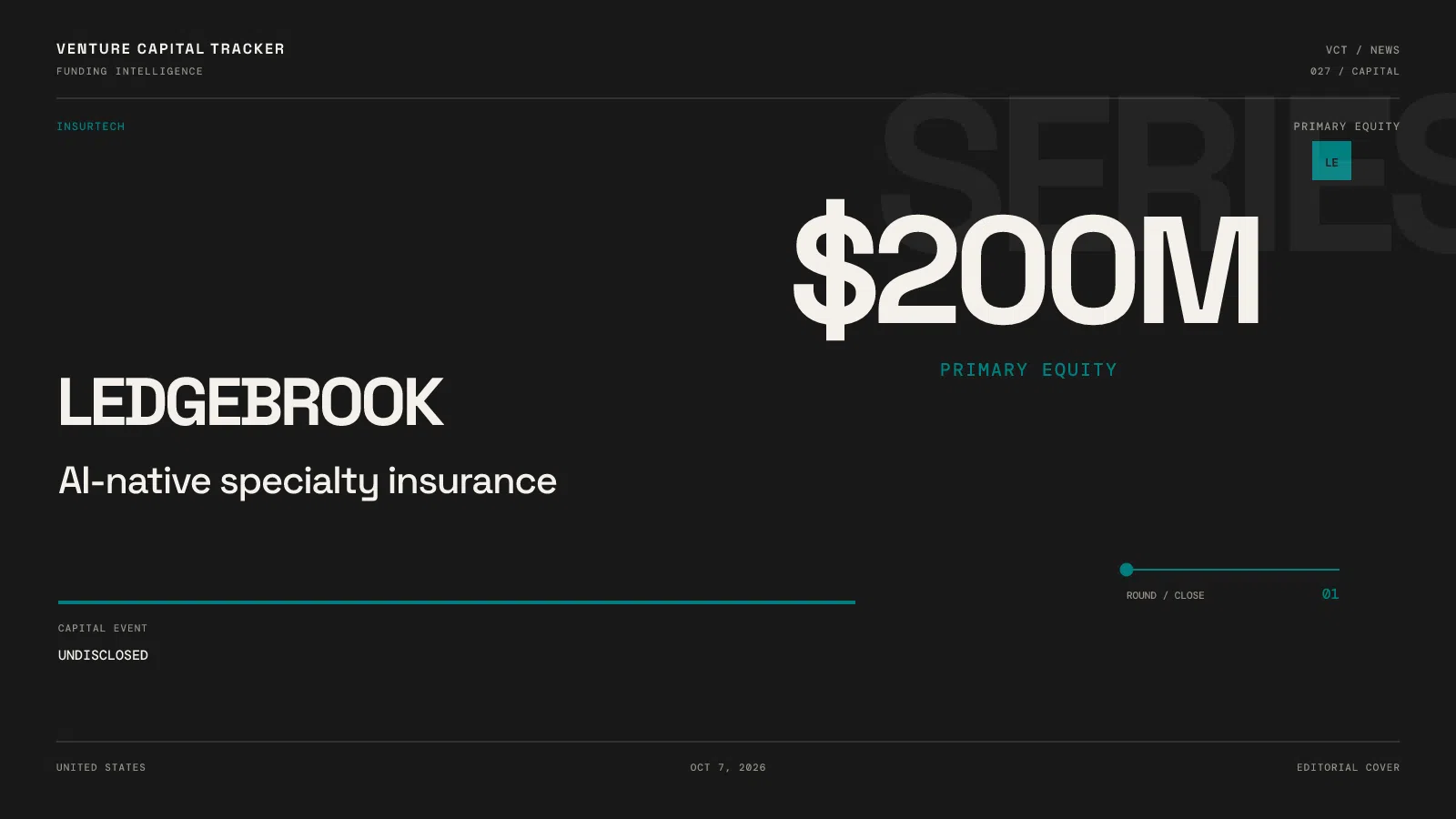
Ledgebrook raised $200M in primary equity led by Allianz X and Rockefeller Capital Management, alongside a separate Allianz Re reinsurance deal.
Ledgebrook Raises $200M for AI-Native Specialty Insurance
Ledgebrook has raised $200 million of primary equity financing to expand its specialty-insurance platform. Allianz X and Rockefeller Capital Management co-led the transaction; the company said additional new and existing investors joined but did not name them.
The financing was announced alongside a multiyear reinsurance agreement with Allianz Re. These are related strategic arrangements, but they are not the same capital. The $200 million is equity invested in Ledgebrook. The reinsurance agreement provides risk capacity and support for policies written by the business; no dollar value was disclosed.
Ledgebrook did not assign a conventional stage such as Series D to the new financing and did not disclose a valuation. Calling it a $200 million primary-equity round is therefore more precise than inferring a stage.
What Ledgebrook is building
Ledgebrook operates in the US excess-and-surplus, or E&S, insurance market. This market handles risks that admitted carriers may not cover under standard policy forms or pricing rules. Customers reach the company through wholesale brokers, while Ledgebrook combines insurance capacity, underwriting teams and its own software.
Its internal platform, Blackbird, is designed to read broker submissions, classify risks and calculate technical pricing inputs. Ledgebrook says this can move some specialty risks from submission to quote in hours rather than weeks. Experienced underwriters retain the final decision.
That distinction matters. Ledgebrook is not selling a generic AI assistant to insurers. It is using software inside an underwriting operation where pricing errors eventually appear as claims losses. Faster quoting is valuable only if risk selection, reserving and reinsurance remain disciplined.
The company says it is approaching $1 billion in cumulative premium written since it began writing business in 2023. This is a measure of insurance volume, not revenue, profit or capital. Premium growth also arrives before the full loss history on newer policies is known.
Why Allianz is investing and reinsuring
Allianz is participating on two sides of Ledgebrook's balance sheet.
Allianz X is providing corporate equity, giving the insurer exposure to a technology-enabled platform in the US specialty market. Allianz Re is separately agreeing to reinsure business written by Ledgebrook. Reinsurance allows an underwriting platform to share risk and increase the volume it can support without retaining every dollar of potential loss.
The pairing offers Ledgebrook more than cash. A well-capitalized reinsurance counterparty can support product expansion and give brokers confidence that claims capacity will remain available. For Allianz, the relationship provides access to specialty risks and underwriting data in a fast-growing distribution channel.
It also creates concentration questions. The economics depend on the price and duration of reinsurance capacity, and on whether Ledgebrook can maintain attractive terms as its portfolio grows. The company did not disclose those contractual details.
Ledgebrook's funding history
Ledgebrook was founded by Gage Caligaris in 2022. Its disclosed financing includes:
| Date | Financing | Amount |
|---|---|---|
| August 2022 | Seed | $4.2M |
| April 2023 | SAFE financing | $4.6M |
| March 2024 | Series A | $24M |
| September 2024 | Series B | $17M |
| June 2025 | Series C | $65M |
| October 2026 | Primary equity financing | $200M |
The 2025 Series C was led by The Stephens Group, with Duquesne, Brand Foundry, Floating Point, American Family Ventures and Hummingbird Nomads among the participants. The latest round is much larger than Ledgebrook's earlier financings and introduces two institutional co-leads with insurance and financial-services reach.
What the new capital must prove
Ledgebrook plans to invest in Blackbird, products and talent. The financing gives the company room to expand, but the decisive evidence will come from insurance performance rather than model benchmarks.
Three indicators matter most:
- Loss ratios across mature policy cohorts. Growth is durable only if claims remain consistent with the prices charged.
- Underwriter productivity without control failures. Faster processing should not weaken documentation, escalation or regulatory compliance.
- Retention and reinsurance economics. Ledgebrook must show that brokers return and that capacity remains available at prices supporting attractive margins.
AI can reduce administrative work and help organize fragmented submission data. It cannot remove the long-tail uncertainty inherent in specialty insurance. Ledgebrook's investment case is strongest if Blackbird turns better information into consistent underwriting decisions—not merely faster quotes.
The competitive landscape
Technology-enabled insurers including Coalition, At-Bay and Vouch have shown that software can improve distribution and risk workflows. Ledgebrook is differentiated by its focus on E&S products and wholesale brokers, but it still competes with established specialty carriers that possess decades of claims data and deep broker relationships.
The new round gives Ledgebrook the capital to narrow that institutional gap. The Allianz relationship may be even more strategically important because it connects technology, underwriting and risk capacity. Whether that combination produces superior underwriting returns will take several policy years to establish.
Editorial note: AI tools assisted with research, structure, or drafting. Venture Capital Tracker retains human editorial responsibility for factual accuracy, relevance, and source quality before publication.