SEVA Growth Closes $160M Fund II Above Target in Under a Month
SEVA Growth closed its second software-focused growth-equity fund at $160 million, exceeding a $125 million target. Its concentrated minority-investment strategy creates both alignment and portfolio-concentration risk.
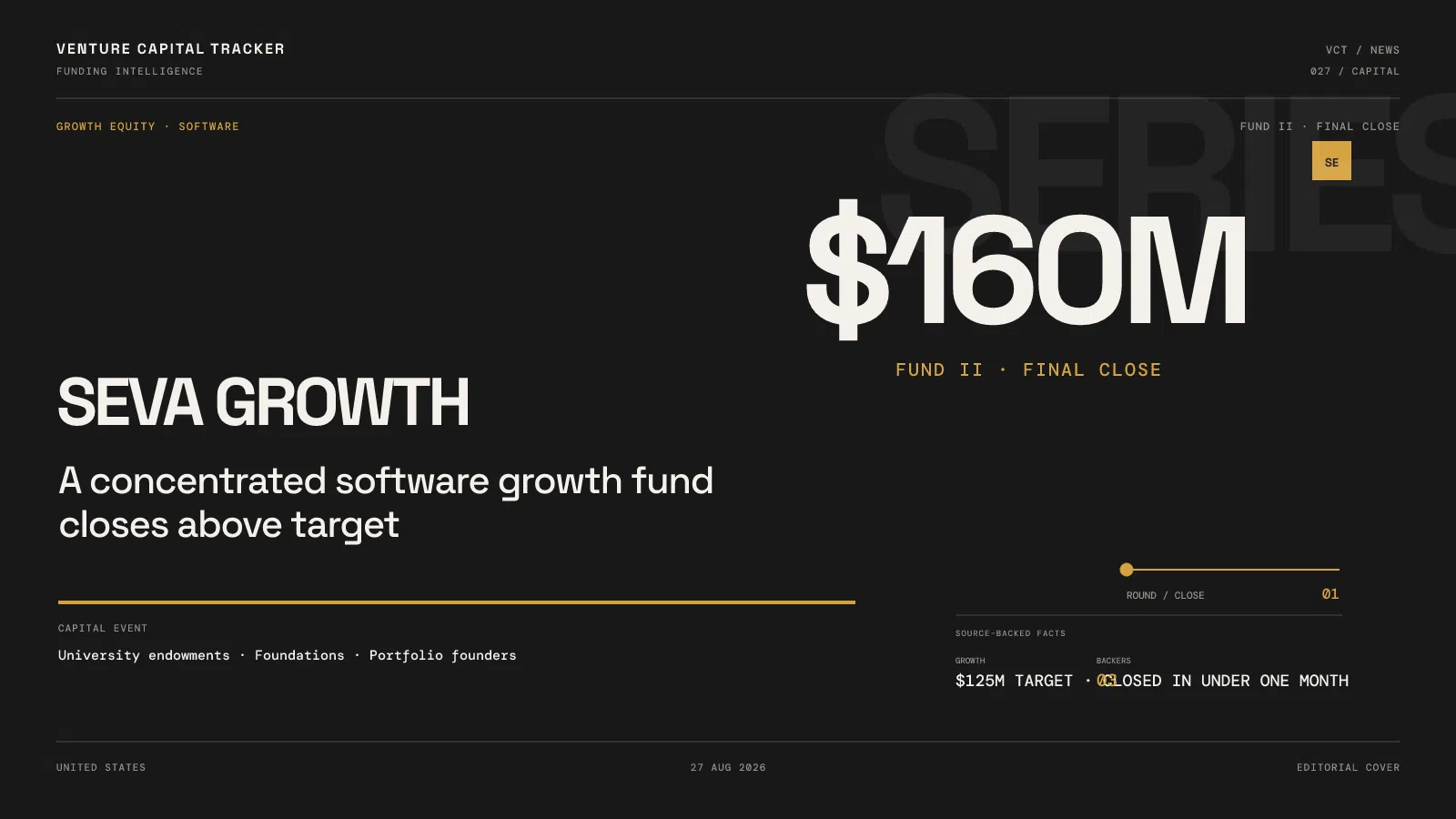
SEVA Growth has closed its second fund with $160 million of commitments, exceeding its original $125 million target after less than one month of fundraising.
The final close gives the Brooklyn firm more than $250 million under management and nearly doubles the $91 million ultimately raised for its first fund. SEVA says Fund II was multiple-times oversubscribed.
The financing at a glance
| Field | Detail |
|---|---|
| Vehicle | SEVA II LP |
| Status | Final close |
| Capital raised | $160 million |
| Original target | $125 million |
| Fundraising period | Less than one month |
| Strategy | Minority growth equity |
| Planned portfolio | Seven to nine companies |
| Sectors | Internet, software, data, marketplaces and technology-enabled services |
This is a fund close, not a company funding round. SEVA did not disclose management fees, carried interest, individual LP commitments, expected deployment timing or return data.
A concentrated growth-equity strategy
SEVA plans to make seven to nine minority investments in profitable or near-break-even, founder-led companies. It emphasizes sustained organic growth, customer retention and little prior institutional capital.
A simple division of $160 million across nine companies implies roughly $18 million per company; across seven, it implies almost $23 million. Actual initial checks should be lower because fees, reserves and follow-on capital also consume commitments. SEVA did not publish its allocation model or check-size range.
The portfolio construction therefore sits between conventional venture capital and control buyouts. Founders retain control, while SEVA takes board seats and provides operating support around hiring, reporting, go-to-market execution and exit planning.
Why the fundraising speed matters
SEVA's first fund targeted $50 million, closed at $85 million in 2023 and was topped up to $91 million in 2025. Fund II is larger and closed much faster.
That acceleration indicates strong LP demand for small, concentrated managers with realized operating access—but it is not proof of investment performance. SEVA disclosed no DPI, TVPI, net IRR or write-off ratio for Fund I.
The LP base includes university endowments, charitable foundations, nonprofit-focused investment managers, family offices and founders from all five existing portfolio companies. Individual institutions were not named.
What differentiates SEVA
SEVA focuses on capital-efficient businesses rather than companies that require repeated venture rounds. That can reduce financing risk and dilution, but creates a different challenge: profitable founder-owned software companies often have many funding alternatives and may resist institutional governance.
The firm also expects to hold relatively few investments. Concentration can make operating support meaningful, but a weak outcome in one company has more impact than it would in a diversified venture portfolio.
Risks to watch
- Concentration: seven to nine holdings leave little room for underwriting mistakes.
- Entry prices: competition for profitable software businesses may compress returns.
- AI disruption: established software companies can face rapid product and pricing pressure.
- Unreported performance: the first fund remains too young for its result to be judged from the announcement.
- Key-person exposure: SEVA is a small organization built around founder Shalin Mehta and a limited investment team.
Editorial view
Fund II is notable less for its absolute size than for the speed and concentration of the raise. SEVA has attracted institutional and founder LPs while maintaining a minority-only strategy aimed at businesses that already demonstrate capital efficiency.
The next evidence should come from deployment: entry valuations, ownership percentages, revenue quality and whether Fund I produces realizations—not from oversubscription alone.
Editorial note: AI tools assisted with research, structure, or drafting. Venture Capital Tracker retains human editorial responsibility for factual accuracy, relevance, and source quality before publication.