· Venture Capital Tracker Editorial
RobCo Crosses $1B Valuation in $40M Employee-Liquidity Transaction
RobCo has surpassed a $1 billion valuation in a reported $40 million transaction dominated by employee share sales—price discovery and liquidity, not a conventional $40 million primary round.
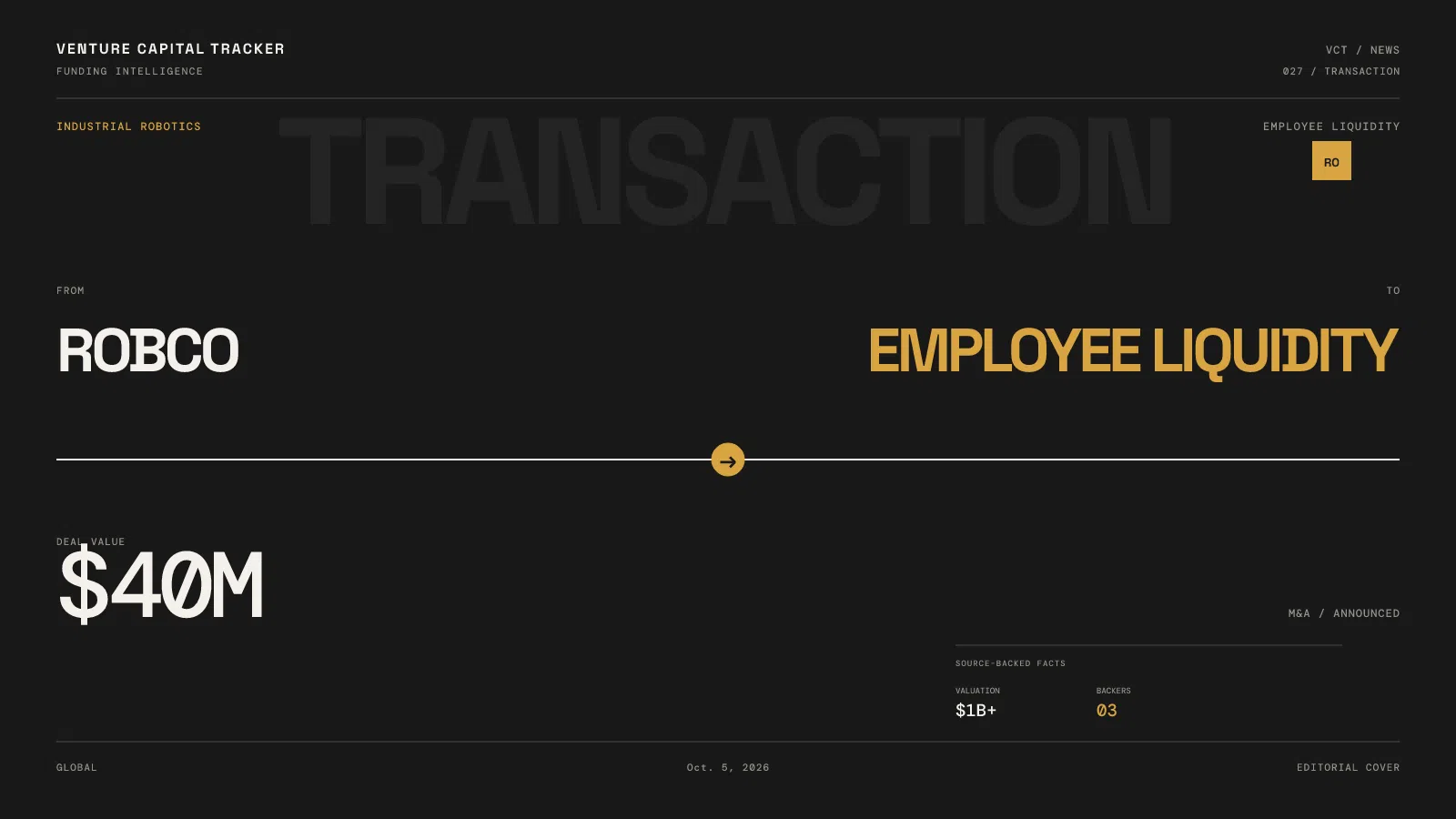
RobCo has crossed a $1 billion valuation in a transaction that is best understood as an employee-liquidity and valuation event—not a conventional $40 million venture round.
The Munich-founded industrial-robotics company confirmed on October 5 that it had completed a secondary transaction providing liquidity to employees alongside a new investment. The Wall Street Journal reported that $40 million of shares changed hands and that most were sold by employees. RobCo did not disclose the transaction’s total size or the precise split between secondary shares and new capital.
That distinction matters. Secondary proceeds go to existing shareholders rather than onto the company’s balance sheet. For market analysis, the deal validates a higher price for RobCo’s stock and gives employees a path to cash out part of their holdings, but it should not be counted as $40 million of fresh funding.
The transaction at a glance
- Reported transaction value: $40 million
- Financing type: Secondary share sale with an undisclosed new-investment component
- Valuation: More than $1 billion
- New investors: Cherry Ventures and European Tech Collective
- Participating existing investors: Sequoia Capital, Lightspeed Venture Partners, Lingotto Innovation, Greenfield Partners, Kindred Capital and Promus Ventures
- Use of proceeds: Employee liquidity; RobCo did not disclose how much new capital entered the company
The new price marks a rapid re-rating. RobCo raised a $100 million Series C in January 2026 in a round co-led by Lightspeed and Lingotto Innovation. Contemporary reporting placed the company’s valuation near $500 million, implying that the latest transaction roughly doubled its price in about eight months.
Why investors are paying up for industrial robotics
RobCo sells modular industrial robots through a robotics-as-a-service model. Rather than asking a factory to make a large upfront capital purchase, the company bundles hardware, software, deployment and service into a recurring contract. That model can shorten procurement cycles for smaller manufacturers, but it also transfers more hardware financing, maintenance and uptime risk to RobCo.
The company says it has sold more than 1,000 robots and counts BMW among its customers. Those figures provide more commercial evidence than many humanoid-robotics companies can show, although RobCo has not published audited revenue, annual recurring revenue, gross margin or retention data.
Its installed base currently focuses on repetitive factory work. RobCo’s modular systems can be configured for machine tending, palletizing, welding and related tasks. The investment case is therefore not dependent on a distant general-purpose robot: it begins with narrow jobs that have measurable labour and throughput economics.
Alfie broadens the ambition—and the execution risk
RobCo is also developing Alfie, a bipedal humanoid designed for industrial environments. The company unveiled the machine in 2026 and has set March 4, 2027 as its commercial launch date.
Alfie expands RobCo’s addressable market beyond fixed work cells, but it also changes the technical and financial profile of the business. Bipedal machines must manage balance, safety, battery life and unstructured movement while meeting the reliability standards of a factory. A compelling demonstration is not the same as an economically productive deployment.
RobCo’s modular robots may give it a useful bridge: revenue and operating experience from conventional automation while the humanoid platform matures. Investors will still need evidence that Alfie can deliver useful work for long shifts without turning field service into a margin burden.
Why employee liquidity is strategically useful
Allowing employees to sell shares can reduce pressure for an early exit and help a late-stage company retain staff whose equity has appreciated on paper. In a capital-intensive sector, that can be a rational complement to primary fundraising.
It also creates a market signal. New investors were willing to buy at a price above $1 billion, while existing backers participated rather than treating the transaction solely as an exit. The signal is meaningful, but it is narrower than a large primary round: the disclosed information does not show how much runway RobCo added.
Competitive landscape
RobCo competes at several layers of the automation market:
- Industrial incumbents such as ABB, FANUC and KUKA have large installed bases, global service networks and proven reliability.
- New robotics-as-a-service vendors such as Standard Bots try to make automation easier to buy and deploy.
- European embodied-AI companies including NEURA Robotics are pursuing more flexible machines and humanoid platforms.
- Systems integrators remain an alternative for manufacturers that prefer custom automation built from established components.
RobCo’s potential advantage is the combination of modular hardware, software-controlled deployment and a recurring commercial model. Its disadvantage is the capital and support burden that comes with owning more of the customer outcome.
What to watch next
The next valuation step should depend less on robot shipments and more on deployment economics. The key indicators are:
- recurring revenue and the share generated by mature installations;
- robot uptime and the cost of field service;
- gross margin after hardware depreciation, maintenance and financing;
- contract retention and expansion at existing factories;
- the number of paid Alfie deployments after the planned March 2027 launch; and
- whether the company can finance rapid growth without excessive balance-sheet strain.
RobCo has earned unicorn status through a real industrial automation business, not just a humanoid prototype. The latest transaction nevertheless provides price discovery and employee liquidity more clearly than it provides fresh operating capital. Keeping those two ideas separate is essential for evaluating the deal.
Editorial note: AI tools assisted with research, structure, or drafting. Venture Capital Tracker retains human editorial responsibility for factual accuracy, relevance, and source quality before publication.