· Updated · Venture Capital Tracker Editorial · investment-strategies
Nuance Labs’s $50M Series A: Lightspeed Bets on Face-to-Face AI
Seattle’s Nuance Labs raised $50M Series A led by Lightspeed on September 14, 2026, with Accel, NVIDIA, South Park Commons, and Define Ventures — funding a full-duplex foundation model for human conversation before a public research preview.
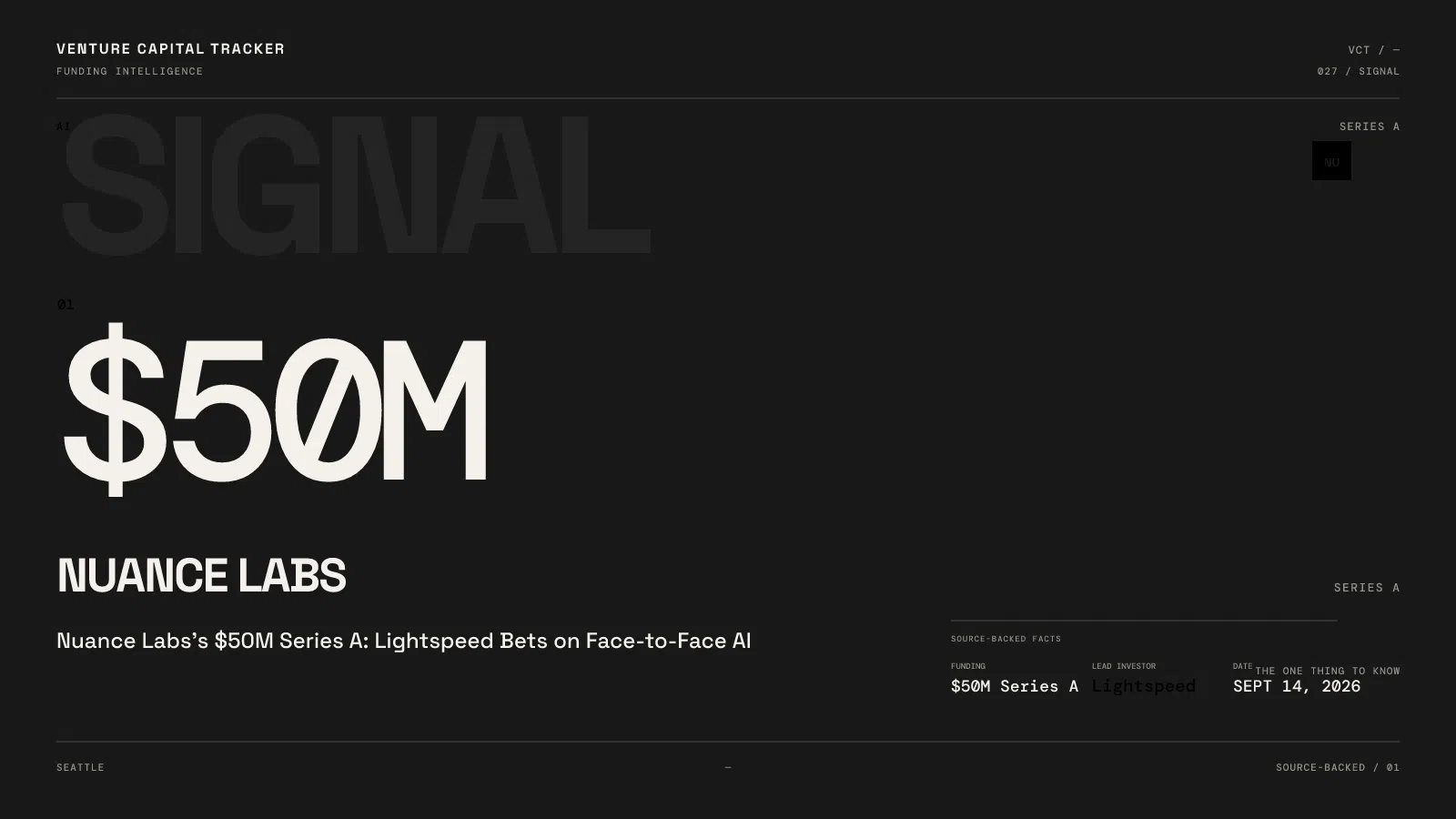
Nuance Labs raised a $50 million Series A on September 14, 2026, led by returning investor Lightspeed Venture Partners, with Accel, South Park Commons, NVIDIA, and Define Ventures participating (company).
A research-stage lab is raising a full Series A on the claim that face-to-face AI fails because of pipelined avatars (STT → LLM → TTS → face), not because users hate talking to machines — and Lightspeed is doubling down before a public preview.
Key facts
| Field | Detail |
|---|---|
| Company | Nuance Labs (nuancelabs.ai) — Seattle |
| Round | $50M Series A; valuation n/d |
| Lead | Lightspeed Venture Partners (returning) |
| Participants | Accel (returning), South Park Commons (returning), NVIDIA (new), Define Ventures (new) |
| Founders | Fangchang Ma, Edward Zhang, Karren Yang — former Apple PhD researchers |
| Product status | Pre-public research preview (planned later in 2026); press notes small team (~8) |
| Thesis | Single full-duplex audiovisual model for perception + expressive response |
Lightspeed (global) and Accel are not linked to /fund/ pages here — our Lightspeed directory entry is NYC-only and must not be used as a stand-in. Define Ventures is linked.
Who uses the product — and for what job
Users (intended): Product teams and enterprises that want face-to-face AI for sales, support, coaching, training, and education — not transcript chatbots with a lipstick avatar.
Job today: Train and serve a model that streams perception (words, tone, gaze, gesture, timing) and response (face + voice) simultaneously, so the system can show it is following while the human is still speaking.
Job next: Public research preview / waitlist access; expand research and go-to-market hiring. There is no disclosed customer ARR at announcement — this is a model bet.
Why now
- Voice AI scaled; avatar / face-to-face AI mostly did not, because stacked pipelines add latency and dead-eyed turn-taking.
- Multimodal models and inference speed finally make a single duplex model a credible research program rather than a demo hack.
- NVIDIA’s participation is a compute/ecosystem signal for a lab that will burn training and real-time serving budget.
Why Lightspeed — and why Define shows up
Lightspeed already knew the founders as a returning lead; partner language in the release frames Nuance as a potential interface layer for AI products everywhere. That matches Lightspeed’s pattern of underwriting ambitious AI platform companies early (see also recent Lightspeed-led AI prints on our site) without requiring revenue on day one.
Define Ventures is a digital-health specialist on paper — so why this deal? The honest read: expressive conversation is a care, coaching, and patient/clinician interface primitive, not only a consumer avatar toy. Define gets optionality on health-adjacent interfaces while Nuance remains a horizontal research lab. Do not invent a clinical product claim the company did not make.
Accel and South Park Commons returning reduce syndicate risk on a pre-product round; NVIDIA adds strategic distribution into inference stacks.
Competitive map
| Approach | Tradeoff |
|---|---|
| Cascaded avatar stacks (STT/LLM/TTS/animation) | Fast to ship; choppy, interruptive, “dead eyes” |
| Voice-only agents | Useful; no visual rapport |
| Big-lab multimodal chat with video | Broad capability; not optimized for live duplex presence |
| Nuance single full-duplex model | Coherent timing thesis; research and productization risk |
What is not proven
- Valuation, prior seed size, and ownership.
- Any customer, latency benchmark, or eval scores in the primary release.
- That Define’s health thesis will become a Nuance GTM path — editorial inference only.
Practical takeaway
- Founders (interface AI): You can still raise a $50M A pre-preview if the technical spine is crisp and top-tier names already know you.
- Investors: Diligence data quality (Nuance says it builds conversational data in-house) and real-time serving cost; do not price this like SaaS ARR.
- Operators: Wait for the research preview before budgeting avatar replacements — this is still a lab announcement.
Sources
Follow Venture Capital Tracker in Google
Add VCT as a preferred source to make our venture-capital coverage easier to find in Google Search.
Last updated:
Editorial note: AI tools assisted with research, structure, or drafting. Venture Capital Tracker retains human editorial responsibility for factual accuracy, relevance, and source quality before publication.