· Updated · Venture Capital Tracker · investment-strategies
Naïve's $28.5M Series A: Infrastructure for Autonomous Companies
YC-backed Naïve raised $28.5M Series A led by Nexus Venture Partners to let AI agents incorporate, provision payments/email/phone, and run businesses — while attacking agent inference cost.
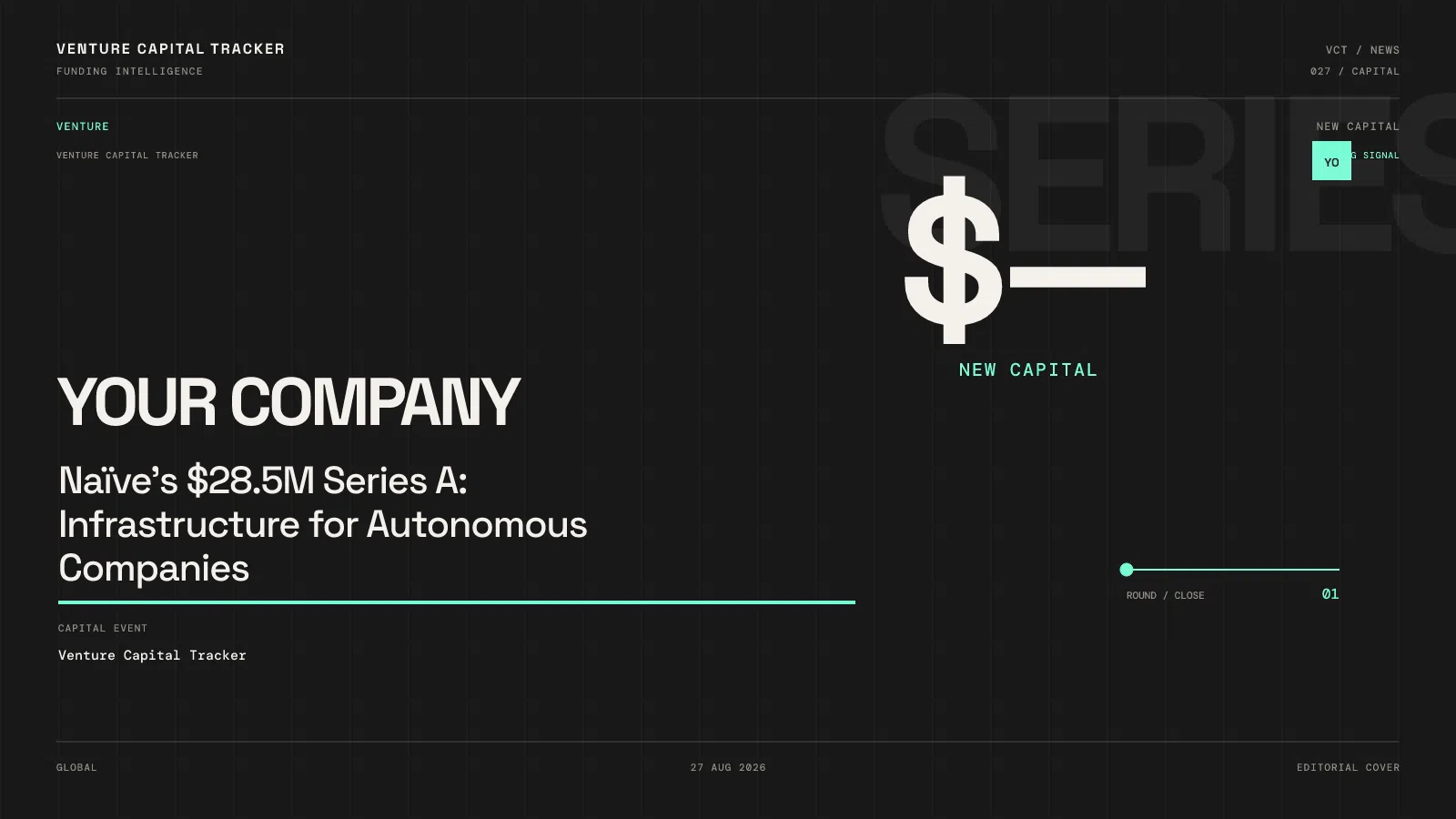
Naïve raised $28.5 million Series A on August 6, 2026, led by Nexus Venture Partners, with Y Combinator, Zetta, Liquid 2, and operators (Gokul Rajaram, Tim Zheng, JD Sherman, and others) joining. Total raised: ~$32M. The product thesis: coding agents can ship an app in an afternoon — running the company still takes months of human API stitching.
Key facts
| Field | Detail |
|---|---|
| Company | Naïve (Palo Alto / Menlo Park) — infra for agent-run businesses |
| Round | $28.5M Series A · ~$32M total |
| Date | August 6, 2026 |
| Lead | Nexus Venture Partners |
| Also | Y Combinator, Zetta, Liquid 2, operator angels |
| Traction | 30,000+ registered developers; ARR 10× to low double-digit $M (6 months) |
| Team | ~10 FT; founders Sean Dorje & Dennis Zax (ex-ezML, YC) |
| Use of funds | Hire researchers; sandboxes, model routing, memory, governance/orchestration |
Who uses the product — and for what job
Users: developers and small operators who already use Cursor / Claude Code / Codex — and increasingly teams whose biggest OpEx line is agent inference.
Jobs:
- Spin up the operating stack — LLC formation flow, virtual cards, email, phone, Stripe/QuickBooks hooks — behind one API (humans still do KYC/KYB).
- Keep agent fleets cheap — model router, memory, serverless JS runtimes so agents are not idling on full VMs.
Fastest-growing customer pattern per Dorje: AI automation agencies selling agents to SMBs. Colorful edge case: faceless TikTok channels (including AI animal-video spam) running on the infra.
Why now
- Vibe coding collapsed build time; ops and compliance glue did not.
- Agent loops burn tokens; cost control is the new platform war (see adjacent router plays).
- Cloud primitives were designed for human-operated SaaS, not thousands of short-lived agents.
Unexpected truth: the sexy “autonomous company” pitch may be the top-of-funnel; durable demand may be inference + serverless agent runtime for enterprises that never wanted a TikTok cat channel.
Why Nexus + YC — portfolio fit
Nexus leads when a product shows developer pull and a path from consumer-ish usage to infra spend. Y Combinator already underwrote the company; staying in at Series A is distribution + brand continuity, not the size of the check.
Likely founder rationale:
- Need a Series A lead comfortable with infra R&D (not just growth marketing).
- Keep YC network for the 30k-developer flywheel.
- Angels who built GTM engines (Apollo, HubSpot alum) match a product that sells to builders.
Portfolio fit (judgment): pairs with the 2026 “agent cost layer” cluster — same macro as routing/orchestration startups, different surface (company OS vs pure model router).
Competitive map
| Player | Lane |
|---|---|
| No-code company formation tools | Human-centric; not agent-native |
| Stripe Atlas / banking stacks | Payments + incorporation pieces; not agent orchestration |
| Model routers (e.g. Sapiom-class) | Pure inference cost; thinner company OS |
| Cloud hyperscalers | General compute; not agent governance + business APIs |
When not to buy the hype
- You need production KYC-complete banking with zero human in the loop (not there).
- Your agents are internal enterprise workflows with existing IdP/SOC2 stacks.
- You only need a model router — buy a focused router, not a company OS.
- Compliance for your industry forbids agent-held virtual cards.
Practical takeaway
- Founders: Instrument two funnels — “provision a business” vs “cut agent $ burn” — and price accordingly.
- Investors: Underwrite retention on the cost product, not just signup vanity from TikTok experiments.
- Operators: Treat governance budgets/approvals as the sales unlock for anyone past hobby scale.
Sources
- TechCrunch (Aug 6, 2026): https://techcrunch.com/2026/08/06/naive-raises-28-5m-to-automate-the-grunt-work-of-setting-up-and-running-a-company/
- Investor: /fund/y-combinator
- Related: /2026-august-6-7-investment-news-defense-autonomy-ai
Last updated:
Editorial note: AI tools assisted with research, structure, or drafting. Venture Capital Tracker retains human editorial responsibility for factual accuracy, relevance, and source quality before publication.