· Venture Capital · 4 sources · Updated · Verified
Manus AI Funding: $500M+ Round After Meta Deal Unwinds
Manus parent Butterfly Effect completed a $500M+ financing led by Boyu Capital and IDG Capital after the Meta acquisition unwind. The closing valuation was not disclosed; the earlier $4B figure remains a reported talks mark.

By Venture Capital Tracker Editorial
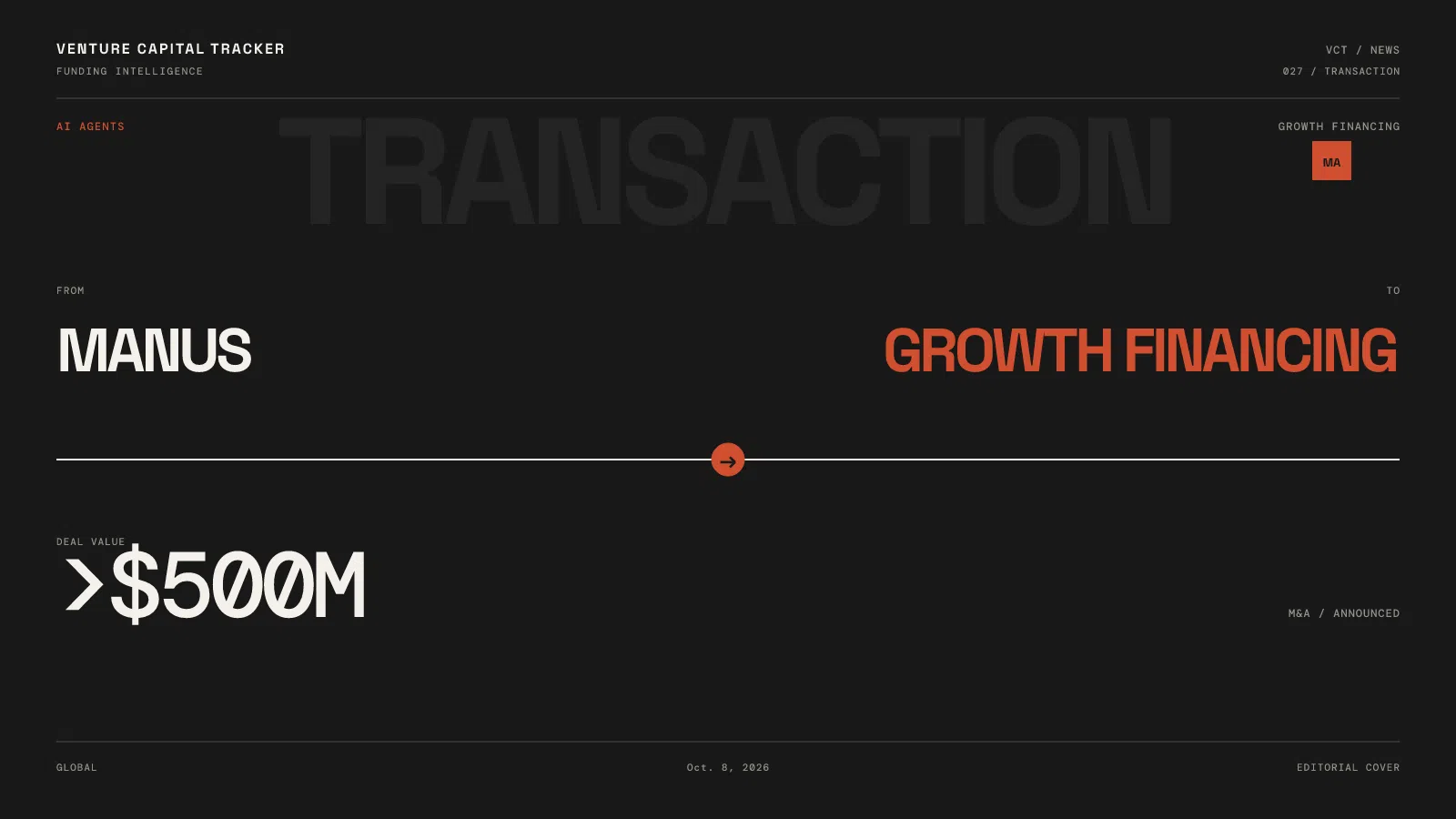
Butterfly Effect, the parent company of Manus, has completed a financing of more than $500 million after resuming independent operations following the forced unwinding of its acquisition by Meta.
Boyu Capital and IDG Capital co-led the round. Existing shareholders Tencent, HSG and ZhenFund also participated. The company did not disclose the exact amount, stage, valuation or use of proceeds.
This article originally tracked September reports that Manus was seeking $500 million at a $4 billion valuation. The completed round confirms the amount exceeded $500 million, but does not confirm the $4 billion valuation. The prior valuation is therefore retained only as historical context, not as a closing term.
Financing at a glance
| Field | Detail |
|---|---|
| Company | Butterfly Effect / Manus AI |
| Amount | More than $500 million |
| Stage | Undisclosed growth financing |
| Leads | Boyu Capital and IDG Capital |
| Existing investors | Tencent, HSG and ZhenFund |
| Valuation | Not disclosed |
| Announced | October 8, 2026 |
| Status | Completed financing |
From blocked acquisition to independent financing
Meta agreed to acquire Manus in late 2025 in a transaction reported above $2 billion. Chinese regulators later required the deal to be unwound amid scrutiny of foreign ownership, advanced AI technology and the cross-border movement of intellectual property and user data.
Manus said in August that it would return to independent operations. The new financing is the clearest indication that investors are willing to recapitalize that independent company rather than wait for another strategic buyer.
The deal also resolves the status of the September fundraising reports. At the time, press coverage described talks for approximately $500 million at a possible $4 billion valuation. Terms were still fluid and the company had not announced a close.
Today's statement confirms a larger-than-$500-million round and identifies the investors. It does not confirm the valuation, ownership percentages or whether any portion of the transaction was secondary.
What Manus sells
Manus develops general-purpose AI agents designed to execute multi-step workflows rather than only answer prompts. The product can coordinate research, document work, coding and other tasks across tools.
The investment case is that agent platforms can become a new application layer above foundation models. A successful provider can combine workflow memory, tool integrations, execution reliability and distribution without bearing the full cost of training a frontier model.
The risk is that model vendors and large software platforms can bundle many of the same capabilities. OpenAI, Anthropic, Google, Microsoft and specialist agent startups are all competing for the orchestration layer.
Why the investor group matters
Boyu Capital and IDG Capital add substantial Asia-focused growth capital. Tencent, HSG and ZhenFund provide continuity from the earlier shareholder base.
That composition may reduce the cross-border friction that derailed the Meta transaction. It also concentrates the company within an investor network familiar with Chinese technology regulation and global expansion.
The financing does not eliminate geopolitical risk. Manus remains Singapore-headquartered but China-origin, and the acquisition unwind showed that corporate domicile does not fully separate a company from regulatory claims over technology, founders, capital and data.
The missing terms are important
A headline above $500 million makes this one of the largest recent AI-agent financings. Several details needed for a complete valuation analysis remain absent:
- the exact primary-equity amount;
- any secondary share purchases;
- post-money valuation;
- investor ownership;
- governance rights;
- liquidation preferences; and
- the allocation between compute, hiring and market expansion.
The September report of a $4 billion valuation could be directionally relevant, but it should not be treated as the final price without confirmation.
Competitive and operating questions
Manus now has enough capital to compete aggressively. The more difficult task is proving durable economics.
Key questions include:
- Retention: Do users continue paying after initial experimentation?
- Gross margin: How much model-inference cost is absorbed by Manus?
- Reliability: Can agents complete complex tasks without expensive human intervention?
- Distribution: Can the company acquire enterprise customers without depending on a larger platform?
- Data governance: Can it satisfy regulators and global customers after the Meta unwind?
- Model dependence: How easily can the product switch between model providers as price and performance change?
Earlier reporting cited more than $100 million of annual recurring revenue around the Meta deal. The company did not provide a current revenue figure with this financing, so that historical number should not be used as an October 2026 run rate.
Editorial view
This is a confirmed financing, not a rumor, but the classification still needs care. It is more than $500 million of financing at an undisclosed stage and valuation. It is not a confirmed $500 million round at $4 billion.
The strategic story is more consequential than the missing valuation: a major AI-agent company has been reconstituted after a blocked acquisition and funded by a largely Asia-based syndicate to continue independently.
The next decisive evidence will be current revenue, enterprise retention, inference margins and a clearer explanation of how Manus will operate across Chinese and international regulatory regimes.
Follow Venture Capital Tracker on Google
Add VCT as a preferred source to see more of our venture-capital reporting in Google Search.
Last updated:
Editorial note: AI tools assisted with research, structure, or drafting. Venture Capital Tracker retains human editorial responsibility for factual accuracy, relevance, and source quality before publication.