Muon Space's $250M Series C at ~$1.5B: Mission Foundry for Bigger Birds
Eclipse led Muon Space’s $250M Series C (Aug 20, 2026); a source put valuation at $1.5B. Google, Salesforce Ventures, and Wellington joined as Muon scales San Jose production toward 500 sats/year.
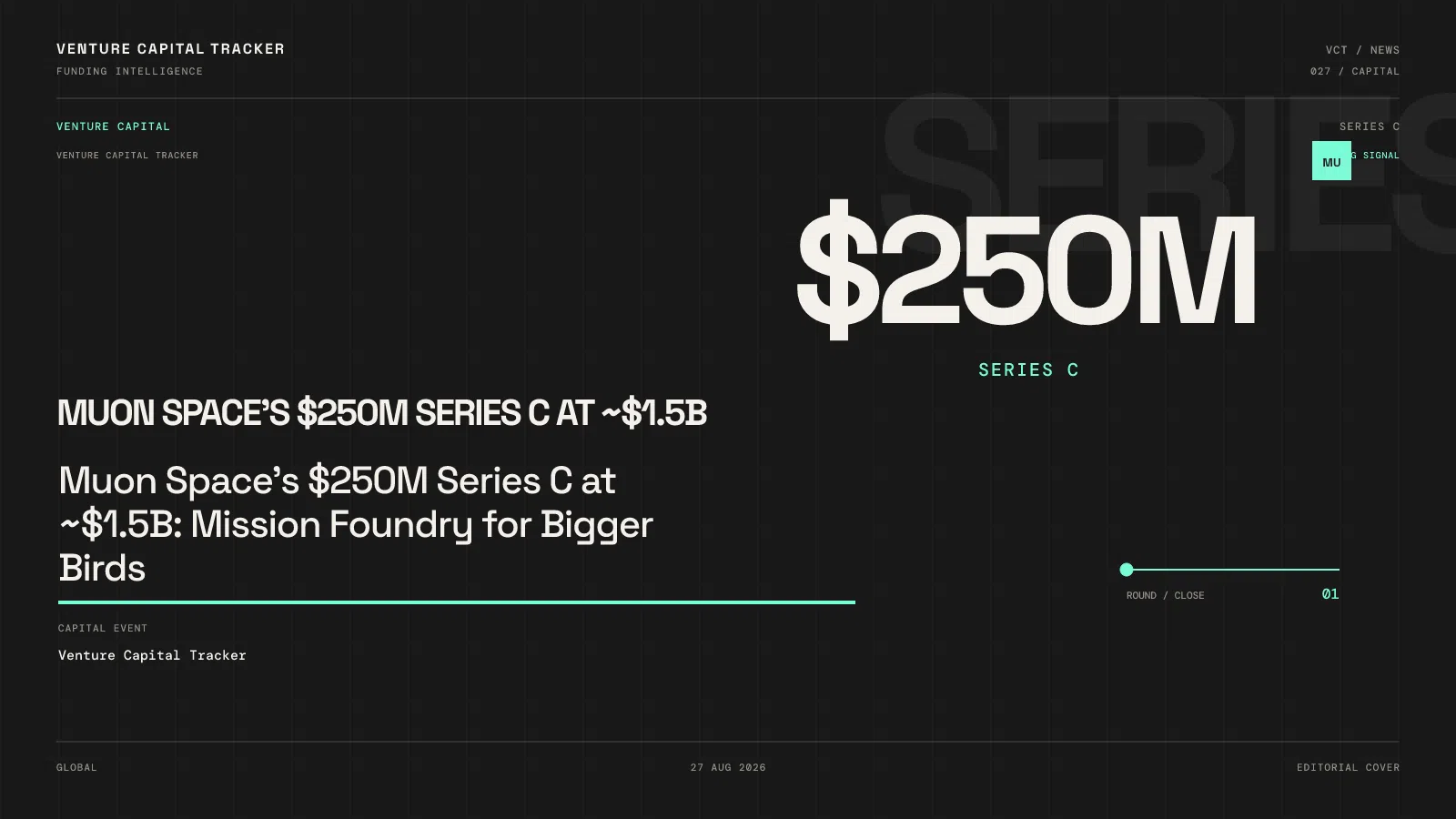
Muon Space closed a $250 million Series C on August 20, 2026, led by Eclipse Capital. Total equity: >$386 million. A source put valuation at about $1.5 billion (SpaceNews/Reuters) — not company-confirmed. This is the manufacturing side of the same August space-capital wave as Starcloud’s orbital compute raise.
Deal snapshot
- $250M Series C · total equity >$386M
- Lead: Eclipse Capital
- Strategics / growth: Google, Salesforce Ventures, Wellington, I Squared, Galvanize, Woven Capital
- Returning: Radical Ventures, Congruent, Costanoa, Activate, ACME, ArcTern, Overlap
- Factory: San Jose facility targeting 500 satellites/year by 2027
- Profile: Muon Space
Who uses the product — and why
Customers: commercial constellation operators, civil/climate programs, and growing U.S. government demand (CEO: backlog mix tilting toward ~50/50 commercial/gov over a couple years — Reuters interview).
Job: get a full mission stack — spacecraft, payload integration, ops, data — without assembling a dozen subcontractors. Muon says it controls ~95% of production in-house under Mission Foundry.
Deployed to date (company): 11 satellites, 7 in H1 2026, 100% mission-success claim. Backlog: 50+ in development; 13 booked for launch in the next year. Next step-up: ~500 kg MuSat XL for Hubble Network; Condor-Ultra (Starship-class, ~20 kW) aimed at 2028 for orbital data-center-class payloads.
Why this is a live problem now
- SpaceX IPO attention + defense/commercial EO demand pulled more capital into U.S. satellite factories (Apex/K2 also raised large rounds this year per SpaceNews).
- Customers want bigger power/aperture platforms — not only 200 kg buses.
- FireSat / Google.org wildfire monitoring is a public proof point that mission + data partners matter as much as hardware.
Why Eclipse / Google / Salesforce — portfolio fit
Eclipse is not in our directory; treat fit as editorial:
- Eclipse: recently co-led True Anomaly’s large defense-space round — pattern of hard space infra.
- Google / Salesforce Ventures: strategic distribution and climate/enterprise data narratives (FireSat; enterprise Earth intelligence).
- Returning climate/space VCs: continuity on manufacturing scale, not a pivot to pure software.
Likely founder rationale: fund the San Jose 10× capacity jump and XL/Condor platforms before backlog converts to launches through 2029.
Competitive map
| Player | Difference |
|---|---|
| Apex / K2 | Large California sat manufacturers; different bus-first vs mission-first stories |
| Traditional primes | Higher cost, slower iteration |
| Starcloud | Buys/hosts compute in orbit — potential payload customer class, not a bus peer |
Practical takeaways
- Founders: Vertical integration claims need yield and schedule proof — ask for on-time launch rate.
- Investors: Source-cited $1.5B is soft; underwrite on booked launches and customer concentration.
- Operators: Mission Foundry vs bus — pick based on whether your payload forces a custom stack.
When not to
- Do not treat source valuation as audited.
- Do not assume Condor-Ultra (2028) is contracted capacity today.
- Eclipse and Radical are not in our fund directory.
Sources
- SpaceNews (Aug 20, 2026): https://spacenews.com/muon-space-raises-250-million-to-ramp-up-satellite-production/
- Company wire: https://investor.wedbush.com/wedbush/article/gnwcq-2026-8-20-muon-space-closes-250-million-series-c-to-scale-space-infrastructure
- /startup/muon-space · related /startup/starcloud
Editorial note: AI tools assisted with research, structure, or drafting. Venture Capital Tracker retains human editorial responsibility for factual accuracy, relevance, and source quality before publication.