· Investment Strategies · 2 sources · Updated
Metriport’s $26M Round: Open-Source Health Records for Clinicians and Agents
Matrix’s TJ Parker led Metriport’s $26M raise (total $28.4M) with ARTIS and Y Combinator — point-of-care patient context for One Medical, Sollis, Color and the agents behind them.

Editorial team
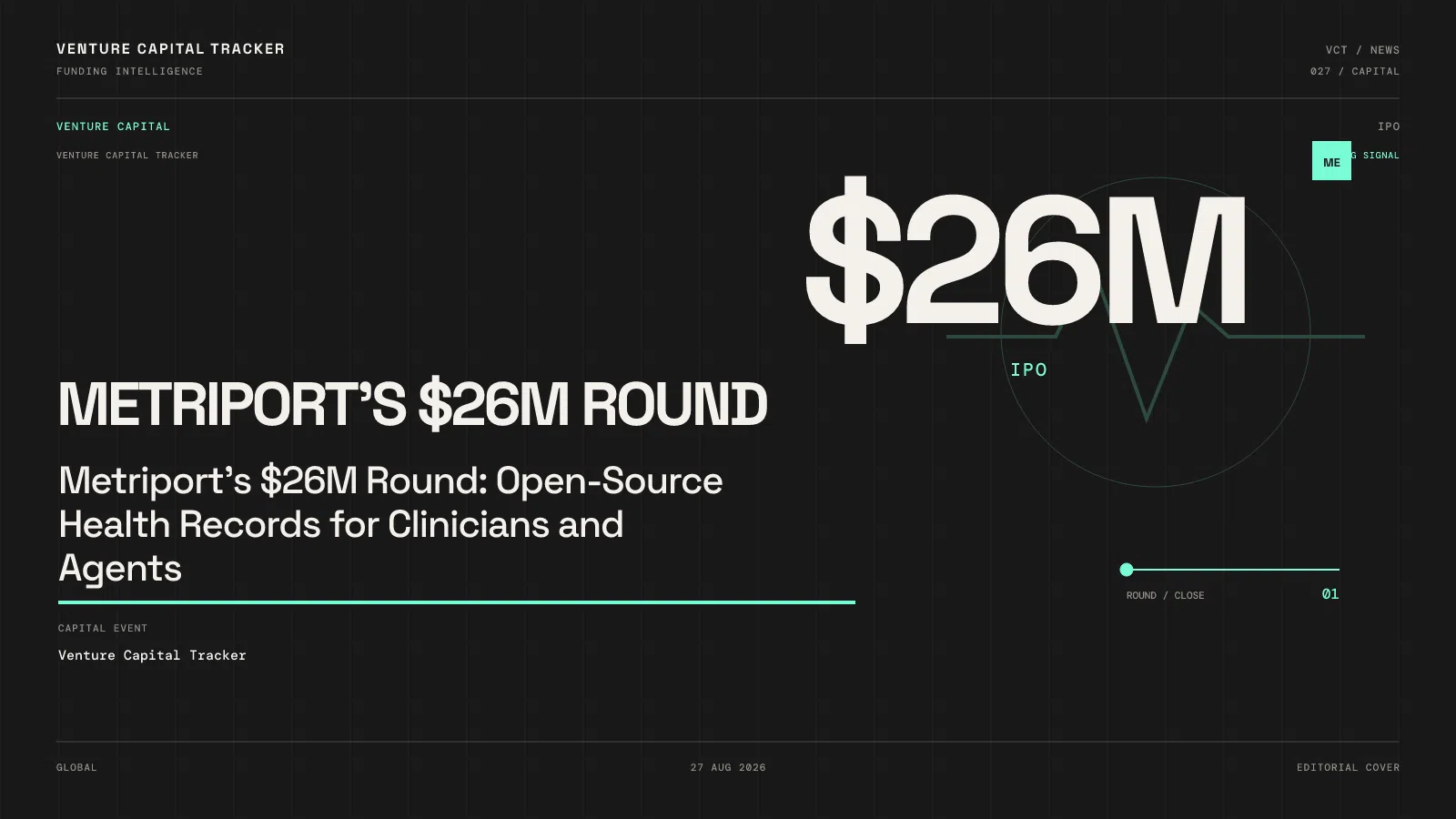
Metriport raised $26 million announced August 27, 2026, led by TJ Parker (Matrix) with ARTIS and Y Combinator, bringing total funding to $28.4 million.
Deal details & investors
Funding event
Metriport
Led by Matrix
Unexpected truth: the product job is not “another EHR.” It is full patient context at the moment of care — for humans first, then for the AI agents clinics are adding on top.
Key facts
- Company
- Metriport (San Francisco; founded 2022)
- Round
- $26M (press often labels Series A)
- Date
- August 27, 2026
- Lead
- Matrix (TJ Parker)
- Participants
- ARTIS, Y Combinator
- Cumulative
- $28.4M
- Customers named
- Amazon One Medical, Sollis Health, Color Health
- Compliance signal
- HITRUST r2 Certification (company)
- Use of proceeds
- Scale platform; expand AI/ML and agentic capabilities
Who uses the product — and for what job
Users: clinicians and care-delivery orgs that cannot afford incomplete charts at the visit; also the AI agents those orgs deploy for intake, summarization, and triage.
Job: pull longitudinal records from HIEs, EHRs, labs, and pharmacies into structured, relevant context fast enough for point-of-care decisions.
Open-source positioning matters for buyers who distrust black-box health data pipes and want engineering control plus compliance rigor.
Why now
- Care delivery and consumer health startups compete on experience; incomplete history is the silent failure mode.
- Agent workflows amplify bad context — wrong chart in → wrong action out.
- HITRUST r2 is a buyer checkbox that lets infrastructure vendors sell into regulated stacks without starting compliance from zero.
Why Matrix / YC — portfolio fit
| Investor | Fit |
|---|---|
| Matrix | Healthcare + developer-infrastructure taste; Parker’s quote frames Metriport as the data layer strong consumer-health companies already pick |
| Y Combinator | Early technical network; healthtech distribution and hiring |
Likely founder rationale: raise from a healthcare-native growth partner who already sees Metriport in diligence of other portfolio companies — plus keep YC as the early-stage connective tissue.
Matrix is named without a /fund/ link (no directory page yet).
Competitive map
| Player | Difference |
|---|---|
| Classic HIE / aggregator vendors | Incumbent pipes; often slower product cycles |
| EHR vendors’ native chart views | Sticky but fragmented across systems |
| Point solutions (single-source APIs) | Narrower coverage vs multi-source context |
| Clinical AI apps without owned data layer | Depend on someone like Metriport underneath |
When not to over-read
- Round letter (Series A) appears in secondary aggregators; company release says “$26 million in new funding.”
- Customer logos are company-cited — not independent revenue disclosure.
- No valuation disclosed.
Practical takeaway
- Founders (health AI): Sell the agent-ready context layer, not only a clinician UI — that is where 2026 budgets are opening.
- Investors: Matrix + YC is a classic infra pattern; diligence network coverage and latency claims.
- Operators: Ask whether your AI roadmap assumes complete charts; if not, Metriport-class pipes become a prerequisite.
Follow Venture Capital Tracker on Google
Add VCT as a preferred source to see more of our venture-capital reporting in Google Search.
Last updated:
Editorial note: AI tools assisted with research, structure, or drafting. Venture Capital Tracker retains human editorial responsibility for factual accuracy, relevance, and source quality before publication.