· Venture Capital Tracker · venture-capital
Metal’s Seed Round Is Reported at $32.5M as Airwallex Backs Tokenized-Finance Rails
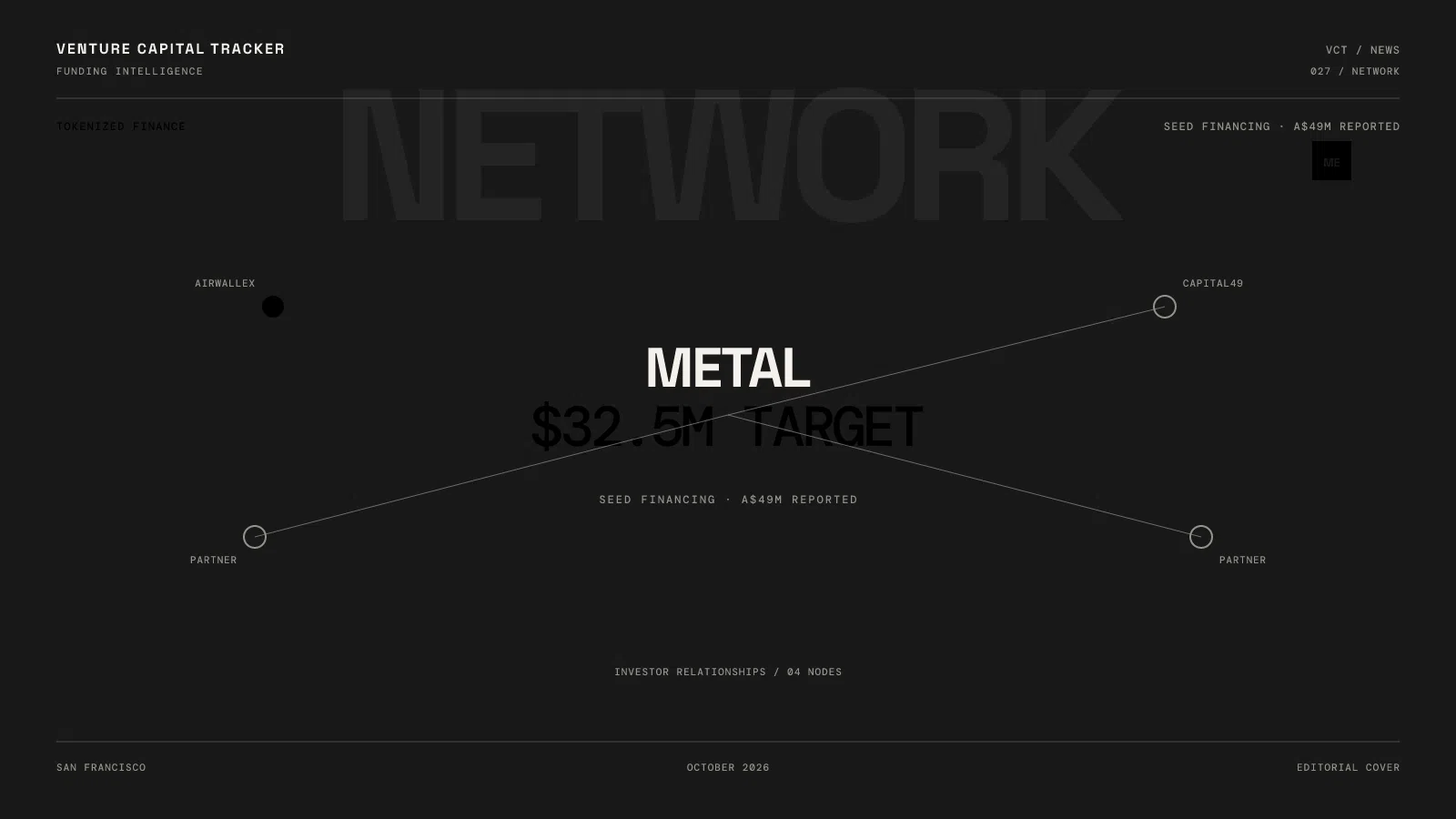
An SEC filing shows Metal sold $26.4M toward a $32.5M seed target. Australian reporting says the round was completed, led by Airwallex and Capital49.
Metal's seed financing is much larger—and more complicated—than its June announcement suggested.
The company announced on June 25 that Airwallex and Capital49 had co-led a seed investment, but it did not publish an amount. A September 11 US securities filing now provides the first official range: Nexus Networks, Inc., the legal entity behind Metal, listed a $32.525 million equity offering, of which $26.400 million had been sold to 25 investors. The filing showed $6.125 million remaining.
On October 4, the Australian Financial Review reported that people familiar with the transaction said the full target had subsequently been completed. At prevailing exchange rates, that is roughly A$49 million. Metal chief executive Loong Wang declined to comment to the publication.
That distinction matters. The SEC filing confirms the offering target and the amount sold as of September 11. The final-close figure is media-reported rather than company-announced.
The financing at a glance
- Company: Metal, operating legally as Nexus Networks, Inc.
- Stage: Seed
- Filed offering target: $32.525 million
- Sold by September 11: $26.400 million
- Investors in the filing: 25
- Reported final amount: Approximately $32.5 million, or A$49 million
- Named co-leads: Airwallex and Capital49
- Valuation: Undisclosed
- Headquarters in the filing: San Francisco
- First sale recorded by the filing: August 3, 2026
Metal's June announcement described the round as completed, while the later Form D recorded a first sale in August and an offering that was still partly open on September 11. The public record therefore may reflect an expanded or continued financing, but the available documents do not establish the precise sequencing. VCT treats September 11 as the canonical filing date and the October 4 report as the fresh amount disclosure.
What Metal is building
Metal describes itself as full-stack infrastructure for tokenized financial products. Instead of focusing only on issuing a stablecoin or moving one digital dollar between wallets, the company wants to support tokenized bank deposits, money-market funds, Treasury bills, equities and other securities.
Its proposed architecture combines several layers:
- A purpose-built settlement network for regulated financial assets.
- Identity, authorization, attestations and programmable transaction controls.
- Privacy mechanisms intended to keep institutional policies and transaction data confidential.
- Native support for AI-agent payment and authorization protocols.
- Connections between tokenized assets and local fiat payment rails.
The fifth layer is where Airwallex becomes strategically important. Metal says the partnership can connect its infrastructure to local payment methods across 200 countries and 90 currencies. Those figures describe Airwallex's network coverage; they do not mean Metal is already operating at that scale.
Airwallex is both an investor and Metal's first design partner. That gives Metal access to experienced payments infrastructure and a potential route into institutional distribution. It also makes the relationship more consequential than a conventional venture cheque.
Why a new settlement network needs more than speed
Most blockchain infrastructure pitches emphasize cheaper and faster settlement. Metal's thesis is that regulated institutions face a different bottleneck: financial assets carry jurisdiction-specific ownership rules, sanctions requirements, internal risk policies and privacy obligations.
The company wants those constraints expressed as programmable policies that can be checked during settlement. Its founders argue that existing public blockchains reveal too much information, while private subnet designs can give network operators excessive visibility.
That is a technically ambitious position. It also sets a demanding commercialization bar. Metal will need to show that its privacy model is auditable, that institutions can configure policy without creating incompatible silos, and that regulators accept the resulting controls.
None of those outcomes follows automatically from the size of the seed round.
The founders' infrastructure experience
Metal was founded by Loong Wang and Catherine Porter.
Wang previously founded Ren, a cross-chain liquidity protocol that helped move Bitcoin onto Ethereum. Metal's website says Ren handled $13 billion of volume in its first 12 months. Porter previously led partnerships and business development for Libra, Meta's blockchain initiative, where she worked on regulatory engagement and licensing strategy.
The pairing is relevant to Metal's design: Wang brings experience with cross-chain infrastructure, while Porter brings exposure to the institutional and regulatory problems that complicated earlier attempts to build global digital money.
Metal is incorporated in Delaware, and its SEC filing lists a San Francisco business address. Its founders and early reporting also retain strong Australian links.
Competitive landscape
Metal is entering a market with established institutional and payments infrastructure.
Canton Network focuses on privacy-enabled synchronization between regulated financial applications. Partior is a bank-backed network for wholesale and cross-border settlement. Fireblocks provides custody, treasury, tokenization and payment infrastructure across multiple chains. Rain and other stablecoin-payment providers focus more narrowly on enterprise payments and cards.
Metal's differentiator is the attempt to combine the chain, asset primitives, programmable compliance, privacy, agent authorization and fiat connectivity in one stack. That vertical integration could reduce fragmentation for developers and institutions.
It could also create a harder adoption problem. Financial institutions may prefer modular infrastructure that works with existing networks, vendors and legal frameworks. A new settlement layer must attract assets, liquidity, developers and regulated counterparties at the same time.
What the round does—and does not—prove
A $32.5 million target is unusually large for a seed financing, but its informational value should not be overstated.
The round shows that investors are willing to finance a costly infrastructure build and that Airwallex sees strategic value in Metal's product direction. It does not establish that the network is live, that regulated institutions beyond Airwallex have committed to use it, or that Metal has processed production transaction volume.
The company has not disclosed:
- A public mainnet launch date
- Production transaction volume
- Named financial-institution customers beyond Airwallex's design-partner role
- Regulatory licences held by Metal itself
- Security audits or independent throughput benchmarks
- The identities of the other investors counted in the Form D
Those are the milestones that will determine whether Metal becomes infrastructure or remains an ambitious protocol project.
Why the amount disclosure matters
The October disclosure changes how the company should be evaluated. Metal is not a lightly funded experimental blockchain. It has capital more typical of a substantial Series A, an experienced founding team and a strategic relationship with a global payments platform.
That raises expectations. By its next financing, investors should be looking for evidence of live regulated assets, repeatable institutional onboarding and real settlement volume—not only protocol specifications and design partnerships.
For now, the accurate formulation is: Metal filed a $32.525 million seed offering, had sold $26.400 million by September 11, and was subsequently reported to have completed the target.
Editorial note: AI tools assisted with research, structure, or drafting. Venture Capital Tracker retains human editorial responsibility for factual accuracy, relevance, and source quality before publication.