· Investment Strategies · 1 source
Kastle Raises $24M Series A — Insight Bets on AI Agents Inside Bank Cores
Insight Partners led Kastle’s $24M Series A (YC and Commerce Ventures returning). Agents have processed $1.8B–$2B in lending transactions — who buys bank ops AI and why Insight fits.

By Venture Capital Tracker Editorial
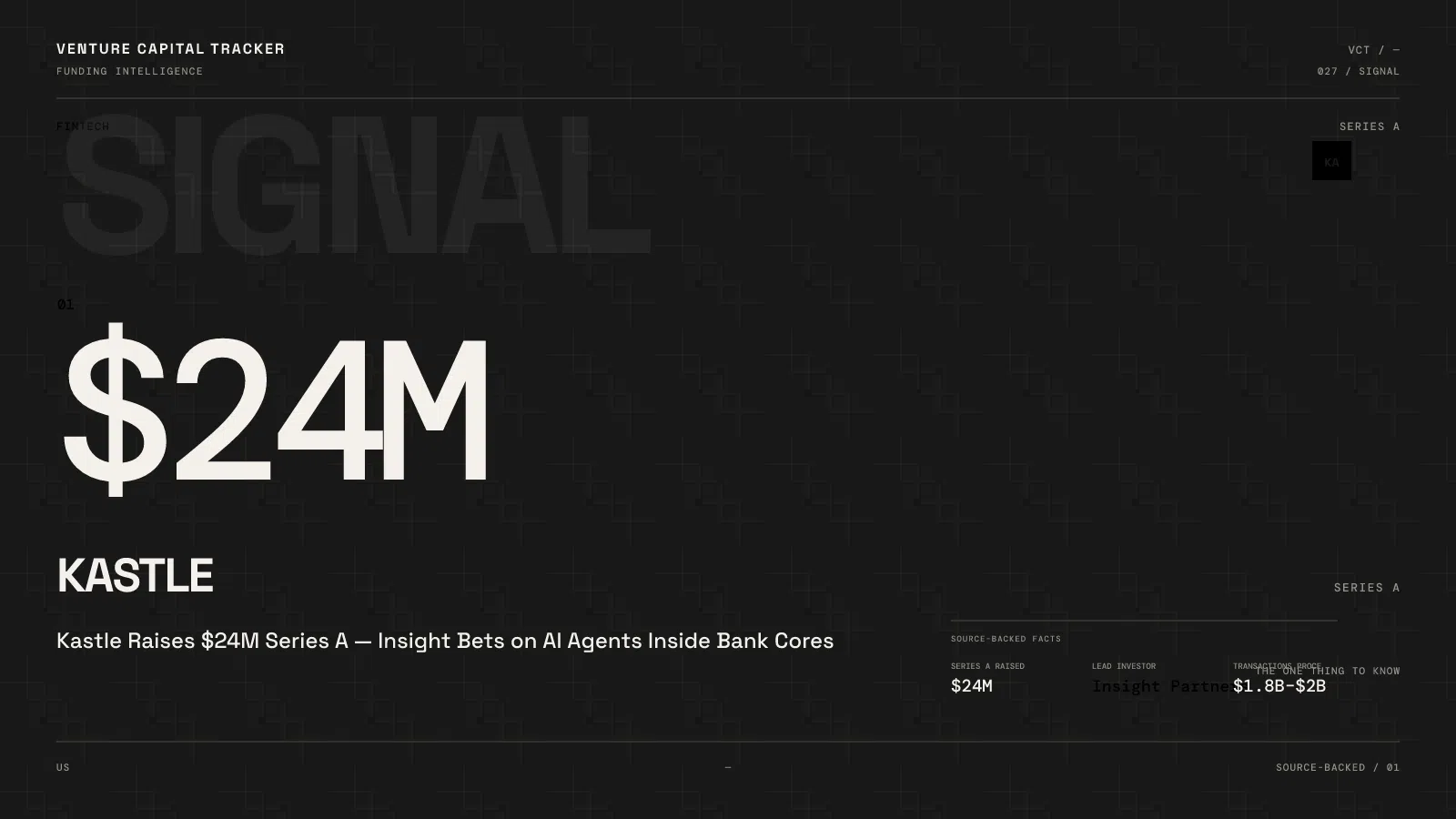
Kastle raised $24 million in Series A funding announced September 17, 2026, led by Insight Partners. Y Combinator and Commerce Ventures returned; Fifth Wall joined.
banks will not rip out cores for AI — Kastle sells agents that do the work on the systems already in production, with transaction volume as the proof point.
Key facts
- Company
- Kastle — San Francisco; consumer-lending AI workforce
- Round
- $24M Series A
- Date
- September 17, 2026
- Lead
- Insight Partners
- Returning
- Y Combinator, Commerce Ventures
- New
- Fifth Wall (+ unnamed founders / FS executives)
- Traction
- Body: >$1.8B transactions processed; About: >$2B — company figures, not audited
- Valuation / ARR
- Not disclosed
- Use of proceeds
- Engineering, product, GTM; deepen bank deployments in North America
Who uses the product — and for what job
Users: large banks and lenders whose consumer-lending ops still run on fragmented cores, queues, and manual exception handling.
Job: deploy specialized AI agents that execute high-volume, time-sensitive lending workflows inside existing systems of record, while humans keep judgment-heavy cases.
CEO framing is explicit: false choice between living with legacy limits vs multi-year rip-and-replace. Kastle sells the third path — hybrid teams (agents + people) under existing controls.
Why now
- Institutions are past chatbot pilots and stuck on production adoption without core migration risk.
- Insight’s Rebecca Liu-Doyle quote emphasizes regulatory rigor and “get high-stakes work done” — the Series A is a compliance-grade ops bet, not a consumer app story.
- Transaction volume claims ($1.8B–$2B) are the diligence hook when ARR is missing.
Why Insight — portfolio fit
Insight Partners leads growth-oriented software rounds and already sat on large enterprise AI outcomes this month (Wonderful $550M). Kastle fits the ScaleUp pattern: vertical workflow software with measurable throughput.
Y Combinator returning keeps early conviction. Commerce Ventures is fintech-native. Fifth Wall adds real-estate/fintech adjacency without needing a directory page.
| Investor | Fit |
|---|---|
| Insight | Enterprise GTM + Series A leadership muscle |
| YC | Seed continuity; founder network |
| Commerce Ventures | Fintech domain diligence |
| Fifth Wall | New capital; proptech/fintech adjacency |
Strategic rationale: trade a brand-name growth firm that knows regulated software for a lead that can follow for years, keep YC for talent signal, and avoid a pure consumer-fintech lead that would mis-price bank sales cycles.
**
Competitive map
| Player | Lane |
|---|---|
| Horizontal agent platforms (generic RPA/LLM copilots) | Low domain depth; weak lending controls |
| Core banking vendors adding AI | Incumbent distribution; slower agent autonomy |
| Vertical lending SaaS | Often still “software of record,” not AI workforce |
| Ops-AI peers (e.g. supply-chain agents) | Same hybrid-team thesis, different industry |
Missing numbers
- No valuation, ARR, customer count, or named bank logos in the release.
- Transaction totals differ slightly between body ($1.8B) and About ($2B) — cite as company range.
Practical takeaway
- Founders (fintech AI): Sell work completed inside cores, not another dashboard for ops managers.
- Investors: Underwrite audit trails, model risk, and sales-cycle length — Insight’s lead implies they think those gates are passable.
- Bank buyers: Ask for production transaction volume and exception rates, not demo latency.
Follow Venture Capital Tracker on Google
Add VCT as a preferred source to see more of our venture-capital reporting in Google Search.
Editorial note: AI tools assisted with research, structure, or drafting. Venture Capital Tracker retains human editorial responsibility for factual accuracy, relevance, and source quality before publication.