· Investment Strategies · 1 source
HiddenLayer’s $100M Series B: AI Security With 10× ARR and DoD Logos
Delta-v Capital led HiddenLayer’s $100M Series B as AI security spend surges — company claims 10× ARR growth into the tens of millions, with financial services, big tech, and DoD/IC contracts.

Editorial team
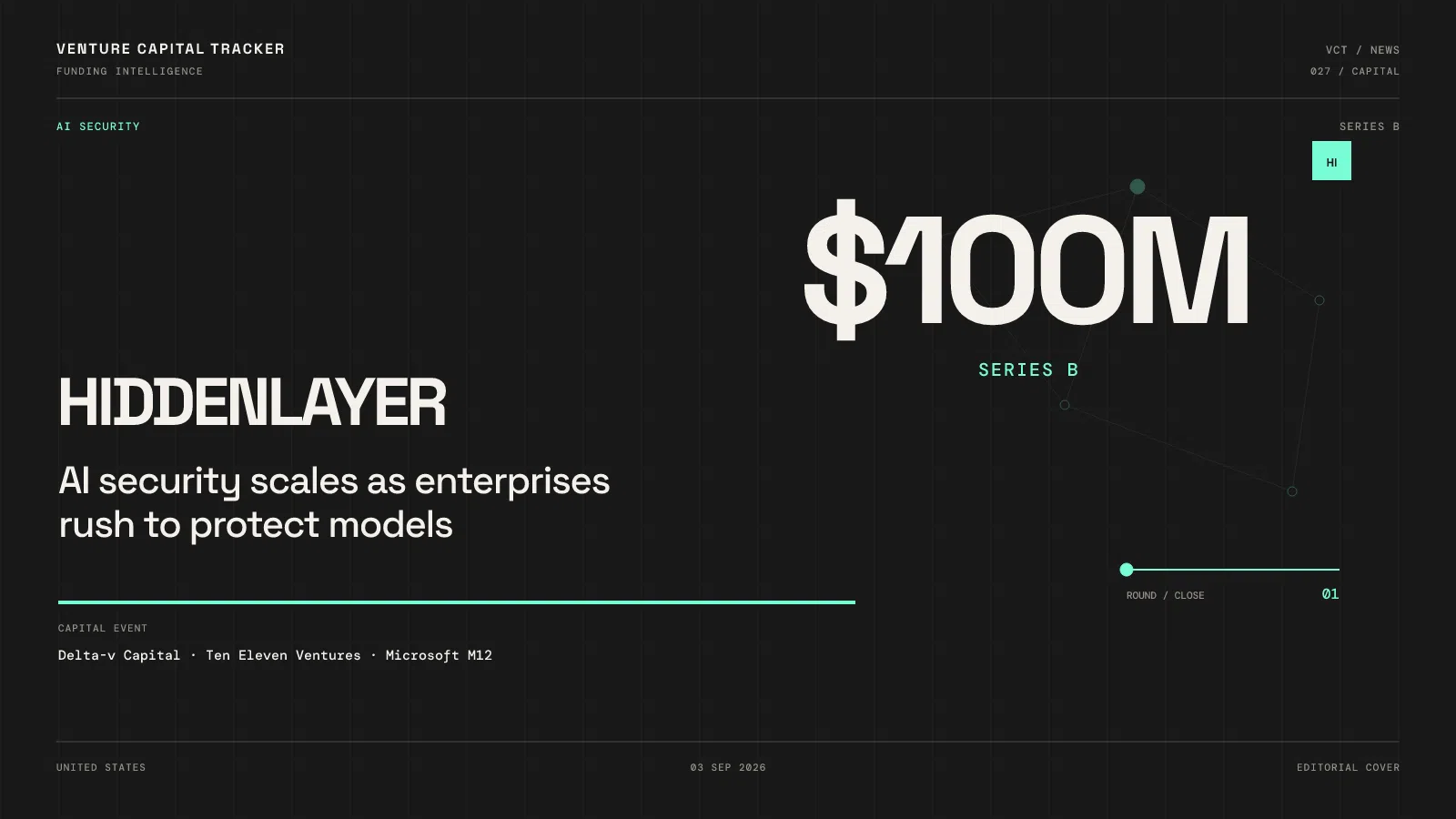
Delta-v Capital led HiddenLayer’s $100 million Series B, reported September 2, 2026 by TechCrunch, with Ten Eleven Ventures, Morgan Stanley, Microsoft’s M12, Booz Allen Hamilton, and others.
Spine: three years after a $50M Series A when AI attacks felt theoretical, HiddenLayer is selling into a market Gartner pegs at $2.83B this year (+83% YoY) — and claims >10× ARR into the tens of millions.
For context on AI model and workload security within the wider venture market, compare this financing with other rounds in VCT’s 2026 cybersecurity funding overview.
Key facts
- Company
- HiddenLayer (Austin)
- Round
- $100M Series B
- Lead
- Delta-v Capital
- Participants
- Ten Eleven; Morgan Stanley; M12; Booz Allen; others
- Prior
- ~$50M Series A (~2023, TechCrunch context)
- Traction (company)
- ARR >10× YoY; “tens of millions”; >90% growth from new logos
- Buyers
- FinServ; large tech AI builders; DoD / IC
Who uses the product — and for what job
Users: security and ML platform teams at banks, hyperscale/tech product orgs, and government agencies deploying models and agents.
Job: treat AI like an endpoint — discovery, runtime protection, attack simulation, supply-chain scanning — including prompt injection, agent manipulation, malicious tool use, and open-weight model impersonation across ~50 file frameworks.
CEO Chris Sestito likens runtime AI security to EDR for models and agent workflows.
Why now
- Agent and GenAI deployments moved from pilots to production; risk shifted from “will attacks exist?” to runtime and supply-chain failure modes.
- Gartner’s AI-security spend forecast (cited by TechCrunch) gives buyers budget cover.
- Agent and model security are splitting into seats — HiddenLayer is the broader model/runtime layer, not only skills/add-on vetting.
Why Delta-v / M12 / Booz — portfolio fit
| Investor | Fit signal |
|---|---|
| Delta-v Capital | Cyber growth lead for category Series B |
| Ten Eleven Ventures | Specialist cybersecurity capital |
| M12 | Microsoft ecosystem adjacency for enterprise AI security |
| Booz Allen | Federal/IC distribution path matching DoD logos |
| Morgan Stanley | Late-stage / growth capital for sales scale |
Likely founder rationale: pair cyber specialist capital with federal strategic (Booz) and platform strategic (M12) while funding a sales-led expansion into Europe/EMEA — proceeds skew GTM over pure R&D (TechCrunch).
None of these leads currently have /fund/ pages in our directory — editorial only.
Competitive map
| Company | Angle |
|---|---|
| HiddenLayer | Model + agent runtime / supply chain |
| Agent-firewall startups | Inline policy for agent skills/add-ons |
| Noma / Zenity (TechCrunch comps) | Adjacent AI security; >$100M raised each |
| Platform bundles (Microsoft, OpenAI, AWS) | Governance/identity/policy — Sestito argues they won’t own full runtime EDR |
Incumbent cyber majors (Cisco, Palo Alto, Check Point) remain buy-vs-build exit overhang.
What is not proven
- Exact ARR and valuation undisclosed.
- Named “700M weekly users” frontier customer is inferred, not confirmed.
- Durability vs platform bundling is CEO judgment, not evidence.
Practical takeaway
- Founders: 10× ARR with federal logos is the Series B proof package AI security needed in 2023.
- Investors: Separate runtime EDR from agent policy startups before writing overlapping checks.
- Buyers: Ask for attack-simulation results on your agent stack — not generic GenAI threat slides.
Sources
Follow Venture Capital Tracker in Google
Add VCT as a preferred source to make our venture-capital coverage easier to find in Google Search.
Editorial note: AI tools assisted with research, structure, or drafting. Venture Capital Tracker retains human editorial responsibility for factual accuracy, relevance, and source quality before publication.