· Venture Capital Tracker Editorial · venture-capital
doxx.net Raises $38M Series A for Private Networks Built Around AI Agents
doxx.net raised a $38 million Series A led by Andreessen Horowitz while launching Agentic Defined Networking in open beta.
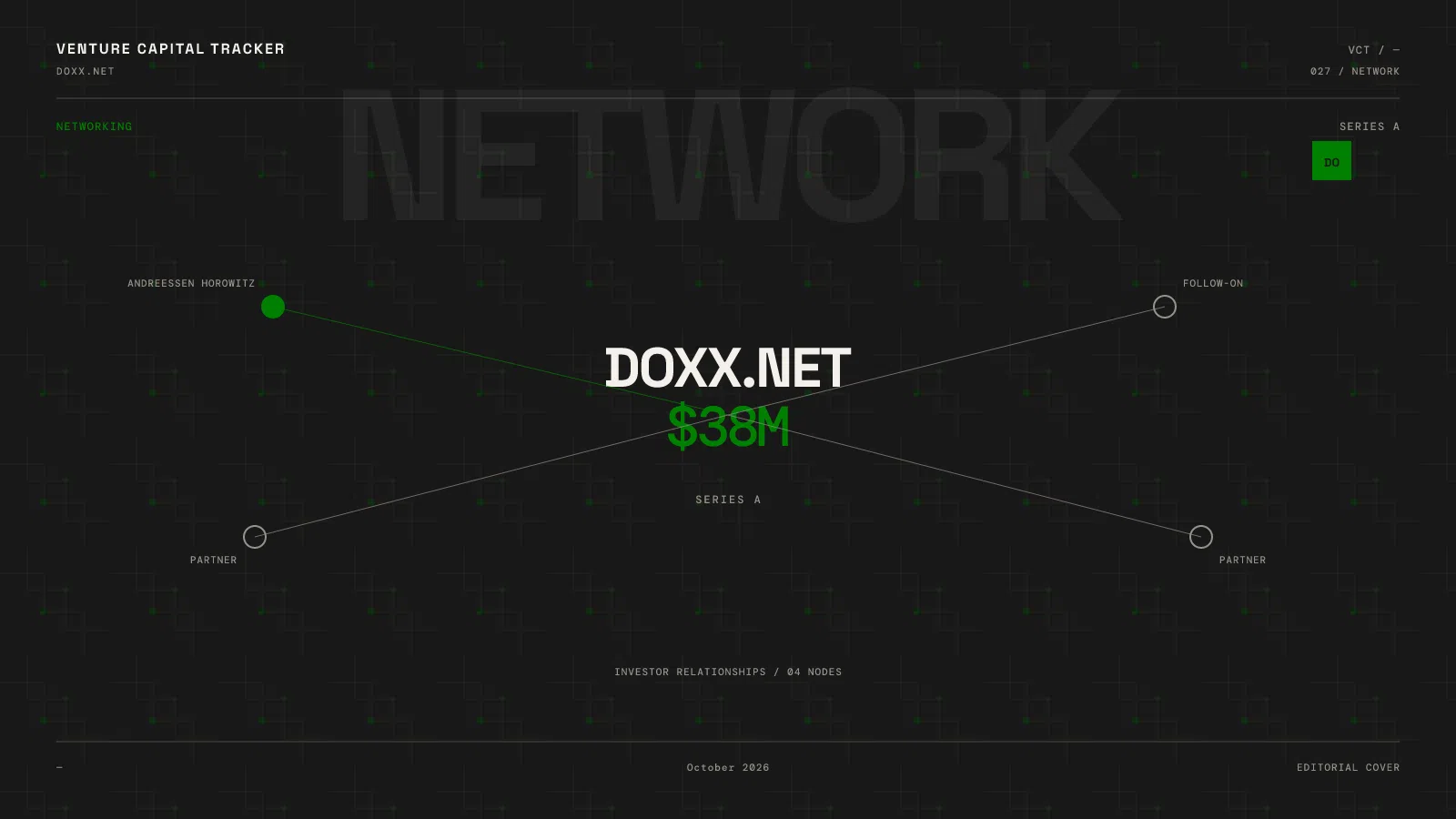
doxx.net has raised a $38 million Series A led by Andreessen Horowitz, with ANIMO Ventures and focal participating, as the company launches the open beta of its Agentic Defined Networking platform.
The financing arrives at an unusual moment for networking security. AI agents increasingly browse websites, call APIs, move files and operate with access to a user's accounts. doxx.net argues that the network itself—not only the application—must enforce what those agents can reach and how they communicate.
Financing snapshot
| Item | Detail |
|---|---|
| Company | doxx.net |
| Financing | $38 million Series A |
| Lead investor | Andreessen Horowitz |
| Other investors | ANIMO Ventures and focal |
| Founder | Barrett Lyon |
| Product stage | Open beta |
| Headquarters | Miami, Florida |
| Valuation | Not disclosed |
| Announced | October 1, 2026 |
The round is large for a company entering open beta. Investors are backing both a product and a capital-intensive infrastructure strategy: doxx.net says it owns its backbone hardware, IP address space, private naming system and certificate authority rather than relying solely on rented cloud infrastructure.
What Agentic Defined Networking means
Software-defined networking separated network configuration from physical hardware. doxx.net extends that idea to AI agents.
The company says a user can give an agent an identity, connect it directly to approved devices and let it configure tunnels, addresses and firewall rules within explicit policies. People and agents can browse, call, message and transfer files through private channels.
The product combines several layers:
- peer-to-peer encrypted communications;
- DNS-level threat blocking;
- private domain names and a private certificate authority;
- APIs for agent-controlled network configuration;
- a global backbone using company-controlled infrastructure;
- native applications for major desktop and mobile platforms.
This is broader than a virtual private network and narrower than rebuilding the public internet. The commercial question is whether customers see enough advantage in a vertically integrated private stack to adopt a new identity, networking and communications layer.
Why agents change the threat model
A conventional browser session is mostly driven by direct user actions. An AI agent can operate continuously and chain together websites, APIs, internal systems and credentials.
That changes both scale and context. A malicious destination or poisoned tool does not need to trick a person into completing every action. It may only need to influence an agent that already has delegated authority.
doxx.net's approach is to enforce boundaries before a connection is established. DNS-level protection blocks known malicious destinations, while private networking can limit which devices and services an agent can reach.
The company says it has blocked more than 38 million threats since its closed beta began in December 2025. That figure is company-reported and does not by itself establish protection quality. Independent testing will need to examine false positives, missed threats, evasions and how the controls behave when agents make complex multi-step decisions.
The vertically integrated bet
Most privacy and zero-trust products sit on top of infrastructure owned by cloud or telecommunications providers. doxx.net says it controls its own IP space, autonomous system number, DNS root, certificate authority, local AI models and bare-metal servers.
That architecture reduces dependence on intermediaries and may minimize the data the provider needs to collect. The company also lets users start without providing an email address or phone number, using proof-of-work for account creation.
Vertical integration can create trust and performance advantages, but it is expensive. The company must build, operate and defend a network across multiple geographies, maintain applications and APIs, and persuade customers to depend on infrastructure from a young vendor.
Founder-market fit
Founder Barrett Lyon previously built Prolexic, an early DDoS-defense company acquired by Akamai, as well as BitGravity and Defense.net, which were acquired by Tata Communications and F5.
That history matters because doxx.net's proposition depends on deep operational networking expertise. The product cannot rely on a polished interface alone; it must work under attack, recover from failures and maintain privacy guarantees across infrastructure the company controls.
Andreessen Horowitz's infrastructure team framed the investment around that experience and the idea that AI makes large-scale surveillance and data correlation cheaper. The round also fits a broader venture trend toward security products designed specifically for non-human identities and autonomous agents.
Where doxx.net competes
The company crosses several established categories.
- Tailscale provides identity-based mesh networking built on WireGuard.
- Cloudflare Zero Trust combines secure access, DNS filtering and global network services.
- Proton VPN and other privacy providers focus on encrypted consumer connectivity.
- Enterprise security vendors are adding controls for AI agents, non-human identities and tool access.
doxx.net's differentiator is not a single control. It is the claim that privacy and agent boundaries should be architectural properties of an independently operated network.
That differentiation will be tested on distribution and interoperability. Enterprises already have identity providers, endpoint agents, secure-access services and network policies. A new platform must integrate with those systems or replace enough of them to justify operational change.
Business-model questions
The financing announcement did not disclose pricing, customer counts, revenue, valuation or the mix between consumer and enterprise adoption.
Those omissions matter. Operating a global backbone can require more capital than selling software alone. Consumer privacy markets are competitive and price sensitive, while enterprise network sales demand certifications, service-level commitments, integration work and long evaluation cycles.
The open beta should begin to reveal which market pulls hardest:
- privacy-conscious individuals;
- developers building agent applications;
- small teams needing simple private networks;
- enterprises controlling autonomous agents;
- security-sensitive organizations seeking infrastructure isolation.
Principal risks
doxx.net must prove several things simultaneously:
- its privacy design withstands independent technical scrutiny;
- DNS and network controls materially reduce agent risk;
- peer-to-peer communications remain reliable across real-world networks;
- company-controlled infrastructure can scale economically;
- account creation without conventional identity does not invite abuse;
- the product can meet enterprise compliance and audit requirements;
- agent APIs cannot themselves become privileged attack surfaces.
The platform's own claims also need careful interpretation. Blocking millions of domains can show activity, but not protection efficacy. A rigorous evaluation requires denominators, false-positive rates, detection methodology and comparative testing.
What to watch next
The most useful evidence will be:
- third-party architecture and cryptography reviews;
- published threat-protection methodology;
- enterprise design partners or named customers;
- pricing and retention once the beta matures;
- integrations with identity and agent frameworks;
- uptime, latency and geographic coverage;
- independent tests against phishing, malware and agent-specific attacks.
doxx.net has raised enough capital to test whether networking becomes a distinct security layer for autonomous agents. The investment thesis is compelling precisely because it is ambitious. The proof will come from whether users trust a new private network—and whether that network can enforce agent boundaries better than software policies layered onto today's internet.
Editorial note: AI tools assisted with research, structure, or drafting. Venture Capital Tracker retains human editorial responsibility for factual accuracy, relevance, and source quality before publication.