· Investment Strategies · 4 sources
Cari’s $32.5M: Regional Banks Fund Their Own Tokenized-Deposit Rail
Seven named U.S. banks put $32.5M into Cari’s first external tranche — zero traditional VC — to own shared infrastructure for minting and settling tokenized deposits inside the regulatory perimeter.

Editorial team
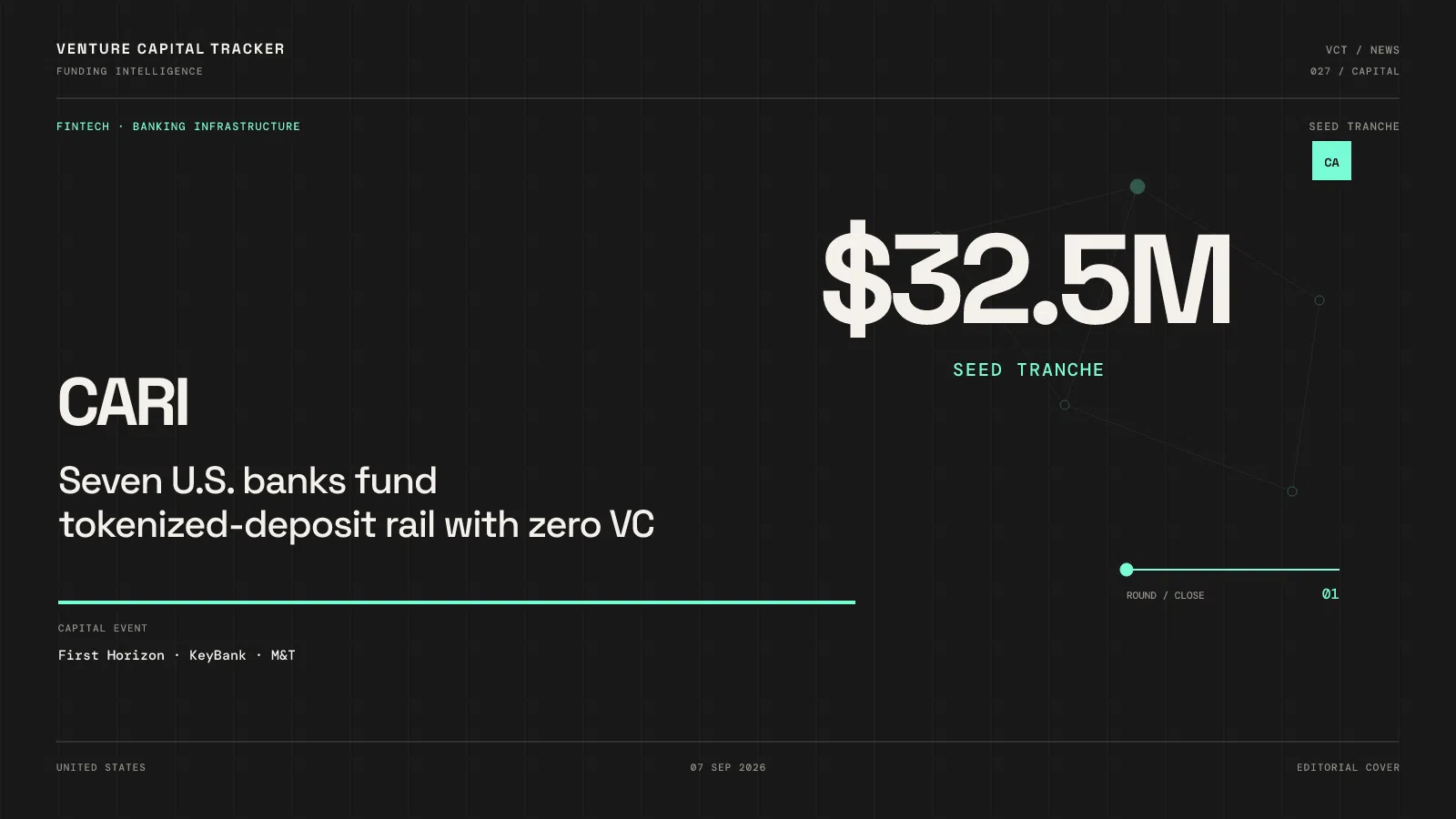
Cari raised $32.5 million in the first tranche of its initial external round — and every disclosed dollar came from chartered U.S. banks, not venture firms (company statement via FF News; announcement dated around September 2, 2026). Named investors: design partners First Horizon, Huntington, KeyBank, M&T, Old National, and SouthState, plus Glacier Bank. Keefe, Bruyette & Woods advised.
Spine: the buyers who must adopt the network also own the equity — a structural answer to “why would a regional bank trust a fintech rail built without them?”
Key facts
- Founder
- Gene Ludwig (former U.S. Comptroller of the Currency; Promontory / IntraFi background)
- Round
- $32.5M first tranche of initial external raise
- Investor type
- 100% banks (no VC named)
- Product stage
- MVP Mar 31; full suite Jul 31, 2026; production targeted YE 2026
- Network claims
- 30+ banks joined; 40+ in talks; pipeline institutions managing >$10T combined assets (company)
- Architecture
- Permissioned L2 anchored to Ethereum (Prividium / ZKsync stack per white paper)
- Valuation / full round size
- Not disclosed — later tranches still possible
Who uses the product — and for what job
Users: regional, mid-size, and community banks (and their commercial treasury clients) that want always-on settlement without handing deposit relationships to nonbank stablecoin issuers.
Job: mint, transfer, and burn tokenized deposits on a shared, bank-governed ledger — programmable money that stays inside the prudential perimeter.
Bank CEOs and product heads quoted in the announcement frame the value as shared R&D: capabilities “difficult and costly to develop independently” while still competing on relationships (First Horizon’s Bryan Jordan and peers).
Cari has not published production transaction volume, live settlement counts, or named commercial end-customers beyond pilot banks — the current job is onboarding toward production, not proven payments market share.
Why now
- Stablecoin and tokenized-deposit narratives forced banks to choose: build alone, join a consortium, or cede ground to nonbanks.
- Design-partner work since September 2025 matured into an investable platform after the July product suite.
- Regulation-aware founders (Ludwig’s OCC / Promontory résumé) lower the “will examiners hate this?” barrier for mid-tier banks.
Why banks — not a classic VC lead
| Dimension | Fit |
|---|---|
| Capital = distribution | Equity from the same institutions that must integrate APIs and govern the network |
| Competitive thesis | Shared infra lets regionals match always-on rails without JPMorgan-scale build budgets |
| Founder rationale | Avoid a VC board that optimizes for crypto-native growth metrics over bank compliance |
| Advisor | KBW — bank M&A/financing specialist — signals financial-institution process, not consumer seed theater |
No /fund/ links — investors are operating banks, not directory VC firms.
What remains undisclosed / high risk
- Final round size after later tranches
- Valuation and ownership percentages
- Interoperability with other bank tokenized-deposit efforts
- Production SLA, finality rules, and failure modes
- Whether the >$10T “pipeline assets” figure overstates near-term liquidity (it is assets of institutions in talks, not AUM on Cari)
Competitive map
Competes with nonbank stablecoin issuers for “instant programmable dollars,” and with large-bank proprietary tokenized deposit projects for mindshare among commercial treasurers. Differentiator claim: multi-bank shared governance aimed at regionals.
Takeaway
$32.5M is a down payment on a consortium rail. The story only becomes durable when mint/transfer/burn moves from pilot portals to measurable production settlement — until then, treat bank equity as alignment, not proof of network effects.
Follow Venture Capital Tracker on Google
Add VCT as a preferred source to see more of our venture-capital reporting in Google Search.
Editorial note: AI tools assisted with research, structure, or drafting. Venture Capital Tracker retains human editorial responsibility for factual accuracy, relevance, and source quality before publication.