· Investment Strategies · 2 sources
Félix’s $200M Series C: a16z Equity + General Catalyst Debt for WhatsApp Remittances
Andreessen Horowitz led $87M equity and General Catalyst’s Customer Value Fund added $113M debt — Félix says $8B+ processed and revenue up >2.5x as it expands beyond remittances.

Editorial team
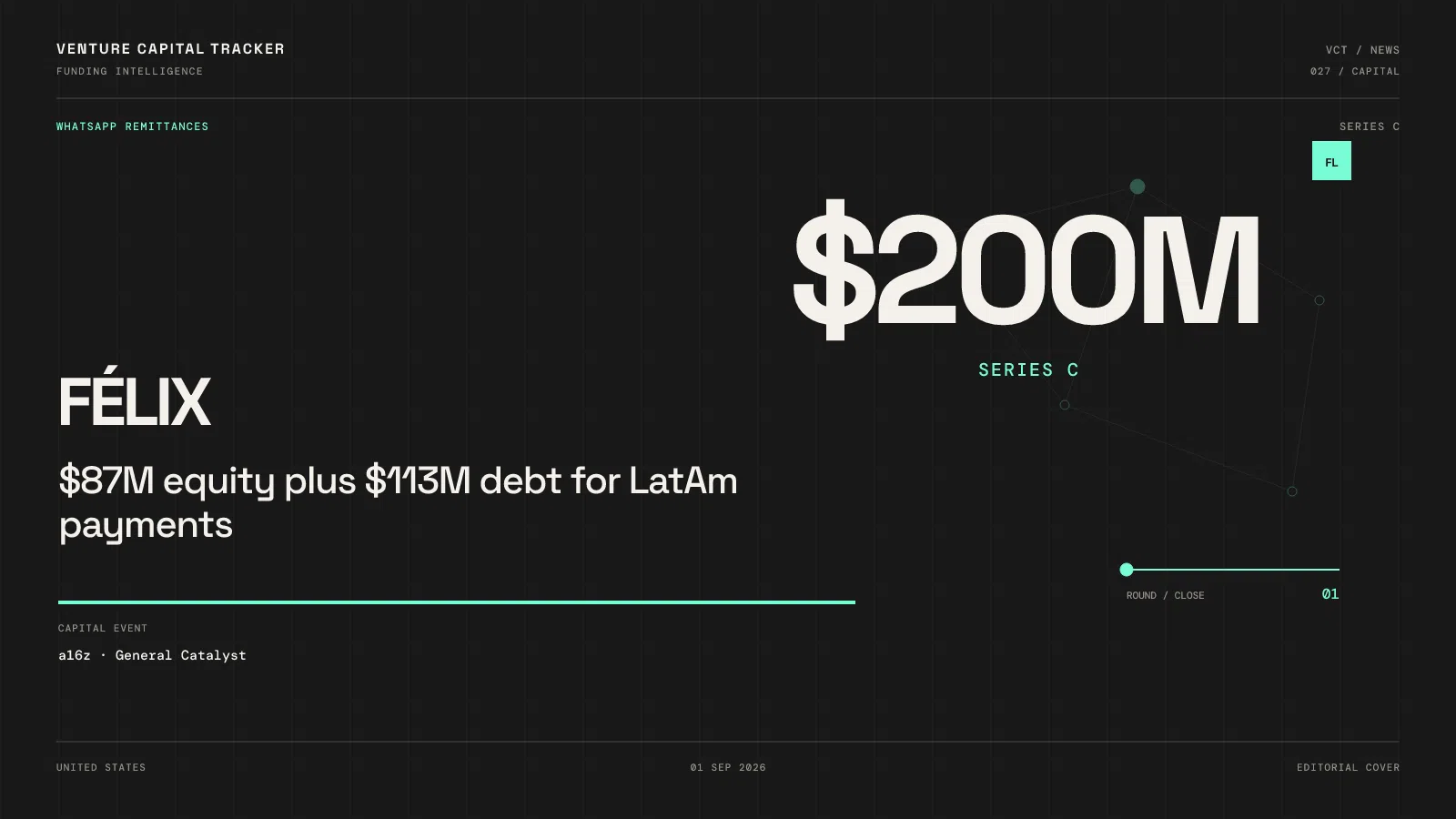
Andreessen Horowitz led $87 million of equity in Félix’s $200 million Series C package announced September 1, 2026; General Catalyst’s Customer Value Fund supplied $113 million of debt. Equity participants include QED Investors, Castle Island Ventures, Switch Ventures, Contour Venture Partners, and Endeavor Catalyst (Crunchbase News).
Spine: the headline is not “another remittance raise” — it is a split capital stack that finances a WhatsApp-native corridor business as it tries to become a broader financial companion, while exact post-money valuation stays undisclosed.
Key facts
- Company
- Félix / Félix Pago (Miami; WhatsApp remittances → broader FS)
- Round
- Series C package — $87M equity + $113M debt
- Date
- September 1, 2026
- Equity lead
- Andreessen Horowitz (Ali Yahya / a16z crypto)
- Debt
- General Catalyst Customer Value Fund
- Traction (company)
- >$8B processed; 6M+ people; 11 LatAm markets; revenue >2.5x YoY
- Valuation
- Not disclosed; company says it tripled vs 2025 Series B ($75M, QED-led)
- Total capital
- Nearly $300M cumulative
Who uses the product — and for what job
Users: U.S.-based Latino immigrants sending money to relatives across Latin America — and, increasingly, the same households for adjacent financial needs.
Job: complete a remittance inside WhatsApp rather than learning a separate banking UI. Founders Manuel Godoy and Bernardo García frame the next step as a conversational “financial companion” (lending, savings, guidance) rather than another remittance SKU.
This is consumer distribution + regulated money movement, not B2B SaaS.
Why now
- Remittance volume and WhatsApp penetration already concentrate the corridor; AI packaging is the product layer on top of that distribution.
- a16z’s public framing pairs AI + blockchain/stablecoin settlement with a consumer workflow — the bet is the stack, not only FX spread.
- Debt from GC’s Customer Value Fund appears when payment flow economics can support non-dilutive capital — a pattern founders should study when volume is real.
Why a16z + General Catalyst — portfolio fit
| Dimension | Fit |
|---|---|
| a16z | Crypto/fintech consumer platforms; Ali Yahya’s thesis on Latino FS via AI + settlement rails |
| GC CVF | Growth debt sized to transaction economics without another full equity slug |
| Founder rationale | Scale corridor → multi-product FS while preserving equity; bring crypto-native lead plus credit facility |
QED, Castle Island, Switch, Contour, and Endeavor Catalyst are covered editorially without inventing /fund/ pages.
What remains undisclosed
- Exact post-money valuation (only the “threefold vs Series B” claim)
- Take rate, contribution margin, or fraud/loss ratios
- How much of the $113M debt is drawn vs committed
- Secondary vs primary mix inside the equity
Competitive map
Digital remittance and LatAm corridor players (Remitly, Wise, Bitso and peers) compete on price, speed, and trust. Félix’s differentiator claim is chat-native distribution plus a path into credit/savings — not a cheaper wire alone.
Takeaway
Treat the $200M as a structured financing, not a single equity check. The unresolved question for diligence is whether WhatsApp remittance relationships convert into lending and savings P&L — or remain a high-volume, thin-margin corridor with expensive CAC if chat distribution weakens.
Sources
Follow Venture Capital Tracker in Google
Add VCT as a preferred source to make our venture-capital coverage easier to find in Google Search.
Editorial note: AI tools assisted with research, structure, or drafting. Venture Capital Tracker retains human editorial responsibility for factual accuracy, relevance, and source quality before publication.