· Venture Capital Tracker Research · venture-capital
Buntar Aerospace Raises $16M to Scale Ukraine-Built Drone Autonomy
Buntar Aerospace raised $16 million to scale Ukraine-based drone manufacturing, autonomy software and international expansion.
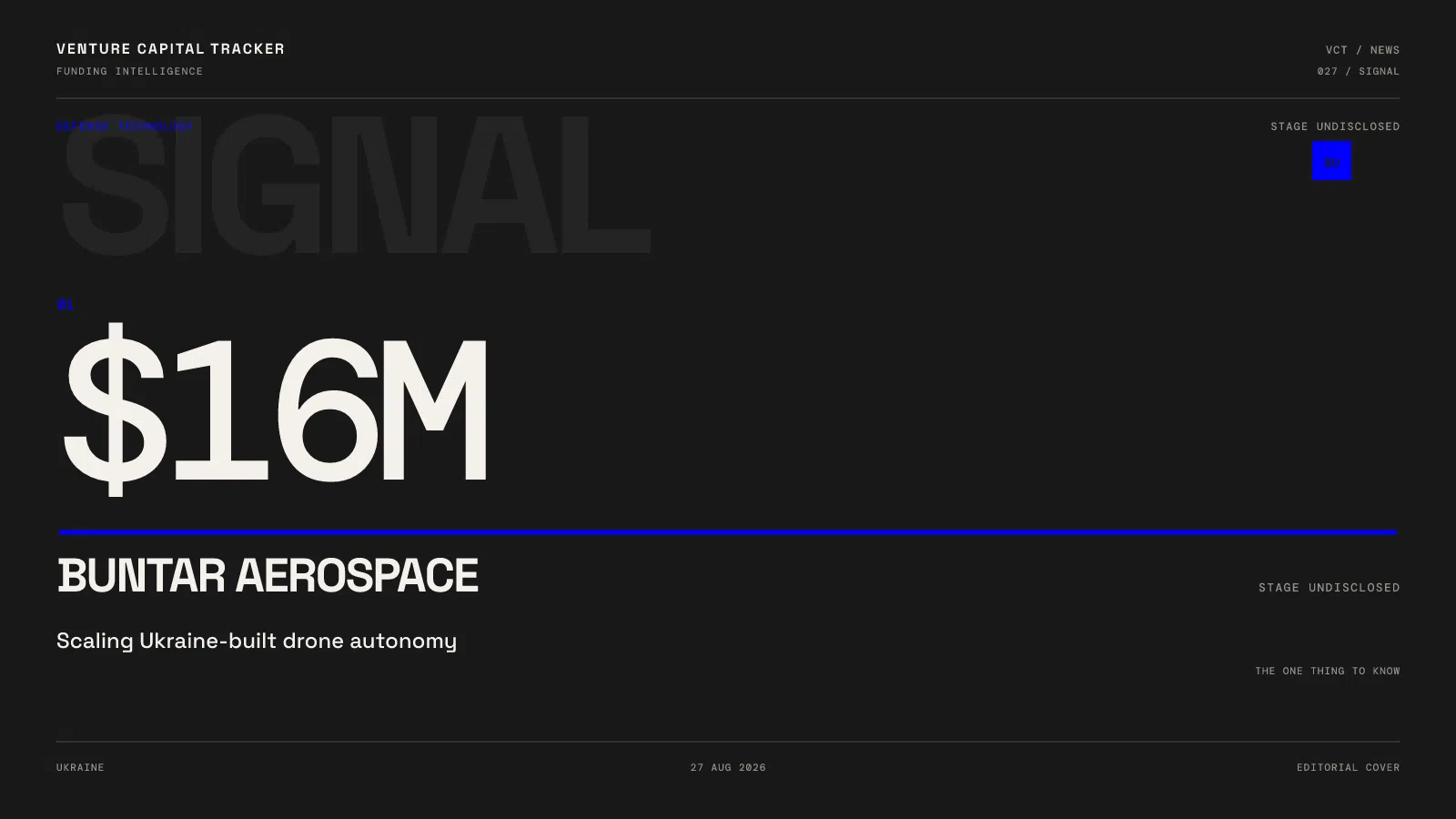
Buntar Aerospace has raised $16 million to expand production of its reconnaissance drones and build a broader defense-autonomy platform from Ukraine. The company announced the financing on October 5, saying Freedom Fund VC and an undisclosed international private equity fund led the round. Gardar Venture Capital, Iron Wolf Capital and Autonomy Capital participated.
The stage and valuation were not disclosed. The financing brings Buntar's total capital raised to $30 million, including a $10.4 million round earlier in 2026.
The financing at a glance
- Amount: $16 million
- Stage: Undisclosed
- Lead investors: Freedom Fund VC and an unnamed international private equity fund
- Other investors: Gardar Venture Capital, Iron Wolf Capital and Autonomy Capital
- Total funding: $30 million
- Use of proceeds: Product development, production capacity, hiring and international expansion
- Headquarters: Founded in Kyiv, with manufacturing inside Ukraine
What Buntar builds
Buntar's core product is the Buntar-3, an electric reconnaissance drone designed for electronically contested environments. The company also develops Buntar Copilot, an AI-assisted software layer that supports mission planning and remote operation.
The combination matters. Airframes can be copied and procurement prices tend to compress. Mission software, electronic-warfare resilience and the operating data collected from real deployments can create a more defensible system.
Buntar says it is expanding beyond intelligence, surveillance and reconnaissance into counter-drone defense and precision-strike support. It also plans dual-use products for civilian markets.
Building inside Ukraine
Most venture-backed defense startups sell into conflicts from relatively safe manufacturing bases. Buntar develops and produces inside the country where its systems are used.
Axios reported that Buntar speaks with military units daily and operates distributed manufacturing facilities rather than one large plant. That structure shortens the feedback loop and reduces the risk that a single strike halts production.
It also creates risks that do not appear in a normal hardware investment memo:
- Facilities and employees operate under direct security threat.
- Supply chains can be interrupted by attacks, energy constraints or border logistics.
- Military demand is urgent but procurement and payment timing can be uneven.
- Product decisions made for one battlefield may not transfer cleanly to NATO buyers.
- International expansion will require export-control, security and procurement compliance.
Proximity is therefore both Buntar's advantage and its largest operating risk.
What the $16 million buys
Buntar says demand from Ukraine's armed forces exceeds its current supply. The first job for the financing is manufacturing expansion.
That is a more concrete use of capital than a speculative product roadmap, but scaling defense hardware introduces its own constraints: component availability, quality assurance, secure software updates and field maintenance must improve alongside unit output.
The second objective is to continue developing Buntar Copilot. Software can raise the value of each deployed airframe and make the product harder to compare on price alone. It can also help less-experienced operators use complex systems, an important requirement as drone operations scale.
The third objective is internationalization. Buntar wants investors and partners that can help it move into foreign markets. Success will depend on proving that battlefield-tested performance can be documented, certified and supported for allied customers.
A crowded but expanding market
Buntar operates in one of venture capital's fastest-growing defense categories. European reconnaissance-drone companies such as Quantum Systems compete for many of the same procurement budgets. Ukrainian autonomy and unmanned-systems companies—including Swarmer and Frontline Robotics—address adjacent parts of the battlefield stack.
The market is large enough for multiple suppliers, but buyers increasingly want interoperable systems rather than isolated drones. That favors companies that can connect aircraft, mission planning, autonomy and data into one operating layer.
Buntar's claim to differentiation is not raw endurance. It is resilient operation under electronic warfare, fast iteration with frontline users and cost structures that allow deployment in volume.
Investor read-through
Freedom Fund VC specializes in Ukrainian defense technology. Gardar is a Nordic fund focused on early-stage defense companies rooted in the Ukrainian ecosystem, while Iron Wolf Capital adds Baltic venture exposure.
The unnamed international private equity co-lead is notable because the round is still venture-sized. Its participation may point to growth-capital interest in manufacturing and international sales, but the absence of a disclosed identity limits what can be inferred.
Buntar also says it plans to seek tens of millions of dollars more, with emphasis on investors that can support expansion abroad. The new $16 million should therefore be read as scale-up capital, not necessarily the company's final private financing.
What to watch next
The most important indicators are production growth, delivery volume, repeat procurement, export customers and the share of revenue generated by software or autonomy services.
A second test is organizational. Buntar says it has hundreds of employees and is recruiting engineering, management and operations talent. Moving from wartime iteration into repeatable manufacturing requires different systems without losing the speed that made the company valuable.
Buntar's financing is smaller than many U.S. defense-tech rounds, but it has a sharper operating thesis: manufacture close to the battlefield, learn faster than distant competitors and turn those lessons into exportable autonomy. The next round will likely depend on whether that model scales beyond urgent domestic demand.
Related VCT coverage
For the capital-provider side of the defense-technology market, see VCT's analysis of Snowpoint Ventures' $411 million dual-use fund and Protego Ventures' $125 million Israel-focused defense fund.
Last updated:
Editorial note: AI tools assisted with research, structure, or drafting. Venture Capital Tracker retains human editorial responsibility for factual accuracy, relevance, and source quality before publication.