· Updated · Venture Capital Tracker · investment-strategies
Aureka’s $100M Series B: Lab-in-the-Loop Biological Foundation Models
Granite Asia backed Aureka Biotechnologies’ $100M Series B (~$200M cumulative) to scale AuraIDE — closed-loop AI + wet lab for antibody discovery.
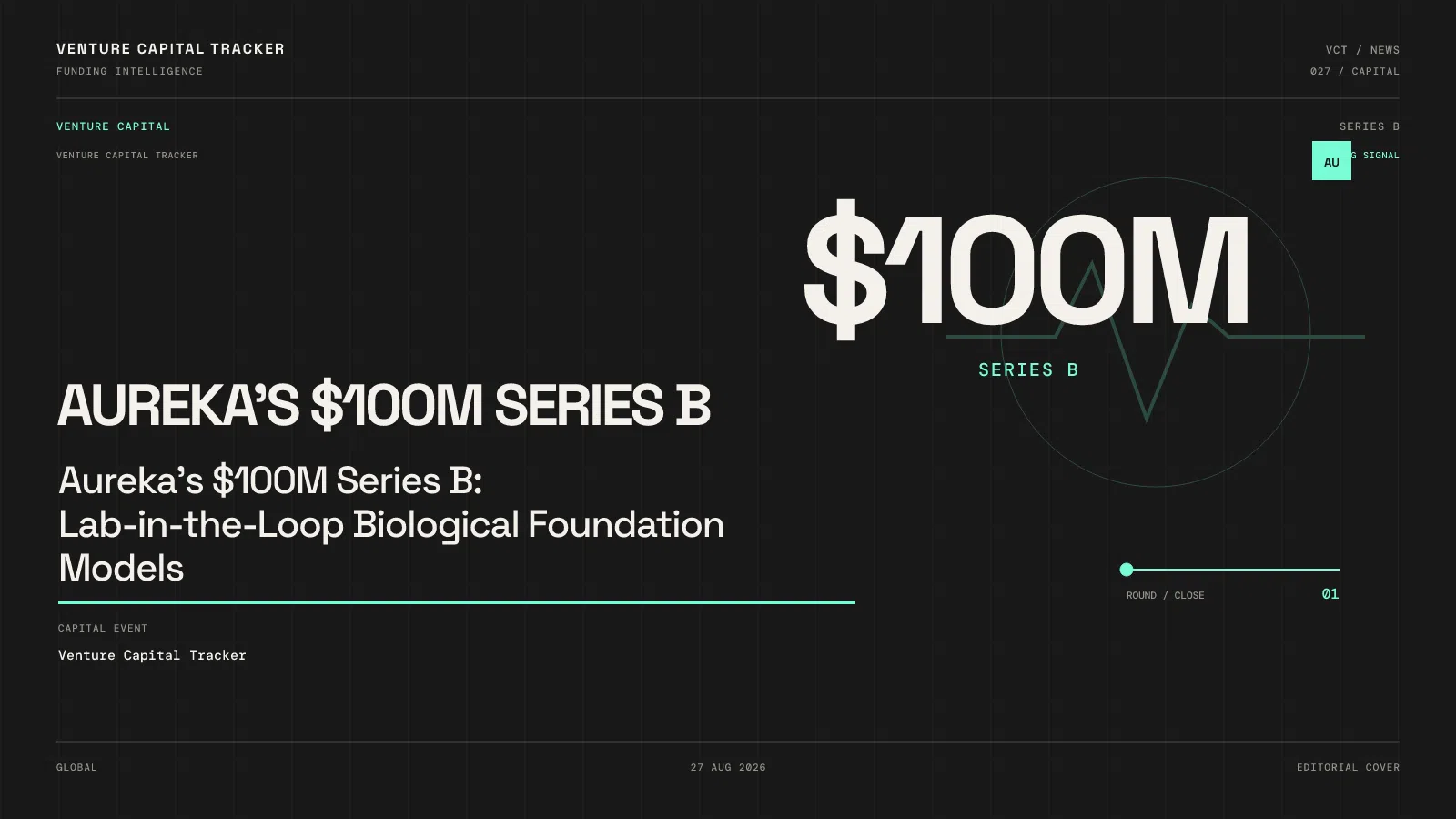
Aureka Biotechnologies closed a $100 million Series B on August 10, 2026, with Granite Asia taking the first tranche exclusively and a strategic investor leading a later tranche. HighLight Capital, MPCi, and NRL Capital participated. Cumulative funding is nearly $200 million. The company is building biological foundation models that learn from a wet-lab loop, not only public protein databases.
Key facts
| Field | Detail |
|---|---|
| Company | Aureka Biotechnologies (Laguna Hills, CA & Shanghai) |
| Round | $100M Series B |
| Date | August 10, 2026 |
| Key capital | Granite Asia (first tranche); strategic lead (later); HLC, MPCi, NRL |
| Cumulative | ~$200M |
| Product | AuraIDE foundation model; OpenDDE open-source; Lab-in-the-Loop infra |
| Commercial | Pharma partnerships; tens of millions revenue over ~2 years (company) |
| Founded | 2023 (CEO Dr. Weian Zhao) |
| Use of proceeds | Next-gen model training + Lab-in-the-Loop upgrades |
Who uses the product — and for what job
Users: large pharma discovery teams and Aureka’s own pipeline groups chasing hard antibody problems (GPCRs, dual-target designs).
Job: generate and validate developable molecules faster by closing the loop between model proposals → high-throughput experiments → post-training, instead of treating the lab as a late QA step.
OpenDDE (open-source AuraIDE cousin) is the credibility play for third-party structure/design benchmarks — useful when buyers distrust closed black boxes.
Why now
- Structure prediction alone is table stakes; buyers want functional, developable assets.
- Static public datasets plateau; proprietary functional screening data becomes the moat.
- Chai Discovery and peers reset TechBio valuations — capital is concentrating on teams with lab + model flywheels.
- Cross-border antibody markets still need partners who can run dual US/China R&D footprints carefully.
Why Granite Asia — portfolio fit
Granite Asia (~$10B AUM platform per its own materials in the release) financing the first tranche exclusively is a classic region-fluent lead for a dual-HQ TechBio: underwrite science risk and global partner intros without forcing an early US mega-fund board reset.
Likely founder rationale: keep Asia-native capital that already believes in closed-loop AI-for-science, add a strategic for distribution into pharma pipelines, and use Series B to train larger models — not to “pivot to SaaS.”
We do not currently list Granite Asia / HLC / MPCi / NRL as /fund/ pages.
Competitive map
| Player | Lane |
|---|---|
| Chai Discovery / structure-first AI bio | Adjacent foundation-model TechBio |
| Classic CRO + ML bolt-ons | Experiment capacity without owned foundation models |
| Big pharma internal AI groups | Build vs buy tension; often partner externally |
| Pure computational design shops | Weak without wet-lab feedback ownership |
When not to underwrite this
- Wrong if “biological world model” language is treated as a shipped product — it is a roadmap phrase.
- Wrong if tens of millions revenue is extrapolated to SaaS multiples.
- Wrong if open-source OpenDDE rankings are confused with proprietary AuraIDE clinical success.
Practical takeaway
- Founders (TechBio): Show the data flywheel (what experiments feed which training loop) before the world-model slogan.
- Investors: Diligence partner concentration and IP/geography constraints as hard as FoldBench scores.
- Operators / scouts: Compare Aureka to other closed-loop antibody platforms on time-to-developable candidate, not blog benchmarks alone.
Sources
- PR Newswire (Aug 10, 2026): https://www.prnewswire.com/news-releases/aureka-biotechnologies-raises-us100-million-series-b-to-build-a-biological-world-model-for-drug-discovery-302847165.html
- Related: /startup/aureka-biotechnologies · /2026-chai-discovery-400m-series-c-index-sequoia
Follow Venture Capital Tracker in Google
Add VCT as a preferred source to make our venture-capital coverage easier to find in Google Search.
Last updated:
Editorial note: AI tools assisted with research, structure, or drafting. Venture Capital Tracker retains human editorial responsibility for factual accuracy, relevance, and source quality before publication.