· Investment Strategies · 10 sources · Updated · Verified
Mirendil's $1B Series A: How Lor Works, Funding History and Research Risks
Can an invite-only AI research workspace turn autonomous experiments into reproducible scientific progress? We examine what Lor actually does, who controls compute, why investors backed it and what the company's training demonstration still cannot prove.

Editorial team
Mirendil is trying to turn the repetitive work of an AI research lab into software. Instead of asking a coding assistant to edit one file, a researcher can ask Lor to run a group of experiments, acquire compute, investigate failures and return results for human review. The person still decides which experiments matter and which conclusions to trust. That difference—research orchestration rather than chat-based code completion—is the core investment thesis, but it is not yet a proven commercial business.
Deal details & investors
Funding event
Mirendil
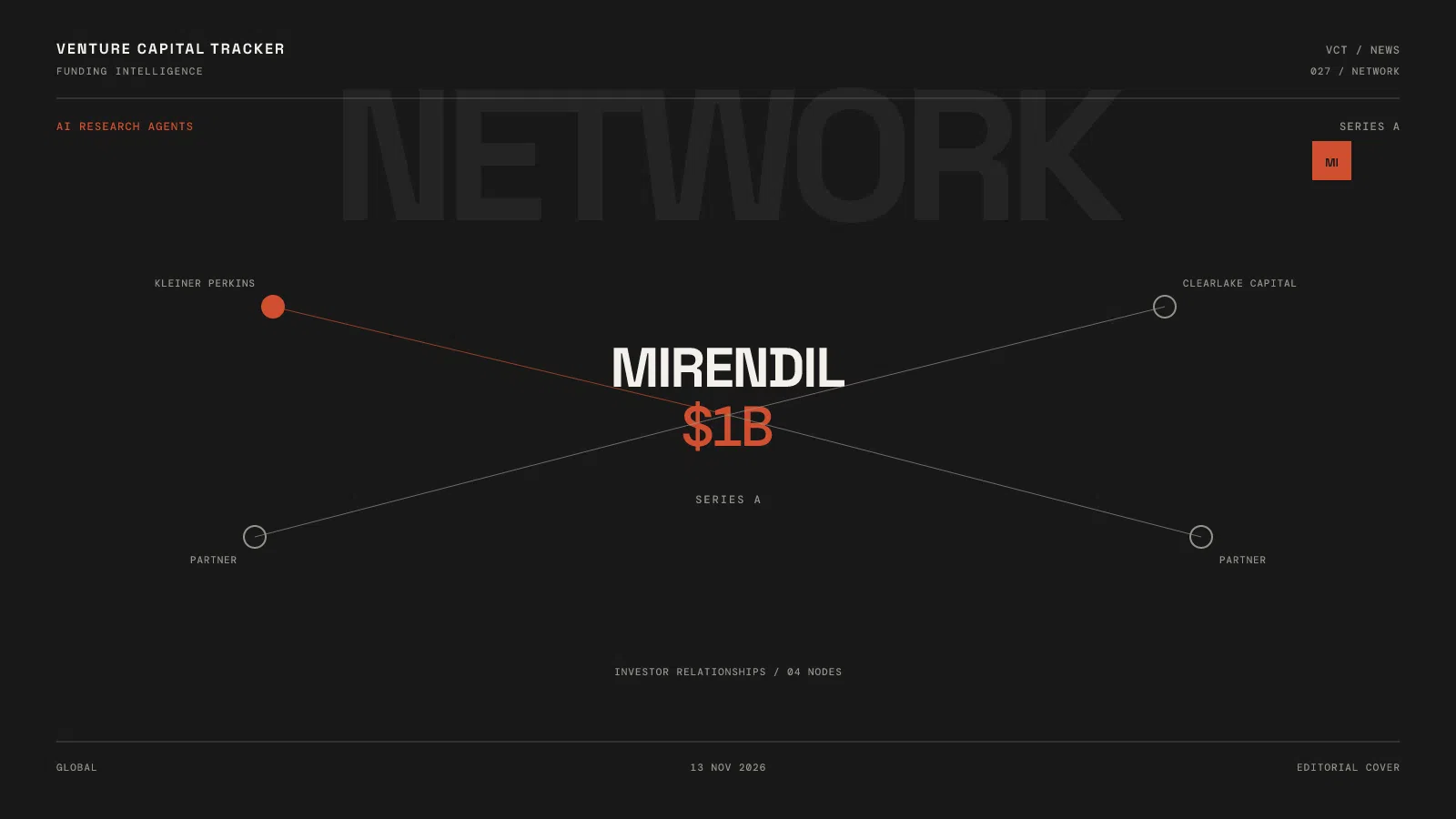
Led by Kleiner Perkins , Clearlake Capital
Its early demonstration is specific: Mirendil says one researcher used agents to build and pretrain a coding-focused foundation model in three and a half months. The company attributes more than 99% of the code to agents and says the compute budget was below $10 million, including experiment runs, agent tokens and processing. Those are company-reported figures, not an outside audit of model quality, safety or the team's full operating cost. The distinction matters because writing most of the code is not the same as autonomously conducting and validating scientific research.
What Lor actually lets a researcher do
Lor is an invite-only private beta announced on October 28, 2026. Mirendil's product description describes the following illustrative workflow, not a hands-on test conducted by VCT:
- Choose a research job. For example, ask an agent to reproduce a paper's benchmark or run 12 model ablations (controlled experiments that remove or change individual features).
- Select models and machines. A user can work with supported frontier and open models, add a macOS/Linux machine, or use Lor-managed cloud computers and GPU nodes.
- Let agents split the work. Lor can provision machines and delegate coding, training, tests and evaluation tasks across parallel agents, according to its documentation.
- Inspect what ran. The user follows progress, reads experiment outputs, spots mismatches and can stop agents or remove connected machines.
- Decide what to accept. A promising result still needs human validation, reproducibility checks, security review and a decision about whether to merge or retrain.
The company says the service can sustain work for days or weeks. It lists macOS, Linux and web access, while Windows, iOS and Android are planned. Lor is free only during private beta; neither post-beta subscription prices nor GPU pass-through costs have been disclosed. A founder evaluating it should therefore request clarity on permissions, cloud billing, data retention, audit logs, experiment reproducibility and model/provider restrictions before trusting sensitive datasets or long-running jobs to it.
From a16z's seed thesis to the new investors
The financing chronology is more revealing than the headline alone. Mirendil's June 24 announcement explicitly states that Andreessen Horowitz and Kleiner Perkins co-led a $200 million seed round. It says an Nvidia investment followed, without quantifying or dating that subsequent investment. That disclosure should not be rewritten as an additional $200 million round. The November 12 company release confirms a separate $1 billion Series A, co-led by Kleiner Perkins and Clearlake Capital. Battery Ventures, Doerr Capital, Gil & Co, Google, M13, Pear VC and S32 participated.
| Distinct capital or cost item | What it actually means |
|---|---|
| June 2026: $200M seed | Company-disclosed financing, co-led by a16z and Kleiner Perkins |
| November 2026: $1B Series A | New company-disclosed round, co-led by Kleiner Perkins and Clearlake |
| Additional Nvidia investment | Mentioned by the company, but amount and timing undisclosed |
| More than $100M Google Cloud deal | CEO-reported multiyear compute arrangement, not equity financing |
| Less than $10M Mirendil-Base compute | Company-stated cost of one model-training effort, not total company R&D spend |
At least $1.2 billion is quantifiable from the two announced financing rounds. That is a disclosed-round subtotal, not an independently established fully diluted valuation or an exact total of every investment received. Mirendil did not disclose its new Series A valuation or individual investor allocations; earlier reports about financing discussions do not establish final terms. See the canonical Mirendil startup profile for current investor roles and the distinct June seed and November investment-event records.
The specific a16z investment thesis was that researchers outside the largest AI labs need the ability to change model weights, run evaluations and improve specialized systems themselves, not just send questions to a general-purpose API. That requires models, agent orchestration, data pipelines and compute management to work together. It is an investor's rationale for taking risk, not evidence that customers are already achieving the intended productivity gains. Kleiner's participation in both rounds establishes continuity, but no independently verified post-financing investor return or ownership percentage is disclosed.
The science and compute economics behind the bet
Mirendil describes three connected assets. Mirendil-Base is the coding-focused model used in its October training experiment; Fern is a post-trained model the company says can handle up to ten million tokens in context; and Lor is the workspace that dispatches agents and compute. Long context can help agents examine logs, code and experiments together, but it does not itself guarantee accurate reasoning across the entire window.
The company's technical write-up says the training experiment began from an empty repository, used standard libraries and public data, and included the token spend of its agents. It also published code-prediction comparisons. A low loss score on code is a useful measurement of predictive performance; it is not a general proof that Mirendil's system can discover drugs, build reliable autonomous labs or outperform researchers in live experiments. Mirendil's Fern description itself records a correction to benchmark figures, another reason to follow reproducible methods rather than treating a single chart as final.
The financial question is whether reducing engineer-hours reduces fully loaded research cost once GPU time, failed runs, software inference, supervision and compliance are included. If a dozen trials run automatically but cost more in GPUs and require extensive human debugging, the benefit could evaporate. If users can reproduce the right results faster with proper controls, the product could have value even without fully autonomous discovery.
There is also a supplier relationship worth distinguishing from financing. Mirendil's August Google Cloud announcement describes TPUs, Nvidia-based infrastructure and managed training clusters. In an August TechCrunch interview, the CEO put that multiyear deal above $100 million. Google is also named among November's investors. These facts suggest cloud access and strategic distribution matter to the business, but they do not prove the equity proceeds are contractually spent with Google or establish commercial margins.
Which alternatives should an AI team compare?
For coding and software fixes, established agentic coding tools such as Cognition's Devin can be considered; the question is how much true experiment orchestration is needed. For managed model training, Google Vertex AI or AWS SageMaker provide infrastructure and experiment capabilities, though the user generally assembles more of the research loop. For custom multi-agent control, open orchestration frameworks such as LangGraph offer flexibility at the cost of maintaining the integration, security and execution environment. For domain-specific science, purpose-built research agents and laboratory software may offer deeper scientific workflows but are not direct substitutes for model-pretraining infrastructure.
Those are overlapping product categories, not a claim that every competitor has the same features or prices. The useful buying comparison is validated experiment throughput per total cost, with a record of who approved each change, which data entered a model, how runs can be repeated and whether a platform's agents have excessive access to production systems.
What has to be proved next?
Investors and prospective users have four unresolved diligence questions: how independent researchers reproduce Mirendil's most important model results; how much actual compute and human time is consumed per successful experiment; whether paying customers adopt Lor after beta and at what price; and what safeguards prevent autonomous code and machine provisioning from running unsafe or irreproducible research.
The significant change since a16z's early backing is the scope of the ambition: Mirendil now has an announced large financing, a visible beta product and technical demonstrations. It still has not publicly established the economics of a broadly deployed AI research service. Treat those as different milestones, not interchangeable measures of success.
Follow Venture Capital Tracker on Google
Add VCT as a preferred source to see more of our venture-capital reporting in Google Search.
Last updated:
Editorial note: AI tools assisted with research, structure, or drafting. Venture Capital Tracker retains human editorial responsibility for factual accuracy, relevance, and source quality before publication.